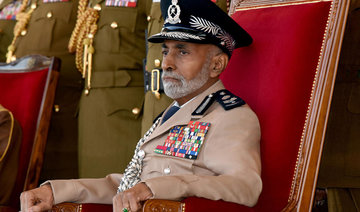
Sultan Qaboos of Oman dies

Sultan of Oman, Qaboos bin Said Al-Said, has died. (AFP)
Short Url
Updated 13 January 2020
Follow

Sultan Qaboos of Oman dies

  • Qaboos, 79, had ruled the Gulf Arab state since he took over in 1970

DUBAI: Oman’s Sultan Qaboos bin Said died on Friday evening, state media said early on Saturday without mentioning a cause of death, and a three-day period of national mourning was declared.

Qaboos, 79, had ruled the Gulf Arab state since he took over in a bloodless coup in 1970.

Qaboos had no children and had not publicly appointed a successor. A 1996 statute says the ruling family will choose a successor within three days of the throne becoming vacant.

If they fail to agree, a council of military and security officials, supreme court chiefs and heads of the two consultative assemblies will put in power the person whose name has been secretly written by the sultan in a sealed letter.

However, two Omani newspapers claimed that Oman's new ruler will be Haitham bin Tariq Al-Said. He reportedly took the oath of allegiance as sultan to succeed his cousin Qaboos bin Said. 
There was no official Omani government confirmation of the report posted by Al-Watan and Al-Roya newspapers on their Twitter accounts.

A three-day period of official mourning for the public and private sectors has been declared, and flags are to be flown at half mast for 40 days, state media said.

Oman state news agency ONA said Qaboos died after “a wise and triumphant march rich with generosity that embraced Oman and extended to the Arab, Muslim and entire world and achieved a balanced policy that the whole world respected.”

Qaboos had been unwell for years and had spent a week in Belgium undergoing medical treatment in early December. 


Algeria votes to declare French colonization a crime and demands restitution

Updated 4 sec ago
Follow

Algeria votes to declare French colonization a crime and demands restitution

  • On Wednesday, 340 of 407 members of Algeria’s National Assembly approved the law
  • The law also calls for the repatriation of Algerian resistance fighters’ remains. France is unlikely to comply with these demands
ALGIERS: Legislators in Algeria voted to declare France’s colonization of the North African country a crime, approving a law that calls for restitution of property taken by France during its 130-year rule, among other demands seeking to redress historical wrongs.
France slammed the law as a “hostile act” threatening bilateral efforts to heal wounds of the past. The two countries retain close cultural and economic ties but have troubled diplomatic relations.
In a solemn ceremony steeped in symbolism, 340 of 407 members of Algeria’s National Assembly voted late Wednesday to approve the law. The move came just a few weeks after African countries made a collective resolution for recognition and reparations for colonial-era crimes.
The law covers the period from the landing of King Charles X’s army on the beaches of Sidi Ferruch west of Algiers in 1830 to July 5, 1962, the date of Algeria’s official independence.
The text provides for the restitution of Algerian archives and property moved to France during the colonial period, and the transmission to Algiers of detailed maps of French nuclear tests conducted in Algeria from 1960 to 1966. It also calls for the repatriation of the remains of some Algerian resistance fighters taken to France.
The law stipulates prison sentences for any action by an Algerian celebrating French colonialism, for attacks on symbols of the Algerian resistance, and “remarks with colonial connotations.”
France is unlikely to heed the demands in the law.
The law is “a manifestly hostile initiative,” the French Foreign Ministry spokesperson’s office said in a statement to The Associated Press. It noted efforts under French President Emmanuel Macron to address colonial-era grievances, and added: “We continue to work toward the renewal of dialogue,” notably about security and migration issues.
Macron, in 2017, described elements of France’s history in Algeria as a crime against humanity, but stopped short of an official apology. Meanwhile, the resurgent far right in France celebrates colonialists.
The economic cost of colonialism in Africa is believed to be staggering. Algeria suffered some of the most brutal forms of French colonial rule.
Nearly a million European settlers held greater political, economic and social privileges, even though Algeria was legally part of France and its men were conscripted in World War II. Hundreds of thousands died in Algeria’s revolution, during which French forces tortured detainees, disappeared suspects and devastated villages as part of a counterinsurgency strategy to maintain their grip on power.
Huge Algerian flags adorned the lower house of parliament as speaker Mohamed Boughali delivered his opening address Wednesday.
“Today, December 24, 2025, is a historic day, to be written in letters of gold in the national narrative,” he began, before being interrupted by lawmakers intoning an excerpt from the Algerian national anthem: “O France, the hour of reckoning has arrived … we have sworn to revive Algeria, bear witness! Bear witness!”
The speaker called the law, ″a political message and an explicit moral stance.″
Government officials, professors, and former members of parliament who championed the bill were all invited to the ceremony. As the speaker declared the law adopted, shouts of “Allahu Akbar!” and “Tahya Al Djazair!” (Long live Algeria!) rose from the floor.
“This is a special day for me, full of emotion and pride. Today marks the culmination of a long struggle that we began in 2001 with fellow members of parliament, for the memory and honor of all those who fought against French colonization,” Mohamed Arezki Ferrad, a former lawmaker who initiated the bill, told the AP.
The law, which contains five chapters and 27 articles, declares that there is no statute of limitation on colonial-era crimes.