

Soleimani successor used false identity to visit Afghanistan in 2018 — Bamiyan governor 

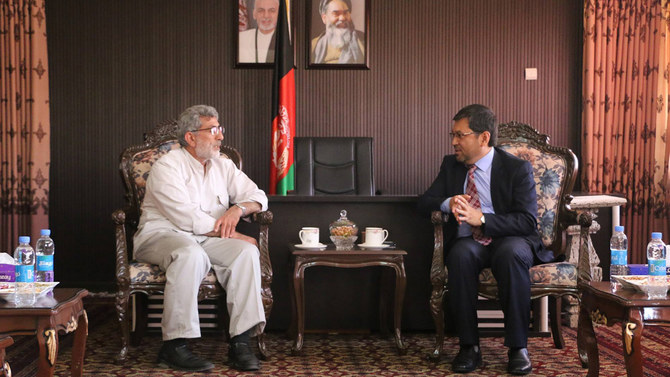
Ismail Qaani (left), the newly appointed commander of Iran’s Revolutionary Guards’ Quds Force, meets Bamiyan governor Tahir Zaheer on July 11, 2018. (Photo courtesy: @bamyan.governor/Facebook)
Short Url
Updated 09 January 2020
Follow

Soleimani successor used false identity to visit Afghanistan in 2018 — Bamiyan governor 

  • Introduced himself as deputy ambassador of Iran to Kabul and used the last name Ismaili, governor says
  • Afghan foreign ministry says investigating the visit of General Ismail Qaani but clear he never served as a diplomat

KABUL: The newly appointed commander of Iran’s Revolutionary Guards’ Quds Force, General Ismail Qaani, traveled to Afghanistan’s central province of Bamiyan using a false identity last year, the governor of the province said on Thursday.
Qaani, 62, was appointed by Iran’s supreme leader Ali Khamenei, who issued a statement praising the general’s role as a prominent commander in the Islamic Revolutionary Guard Corps. As a key branch of the Revolutionary Guard, the country’s most powerful security organ, the Quds Force carries out the Iranian military’s special operations abroad.
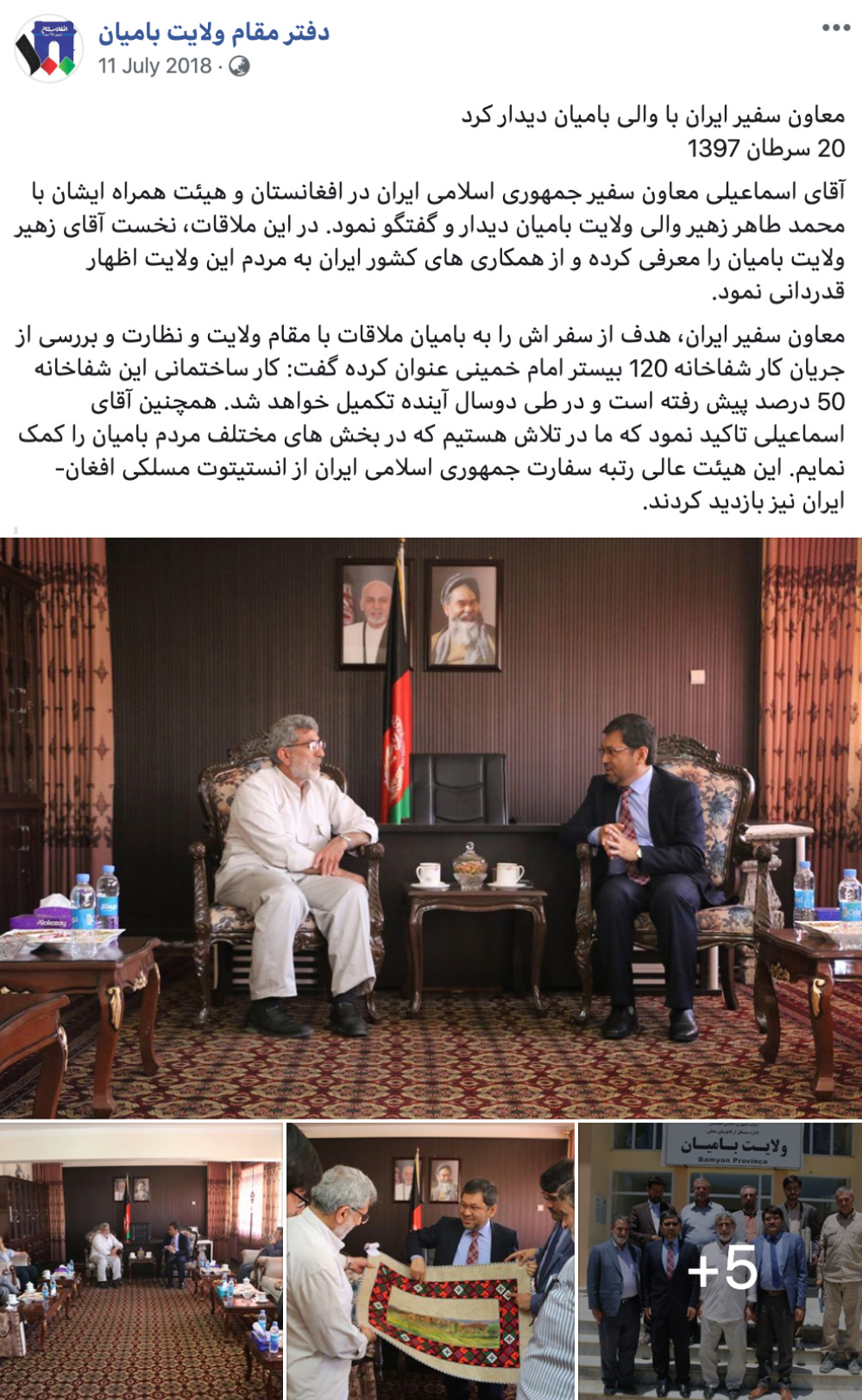


This July 2018 file photo shows the Bamyan governor's Facebook post in which he is welcoming General Ismail Qaani, the newly appointed commander of the Iranian Quds Force, who purported to be his Tehran's deputy ambassador to Kabul at the time of the meeting. (Screenshot taken from Bamyan Governor's Facebook)

Qaani takes over from Qassem Soleimani, the architect of Tehran’s overseas clandestine and military operations as head of the Quds Force, who was killed on Friday in a US air strike on his convoy at Baghdad airport.
Tahir Zaheer, the governor of Afghanistan’s rugged central province of Bamiyan said last year Qaani and eight other Iranians traveled to Bamiyan in a small airplane. The general introduced himself as deputy ambassador of Iran to Kabul and used the last name Ismaili, Zaheer said.
“He had traveled with the coordination from center [The Afghan Government] and the esteemed [Afghan] foreign ministry needs to find out as to how he was given visa, under what name and what sort of passport,” Zaheer told Arab News by phone.
Zaheer said Qaani visited Bamiyan to restart construction work on an Iran-funded 120-bed hospital where work had come to a halt in recent months. 
Afghanistan and Iran share a border. Afghanistan has a sizeable Shia population and many followers of the sect have reportedly been recruited by Quds force in recent years to fight as mercenaries in Iraq and Syria.
On Tuesday, the Afghan Foreign Ministry said Qaani had never served as a diplomat in Afghanistan.
Acting Minister of Foreign Affairs Idrees Zaman said Qaani’s visit was being investigated but it was clear that he “never served as deputy ambassador.”


South Sudan officers face court martial over civilian massacre

Updated 17 sec ago
Follow

South Sudan officers face court martial over civilian massacre

  • The increasingly unstable country is seeing a surge of fighting between government and opposition forces

JUBA: South Sudanese soldiers, including two officers, will face a court martial over a civilian massacre last month, the army spokesman said Wednesday.

The increasingly unstable country is seeing a surge of fighting between government and opposition forces, much of it in eastern Jonglei state where at least 280,000 people have been displaced since December according to the UN.

At least 25 civilians, including women and children, were killed in Ayod County in Jonglei state on February 21, according to the opposition.

Army spokesman Lul Ruai Koang said that two officers, including a major, and several non-commissioned officers, had been arrested and would face charges in the capital Juba, “before they are arraigned before a competent military court martial.”

He said the deaths were attributed to “some elements” under Gen. Johnson Olony, who was filmed in January ordering troops to “spare no lives” in Jonglei.

Koang said the soldiers had “moved out without the knowledge or authorization of the division commander.”

He also said they had been part of a militia group allied to opposition forces, parts of which had not yet been fully integrated into the army.

Military integration was among the core principles of a peace agreement that ended South Sudan’s five-year civil war in 2018 between President Salva Kiir and his long-time rival, Riek Machar, but it was never implemented.

Koang said the army regretted the loss of lives, adding: “We would like to once again remind our forces that their mandate is to protect civilians and their property, not to do the opposite.”

It followed an impassioned plea from the Sudan and South Sudan Catholic Bishops’ Conference on recent civilian killings — in Ayod, and also in Abiemnom County near the Sudan border where at least 169 people were killed on Sunday.

“We implore you to deploy resources to protect vulnerable populations and foster a climate of dialogue and reconciliation instead of violence and revenge, consoling the bereaved and supporting the afflicted,” it said in a statement.