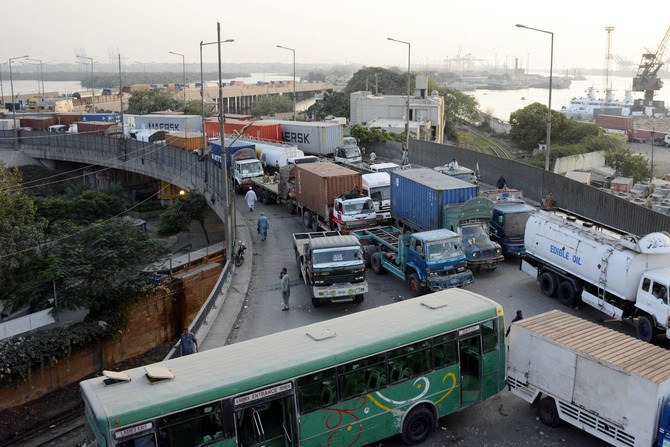

KARACHI: A countrywide strike of transporters against a new regulation and imposition of heavy fines entered its third consecutive day on Wednesday, though government officials said they were hopeful of resolving the issue soon.
Pakistan’s communications ministry recently enforced a new axle load control regime to address the problem of overloading that can cause accidents or damage highways. However, goods transporters have been demanding the restoration of axle load law as per the National Highway Safety (NHS) Ordinance 2000.
Transporters say they have taken 400,000 vehicles off the road to protest the new regulation.
“Our drivers are fined up to Rs10,000 in the name of online verification of their licenses which are issued by government authorities. Besides, they are also fined for overloading vehicles despite the fact that the law dealing with the issue has not even been promulgated,” Imdad Hussain Naqvi of the All Pakistan Goods and Transporters Association told Arab News.
Due to the three-day strike, the transportation of imported and exported goods remains suspended at Karachi’s ports.
“The situation is very difficult as our ports are gradually chocking with inbound and outbound goods,” Tariq Haleem, Convener of the Federation of Pakistan Chambers of Commerce and Industry’s Standing Committee on Maritime Affairs, told Arab News.
Estimates suggest that transporters move Rs40 billion worth of goods across the country on a daily basis.
“The daily transportation schedule includes Rs20 billion worth of imports and Rs10 billion in exports. The interprovincial movement also stands at Rs10 billion per day,” Naqvi claimed.
He said the per day loss to transporters was around Rs10,000 per vehicle for upcountry movement while they incurred Rs5,000 for intercity movement.
When contacted by Arab News, Mehmood Moulvi, an adviser to the maritime ministry, said that the government was looking into the problem and it “will hopefully be resolved by Wednesday evening.”
The stakeholders say the government must come up with an amicable settlement of the issue that meets international standards and the treaties signed with neighboring countries.
“Pakistan suffers by nearly Rs50 billion on account of maintenance of highways every year due to overloading. The implementation of the axle load regime will be an important step toward the implementation of regional connectivity,” Aasim Siddiqui, Chairman of the All Pakistan Shipping Association (APSA), told Arab News.
“The regime is changing and under the agreements of regional connectivity Pakistani trucks cannot cross the borders because they are unsafe. We have to upgrade our fleet under the national freight and transportation policy which also demands proper licensing. Otherwise, only the Chinese will benefit from the changing regime,” Siddiqui added.