

Gen Bajwa offered ‘sound advice’ over Iran conflict – US defense chief

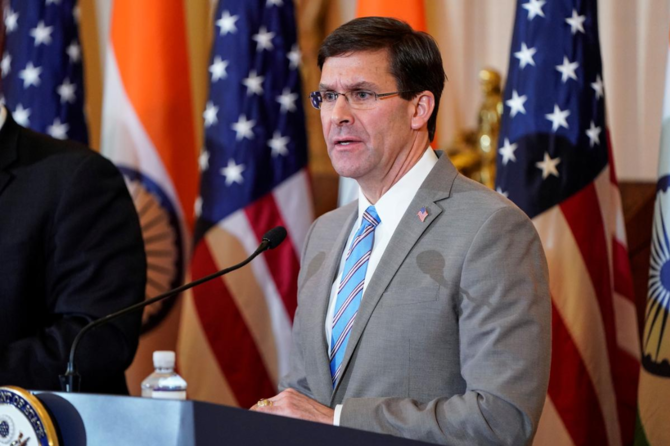
U.S. Defense Secretary Mark Esper speaks to the media after the 2019 U.S.-India 2+2 Ministerial Dialogue at the State Department in Washington, U.S., December 18, 2019. (Reuters/ File Photo)
Short Url
Updated 08 January 2020
Follow

Gen Bajwa offered ‘sound advice’ over Iran conflict – US defense chief

  • Mark Esper says everyone wants de-escalation of tensions with Iran
  • Pakistan’s foreign minister vows his country won’t become part of the US-Iran conflict

ISLAMABAD: US Defense Secretary Mark Esper acknowledged on Wednesday that Pakistan’s Army Chief General Qamar Javed Bajwa and Afghan President Ashraf Ghani offered him “sound advice” on deescalating tensions with Iran.

“The United States does not seek conflict but will respond forcefully if necessary. Afghan President and Pakistani General Bajwa both offered sound counsel and advice in calls today,” Esper said in a Twitter post.

“I always appreciate speaking with our partners and allies in the region. We all seek the de-escalation of tensions with Iran,” he added.

Earlier, the US secretary of state, Mike Pompeo, made a phone call to Gen. Bajwa to discuss the regional situation after the killing of Gen. Qassem Soleimani, a top commander of Iran’s elite Al Quds force in Baghdad.

“#Pakistan’s Chief of Staff General Bajwa and I spoke today about US defensive action to kill Qassem Soleimani. The #Iran regime’s actions in the region are destabilizing and our resolve in protecting American interests, personnel, facilities, and partners will not waver,” Pompeo wrote on Twitter on Friday.

Confirming Esper’s call, the Pakistan military’s media wing, ISPR, quoted Gen. Bajwa: “We would like situation to de-escalate & shall support all initiatives which bring peace in the region. We call upon all concerned to avoid rhetoric in favor of diplomatic engagement. We all have worked a lot to bring peace in the region by fighting against terrorism.”

He added that “we will continue to play our constructive part toward the success of Afghan reconciliation process so that it doesn’t get derailed and region goes toward conflict resolution instead of new conflicts.”

Author Zahid Hussain told Arab News on Wednesday that the best option for Pakistan was to stay out of the conflict and not allow itself to sucked into the conflagration in any way. “The latest escalation in the region has worsened Pakistan’s predicament as this is happening in its neighborhood. Pakistan doesn’t have any leverage to deescalate the tension,” Hussain said.

International affairs analyst Rasul Bakhsh Rais concurred that Pakistan could not do much to defuse tensions in the Middle East. However, he added that “no country, particularly in Iran’s neighborhood, wanted another war in the region. Pakistan is rightly concerned that hostilities in the Middle East will result in a sectarian conflict.”

Rais noted that Islamabad’s assertion that it would not allow its soil to be used against any country had sent out a clear signal that it would remain neutral in case of a conflict.

“In official interactions with the US and regional powers, it has emphasized de-escalation, avoidance of war and political means to settle problems,” he said.

This week, on Monday, Pakistan’s foreign minister, Shah Mahmood Qureshi, vowed while giving a policy statement in parliament that Pakistan would not become a party to any regional conflict and its “soil will not be used against any other state.”

Qureshi also said that the US-Iran tensions could hit the Afghan peace process.

The foreign minister also spoke to his counterparts in Iran, Saudi Arabia, and the United Arab Emirates after the missile strike killed Soleimani and discussed the unfolding situation in the region.

Qureshi also reiterated Pakistan’s readiness to play a role in preventing further escalation of tensions and maintaining regional peace and stability.


Pakistan, other Muslim states raise alarm over Gaza situation after heavy flooding

Updated 02 January 2026
Follow

Pakistan, other Muslim states raise alarm over Gaza situation after heavy flooding

  • Cold winter rains have repeatedly lashed the sprawling tent cities, turning Gaza’s dirt roads into mud and causing damaged buildings to collapse
  • The situation has been compounded by lack of sufficient humanitarian access, acute shortages of essential life-saving supplies and materials

ISLAMABAD: Foreign ministers of Pakistan, Saudi Arabia and other Muslim nations on Friday voiced concern over the situation in Gaza, following severe flooding triggered by heavy rains in the territory.

As 2026 begins, the shaky 12-week-old ceasefire between Israel and Hamas has largely ended large-scale Israeli bombardment of Gaza. But Palestinians are still being killed almost daily by Israeli fire, and the humanitarian crisis shows no signs of abating.

Cold winter rains have repeatedly lashed the sprawling tent cities over past weeks, turning Gaza’s dirt roads into mud and causing buildings damaged in Israeli bombardment to collapse. UNICEF says at least six children have now died of weather-related causes.

In a joint message, foreign ministers of Pakistan, Saudi Arabia, Egypt, Indonesia, Jordan, Qatar, Türkiye, the United Arab Emirates, expressed their “deepest concern” over the situation, compounded by lack of sufficient humanitarian access, acute shortages of essential life-saving supplies, and the slow pace of the entry of essential materials required for the rehabilitation of basic services.

“The ministers highlighted that the severe weather has laid bare the fragility of existing humanitarian conditions, particularly for almost 1.9 million people and displaced families living in inadequate shelters,” the Pakistani foreign ministry said in a joint statement.

“Flooded camps, damaged tents, the collapse of damaged buildings, and exposure to cold temperatures coupled with malnutrition, have significantly heightened risks to civilian lives, including due to disease outbreaks, especially among children, women, the elderly, and individuals with medical vulnerabilities.”

The statement came a day after UNICEF said a 7-year-old, Ata Mai, had drowned Saturday in severe flooding that engulfed his tent camp in Gaza City. Mai had been living with his younger siblings and family in a camp of around 40 tents.

They lost their mother earlier in the war, according to the UN agency.

Video from Civil Defense teams, shown on Al Jazeera, showed rescue workers trying to get Mai’s body out of what appeared to be a pit filled with muddy water surrounded by wreckage of bombed buildings. The men waded into the water, pulling at the boy’s ankle, the only part of his body visible. Later, the body is shown wrapped in a muddy cloth being loaded into an ambulance.

Foreign minister of Pakistan, Saudi Arabia and other states appreciated the efforts of all United Nations (UN) organizations and agencies as well as non-government organizations (NGOs) in continuing to assist Palestinian civilians and deliver humanitarian assistance under extremely difficult and complex circumstances.

“They demanded that Israel ensure the UN and international NGOs are able to operate in Gaza and the West Bank in a sustained, predictable, and unrestricted manner, given their integral role in the humanitarian response in the Strip. Any attempt to impede their ability to operate is unacceptable,” the statement read.

The foreign ministers reaffirmed support to President Donald Trump’s plan for Gaza, with a view to ensuring the sustainability of the ceasefire, bringing an end to the war in Gaza, to secure a dignified life for the Palestinian people who have endured prolonged humanitarian suffering, and leading to a credible pathway to Palestinian self-determination and statehood.

“In this context, they stressed the urgent need to immediately initiate and scale up early recovery efforts, including the provision of durable and dignified shelter to protect the population from the severe winter conditions,” the statement read further.

“The ministers called on the international community to uphold its legal and moral responsibilities and to pressure Israel, as the occupying power, to immediately lift constraints on the entry and distribution of essential supplies including tents, shelter materials, medical assistance, clean water, fuel, and sanitation support.”