

Pakistan bullion, stock markets recover as investors discount Iran threat

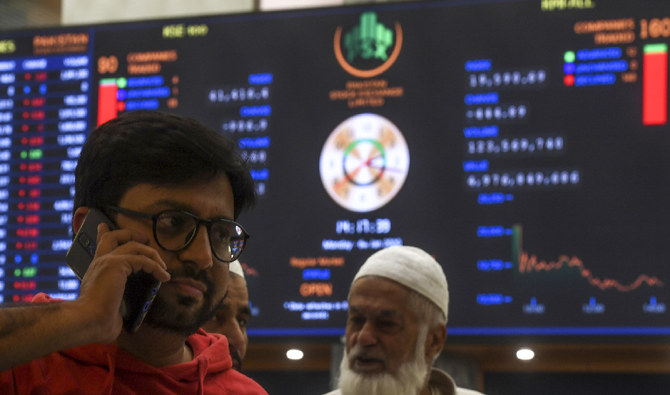
Stockbrokers monitor latest share prices during a trading session at the Pakistan Stock Exchange (PSX) in Karachi on January 6, 2020. (AFP)
Short Url
Updated 07 January 2020
Follow

Pakistan bullion, stock markets recover as investors discount Iran threat

  • Gold prices decline by Rs1300 per tola, stock market recovers by 605 points
  • Fears remain over disruptions to oil supplies in the Strait of Hormuz

KARACHI: The prices of gold in Pakistan retreated on Tuesday after climbing to the highest-ever level of Rs93,400 per tola (approximately 12 grams) amid US-Iran tensions.

The prices went up following global trends after the killing of a top Iranian military commander by a US strike last week. But investors have now discounted Iran’s threats of retaliation.

The price of gold declined by Rs1,300 per tola following an $11 per ounce drop in the international bullion market. The market opened on Tuesday afternoon at Rs92,100 per tola, while 10-gram gold prices were down by between Rs1,114 and Rs78,961, according to All Sindh Saraf and Jewellers Association (ASSJA), a body that issues gold rates.

“The gold prices have declined following the international market, where investors have downplayed the security threats after the killing of Iran’s general Qassem Soleimani,” Hajji Haroon Rasheed Chand, ASSJA president, told Arab News.

Analysts say that global stock and commodities markets have recovered from Monday’s shock, as no immediate reaction from Iran to avenge the death of Soleimani was expected.

“Global equity and commodities markets are recovering as investors expect that the US-Iran tension is easing off. Investors think that the matter is being resolved after no retaliation from Iran so far,” said Ahsan Mehanti, a senior commodity, and stock analyst. “Gold has emerged as the outperformer with 5 percent value appreciation since the start of the new year.” 

Analysts say in most volatile times investors often find assets with intrinsic value such as gold and rush to offload risky stocks. 

Pakistan’s equity market also recovered by 608.23 points or 1.5 percent 41,904 level on Tuesday after posting 1027.06 points or a 2.4 percent decline on Monday.

“Stocks showed a major recovery at the PSX (Pakistan Stock Exchange) as investors weigh stronger economic data on trade deficit, exports for July-December 2019, and robust recovery in global equities on easing reactions to the US-Iran tensions,” Mehanti said, adding that compliance with Financial Action Task Force (FATF) recommendations, higher local auto and fertilizer prices, and surging global crude oil prices played a positive catalyst role.

Global oil prices also eased on Tuesday despite concerns over potential disruptions to the global oil supply through the Strait of Hormuz, a shipping route between Oman and Iran that facilitates a fifth of the global oil supply flows.

Oil prices climbed above $70 a barrel on Monday amid fears that Iran may retaliate. Brent crude on Tuesday eased to $68.25. 

Economists say any oil supply disruption would adversely impact the already fragile economy of Pakistan in the face of mounting inflationary pressure. Pakistan has imported petroleum products worth $14.44 billion during the fiscal year FY19.

“Though there is no immediate threat, any supply disruption will impact the economy of the country and may halt everything because we relay 80-85 percent on imported oil,” commented Muzamil Aslam, a senior economist.

Pakistan’s central bank also says the country is likely to miss the growth target of 4 percent in FY20 as many sectors are underperforming. The bank projects that the inflation rate would remain at 11-12 percent.


In Pakistan’s Bannu, people start their day with a sugar rush

Updated 5 sec ago
Follow

In Pakistan’s Bannu, people start their day with a sugar rush

  • While much of Pakistan favors savory breakfasts, residents of Bannu prefer a sweet, caramelized halwa
  • People line up before sunrise at the decades-old Speen Sar restaurant to cherish its signature dish

BANNU, Pakistan: Before sunrise, the narrow lane outside Speen Sar, a modest restaurant, fills with customers waiting for halwa, a dense sweet made from wheat starch, sugar and clarified butter, that serves as breakfast for many people in this northwestern city.

Inside the restaurant’s kitchen, the morning air is thick with the scent of caramelized sugar and heated ghee. A chef leans over a large metal vat, dissolving sugar into the hot fat before adding a slurry of flour and water. With rhythmic, heavy strokes, he stirs the mixture until it thickens into a glossy halwa.

He pours the sweet onto a tray and rushes toward the counter, where a crowd of patrons has already gathered. Three cooks work in quick succession to keep pace with demand, turning out batch after batch during the breakfast rush in Bannu, a city in Pakistan’s Khyber Pakhtunkhwa province.

While halwa is widely eaten as a dessert or festival sweet across South and Central Asia and the Middle East, Bannu stands apart for turning it into a morning staple. Across most of Pakistan, breakfast tends to be savory, typically consisting of omelets, parathas or puris, and in some places nihari, a slow-cooked meat stew. Here, however, halwa is not a side dish but the meal itself, eaten plain or with bread before the workday begins.

“We open the shop at the time of morning prayer, and after prayer, we start preparing,” says Zahid Khan, whose grandfather Akbar Ghulam opened the restaurant over six decades ago.

The shop’s name, Speen Sar — Pashto for “white-haired man” — dates back to its earliest days. Khan said the business began as a small stall run by his grandfather. As he grew older and his hair turned white, customers began directing others to the “speen sar” shop, the place where the white-haired man sold halwa. The nickname endured, eventually becoming the shop’s official identity.

Speen Sar relies on a labor-intensive process of extracting starch from wheat flour.

“In our halwa, we use ghee, sugar, flour and other ingredients. From the flour, the starch that comes out is what we use to make the halwa,” Khan explained before examining the cooking process in his kitchen.

Bannu sits at the crossroads between Pakistan’s former tribal areas and the settled plains of the northwest, and the halwa shop serves as a rare social equalizer, drawing laborers, traders, students and travelers to the same counter each morning. For many passing through the city, stopping for halwa is not optional.

“Whenever I come from Waziristan ... the first thing I do is start with halwa,” says Irafullah Mehsud, an expatriate worker. “I eat the halwa first, and only then move on to other things.”

The popularity of the dish is partly due to its shelf life and to what the owners call good quality. At Rs500 ($1.80) per kilogram, it is an affordable luxury as well.

“Our halwa is widely consumed with breakfast, and it does not spoil quickly. If you want, that you will eat it tomorrow, you can even set some aside for the next day,” Khan said, pointing to a tray of nishasta halwa, a variety made by extracting wheat starch before cooking.

While the region offers variations including sohan halwa, milk-based recipes, and carrot-infused batches, this halwa offered by Speen Sar remains the undisputed king of the breakfast table in this city.

“This is a tradition of the people of Bannu. Early in the morning, everyone eats it and comes here,” says Razaullah Khan, a student at a local college. “Eating halwa is a common practice here ... but this one is the most popular. People eat it for breakfast.”

For the elders of the city, the habit is as much about routine as it is about flavor.

“This tradition has been going on for the past forty to fifty years ever since I can remember,” says Sakhi Marjan, a local elder in his late sixties. “We first come to the Azad Mandi market and then come here to eat halwa. We really enjoy this halwa. It is delicious.”

As the sun rises over Bannu, this ‘sweet’ trade shows no sign of slowing. For those like Gul Sher, a regular from Jani Khel, a town in a neighboring tribal district, a day without the local sweet is a day started wrong.

“As soon as I step into Bannu, I start my day with halwa. After that, the rest of the day goes well,” Sher said before finishing his plate of halwa.

“It is a sweet dish, and it makes the day better. It is a good thing.”