


KARACHI: The prices of gold in Pakistan retreated on Tuesday after climbing to the highest-ever level of Rs93,400 per tola (approximately 12 grams) amid US-Iran tensions.
The prices went up following global trends after the killing of a top Iranian military commander by a US strike last week. But investors have now discounted Iran’s threats of retaliation.
The price of gold declined by Rs1,300 per tola following an $11 per ounce drop in the international bullion market. The market opened on Tuesday afternoon at Rs92,100 per tola, while 10-gram gold prices were down by between Rs1,114 and Rs78,961, according to All Sindh Saraf and Jewellers Association (ASSJA), a body that issues gold rates.
“The gold prices have declined following the international market, where investors have downplayed the security threats after the killing of Iran’s general Qassem Soleimani,” Hajji Haroon Rasheed Chand, ASSJA president, told Arab News.
Analysts say that global stock and commodities markets have recovered from Monday’s shock, as no immediate reaction from Iran to avenge the death of Soleimani was expected.
“Global equity and commodities markets are recovering as investors expect that the US-Iran tension is easing off. Investors think that the matter is being resolved after no retaliation from Iran so far,” said Ahsan Mehanti, a senior commodity, and stock analyst. “Gold has emerged as the outperformer with 5 percent value appreciation since the start of the new year.”
Analysts say in most volatile times investors often find assets with intrinsic value such as gold and rush to offload risky stocks.
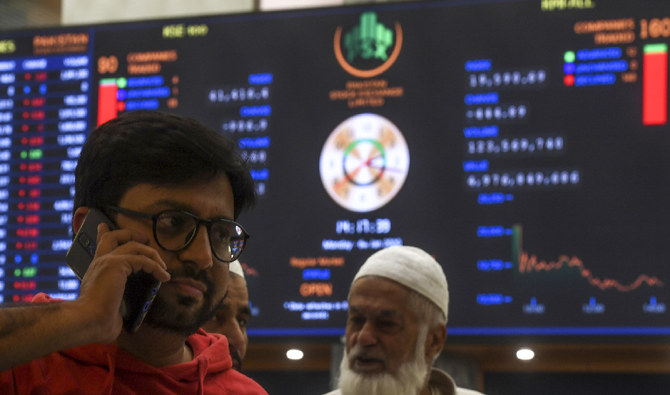
Pakistan’s equity market also recovered by 608.23 points or 1.5 percent 41,904 level on Tuesday after posting 1027.06 points or a 2.4 percent decline on Monday.
“Stocks showed a major recovery at the PSX (Pakistan Stock Exchange) as investors weigh stronger economic data on trade deficit, exports for July-December 2019, and robust recovery in global equities on easing reactions to the US-Iran tensions,” Mehanti said, adding that compliance with Financial Action Task Force (FATF) recommendations, higher local auto and fertilizer prices, and surging global crude oil prices played a positive catalyst role.
Global oil prices also eased on Tuesday despite concerns over potential disruptions to the global oil supply through the Strait of Hormuz, a shipping route between Oman and Iran that facilitates a fifth of the global oil supply flows.
Oil prices climbed above $70 a barrel on Monday amid fears that Iran may retaliate. Brent crude on Tuesday eased to $68.25.
Economists say any oil supply disruption would adversely impact the already fragile economy of Pakistan in the face of mounting inflationary pressure. Pakistan has imported petroleum products worth $14.44 billion during the fiscal year FY19.
“Though there is no immediate threat, any supply disruption will impact the economy of the country and may halt everything because we relay 80-85 percent on imported oil,” commented Muzamil Aslam, a senior economist.
Pakistan’s central bank also says the country is likely to miss the growth target of 4 percent in FY20 as many sectors are underperforming. The bank projects that the inflation rate would remain at 11-12 percent.


