
PESHAWAR: The ancient Gandhara civilization left behind amazing archaeological treasures, but most of the artifacts are no longer in their place of origin. Khyber Pakhtunkhwa (KP) province is now struggling to get them back.
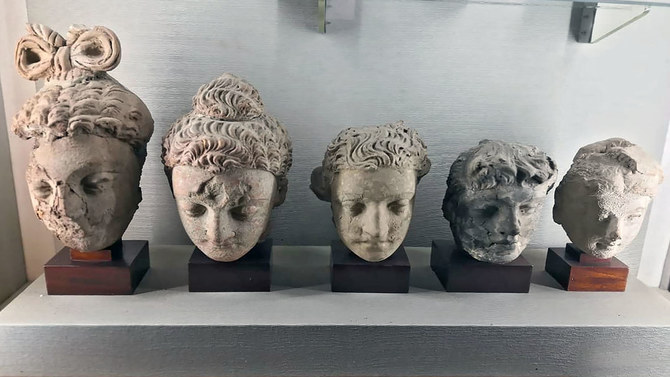
Gandhara sprawled through the Valley of Peshawar between the first millennium BCE and the beginning of the second millennium CE and was a major cultural and religious center of the region. As thousands of its relics have been scattered in museums across the country, the KP government wants to return them to the province and promote tourism.

Fasting Siddhartha from the Lahore Museum’s collection. (Photo courtesy: Peshawar Museum)
“The provincial government has written three letters to the Ministry of Inter-Provincial Coordination (IPC) to help return 3,150 ancient Gandhara artifacts, including the Fasting Siddhartha statue to the place of its origin, the northwestern province. Those artifacts are currently stored at museums in Taxila, Bahawalpur, Karachi, Lahore, and Islamabad,” Bakht Muhammad of the KP Archaeology Department told Arab News on Monday.
Under UNESCO laws, he said, the antiques should be given back to their place of origin.

A statue presenting Buddha’s departure in on display at the Peshawar Museum on Jan. 6, 2020. (AN photo)
According to Muhammad, the requests have not been answered. Arab News made repeated attempts to reach the ministry, but neither phone calls nor text messages were answered.
Many of the Gandhara treasures the province wants to retrieve are important remains of the country’s Buddhist heritage and KP officials argue they would greatly help their current efforts to achieve the region’s cultural and religious tourism potential and generate job opportunities and revenue.

Buddhizattva Avilakateshvera from the Gandhara period is displayed at the Peshawar Museum on Jan. 6, 2020. (AN photo)
KP Tourism Corporation spokesman Nisar Muhammad said that the return of the relics would multiply the tourist appeal of the sites from which they were taken, but acknowledged that national-level planning was needed as “for instance, if the statue of Buddha is housed at Lahore Museum, all Buddhist pilgrims coming to KP will definitely go to Lahore as well.”
“We leave no stone unturned to promote religious tourism aimed at wooing foreign tourists and multiplying businesses,” KP Information Minister Shaukat Yousafzai said, adding that the return of the ancient artifacts was an administrative issue between departments.
However, Abdul Azeem, director general at the Federal Archaeology Department, told Arab News it was complicated and has to be solved by the IPC Ministry.
“But let me clarify that in the wake of 18th amendment, provinces are given ownership of assets, liabilities and items such as monuments and sites. We don’t have any objections, but a final decision in this regard is to be made by the IPC,” he said.
Museums may oppose the move.
Dr. Izzah Khan, secretary of the International Council of Museums (ICOM) in Pakistan, said that while Gandhara art was of paramount importance for KP, which is the custodian of the ancient civilization, the province’s demand is not legitimate.
She likened it to a possible request that Balochistan could make for KP museums to return their collection of Mehrgarh civilization relics.
“It is not convenient for everyone to travel far to see these artifacts in another province thus their circulation in museums is significant for everyone to be able to benefit from them,” she said.