Why Kashmiri tea should be your choice for cold days

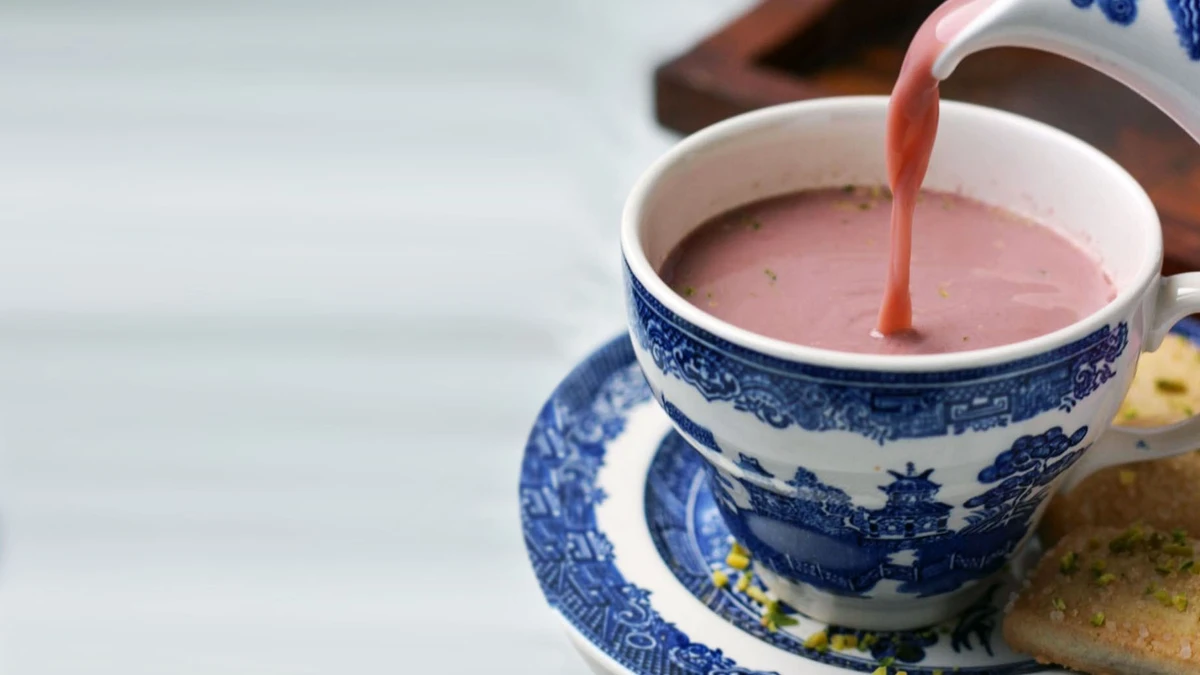
Kashmiri chai's other names are gulabi chai, pink tea, and noon chai. (Photo courtesy: FlourAndSpiceblog/Instagram)
Short Url
Updated 06 January 2020
Follow

Why Kashmiri tea should be your choice for cold days

  • Kashmiri tea is also known as noon chai and gulabi chai
  • Traditionally it is not served sweet, but Pakistanis like to have it for dessert

ISLAMABAD: When winter is in full swing, with temperatures across Pakistan dropping dramatically, a warm pink drink with cardamom, pistachios and some salt can provide a great respite. As Arab News will tell you how to brew, and we are sure this Kashmiri chai is going to become your cup of tea.

Also known as noon chai (“noon” meaning salt in many South Asian languages) and gulabi chai (“gulabi” means pink in Urdu and Punjabi), Kashmiri tea is made from green tea leaves that have been rolled into small balls, also known as gunpowder. Its signature pink hue comes from a specific brewing process.

When the tea is boiled through and becomes brown, baking soda is tossed into the water and sodium bicarbonate turns its color into a saturated red hue. Mixed with milk or cream, the drink becomes deliciously baby pink.

Kashmiri chai is not a light on the belly sort of drink. Often made with heavy cream or full-fat milk, it is customizable with salt, sugar and nut garnish – all usually the drinker’s choice. You can drown sugar in it to match the overall saccharine aesthetic of the drink, or you can throw in a bunch of nuts and control its sweetness with salt. Kashmiri chai is traditionally not served as a sweet forward tea, but Pakistanis like to have it for dessert.

Making Kashmiri chai at home has a nostalgic and luxurious feel to it, but it requires some patience and elbow grease to get the mix cooked properly. The following tried and tested recipe by Karachi-based food blog Mirchi Tales will help you do it just right.

Ingredients:

1 liter of water
4 teaspoons Kashmiri chai leaves (1 teaspoon for a 250 ml cup)
½ teaspoon baking soda
500 ml ice-cold water or ice-cubes
1 liter of milk
½ teaspoon salt
3-4 crushed cardamom/elaichi pods
Almonds and pistachios crushed to garnish
Sugar to taste

Instructions:

Heat one liter of water in a large and wide saucepan. Once it boils, add the tea leaves and let the mixture boil for 10-15 minutes or until it reduces to about half the initial amount.

Turn heat to low and add baking soda. The soda will bubble up and there will be a hint of pink around the edges. Too much baking soda can result in a bitter aftertaste, so be careful. Cook the mixture on medium heat for three to four minutes until it turns brown with hints of red. Turn off the heat, and strain the green tea.

Fill a jug with 500 ml of ice-cold water. Add a few ice-cubes to make sure it is chilled.

Take a large spoon or soup ladle and stir the tea mixture by pouring and re-pouring it from a height. This is known as “paitha lagana” in Urdu. Pour and re-pour using one hand and add ice-cold water slowly from the other hand. Continue doing this for at least five to 10 minutes as this is what brings out the pink color. Once you are done and the color of the tea is dark red, strain it to another saucepan.

The tea for Kashmiri chai is ready and can be poured into a jug and kept in the fridge for a week or so until you decide to mix it with milk. Based on the quantity in the recipe, you should have around one liter of tea.

Heat the tea in a saucepan. Add milk to taste. The ratio is 1:1, that is for every 500 ml of tea, add 500 ml of milk. For creamier tea add more milk.

Add crushed cardamom seeds, salt and optionally sugar. Once it starts boiling, lower heat to simmer and cook for a minimum of 15-20 minutes. Keep an eye on the tea to make sure it does not boil over, and if necessary add more milk.

Pour into mugs and add crushed almonds and pistachios for garnish.

Pakistan to open today televised bidding for privatization of loss-making flag carrier PIA

Updated 10 sec ago
Follow

Pakistan to open today televised bidding for privatization of loss-making flag carrier PIA

  • Pakistan plans to privatize 75 percent of the carrier, while retaining its name and branding
  • Three contenders remain in race to buy the airline after Fauji Fertilizer Company’s withdrawal

ISLAMABAD: Pakistan is set to hold a live broadcast bidding process today, Tuesday, for the privatization of the Pakistan International Airlines (PIA), officials said, with three consortiums contending to buy the loss-making national flag carrier.

The government prequalified four investor groups in July, but Fauji Fertilizer Company, part of a military-backed conglomerate, withdrew from the process recently.

The remaining contenders include two consortiums led by Lucky Cement and Arif Habib Corporation, and a private airline Airblue.

Pakistan aims to privatize 75 percent of the carrier, while retaining its name and branding, according to PM Shehbaz Sharif’s office. The decision marks Islamabad’s most aggressive push in decades to reform the debt-ridden airline, which has accumulated more than $2.8 billion in losses.

Speaking to Arab News, Muhammad Ali, adviser to the prime minister on privatization, said the exit of Fauji Fertilizer Company from the bidding process does not preclude future collaboration.

“We don’t know if Fauji [Fertilizer Company] will partner or not with the winning bidder. However, they have withdrawn from the race,” he said.

The sealed bids will be submitted by the bidders at 10:30am on Tuesday.

“Reference price for PIACL’s (Pakistan International Airlines Corporation Limited) bidding will only be approved by the Privatization Commission Board and the Cabinet Committee on Privatization after bids have been received,” the government said in a statement on Monday.

“The bids will be opened in a ceremony starting at 3:30pm [on Tuesday] in the presence of the bidders. The bids and the reference prices will be announced and the bidding will be concluded as per agreed terms.”

PIA’s sale is a central to Islamabad’s economic reform agenda under a $7 billion bailout agreed last year with the International Monetary Fund (IMF). Officials say the airline’s privatization is essential to halt recurring losses, revive international routes and ease pressure on the budget.

This is Pakistan’s third attempt at PIA privatization, following a failed 2024 auction that received only one bid of $35 million that was far below the government’s nearly $300 million asking price, according to Privatization Commission records. Islamabad is targeting $302 million in privatization proceeds this year.

“Privatization of PIA will avoid burden on exchequer, expand airline’s fleet, improve service quality, create employment opportunities, and help Pakistan’s aviation, tourism and GDP (gross domestic product) to grow,” Ali said.

Once considered among Asia’s leading airlines, PIA has accumulated more than $2.8 billion in losses. The airline has struggled with chronic mismanagement, political interference, overstaffing, mounting debt and operational issues that led to a 2020 ban on flights to the European Union, United Kingdom and the United States (US) after a pilot licensing scandal, further shrinking PIA revenues.

Pakistan’s Finance Adviser Khurram Schehzad said PIA used to be the region’s “best airline” in the 70s and 80s, adding that Pakistani diaspora in various countries wants their own airline to flourish again.

“Airlines help turnaround the economy, promote growth, investment and economic activity through multiple ways,” he said, noting, “We are a country of 250 million people, with a huge diaspora.”

Former finance minister Miftah Ismail believed the airline’s privatization would benefit consumers and taxpayers even if it did not materially move the macroeconomic needle.

“PIA’s privatization will have a positive impact on the aviation industry,” he told Arab News. “There will be greater competition and hopefully better service for consumers. It will also save the money people of Pakistan have to pay every year for PIA to keep going.”

Ismail noted the government had already transferred around Rs800 billion ($2.85 billion) of PIA’s liabilities onto the public balance sheet ahead of the sale.

“So, PIA has lost 800 billion rupees of people’s money. That money is gone forever and the consumers will have to pay, but at least further losses will be cut,” he said.

To a question, he said the process of privatization was “transparent” this time around but cautioned that broader privatization momentum remains limited only to state assets like power companies, oil exploration groups and gas distribution companies.

Islamabad has launched a five-year privatization plan covering 24 state entities between 2024 and 2029, including the Roosevelt Hotel in New York, three banks, power distribution companies, and the Postal Life Insurance Company, according to the Privatization Commission.

Aviation industry veterans say structural constraints under state ownership doomed repeated turnaround plans for PIA.

Speaking to Arab News, former PIA chief executive officer Musharraf Rasool Cyan pointed to “pervasive interference” and “rigid” public-sector rules for the failure of PIA.

“Due to interference by institutions like the judiciary and even parliament, the management cannot take market-aligned decisions,” he said, citing non-performance-based contracts, slow procurement rules, union pressures and corruption.

Cyan said PIA failed to adapt as competition intensified from the 1990s, lagged in network optimization and technology, and suffered from weak accountability.

“The work culture became more political than professional,” he said, adding the airline now needs equity injections and a fleet renewal.