

Why Kashmiri tea should be your choice for cold days

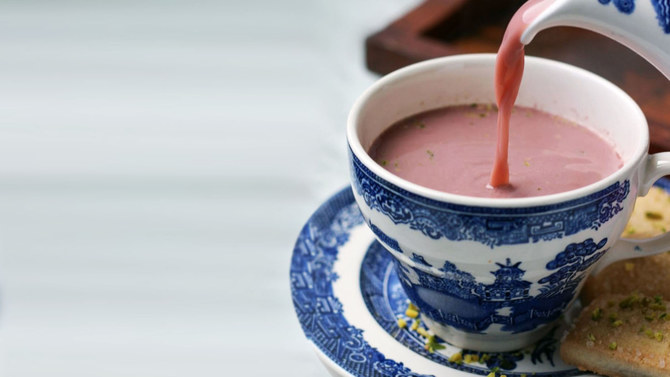
Kashmiri chai's other names are gulabi chai, pink tea, and noon chai. (Photo courtesy: FlourAndSpiceblog/Instagram)
Short Url
Updated 06 January 2020
Follow

Why Kashmiri tea should be your choice for cold days

  • Kashmiri tea is also known as noon chai and gulabi chai
  • Traditionally it is not served sweet, but Pakistanis like to have it for dessert

ISLAMABAD: When winter is in full swing, with temperatures across Pakistan dropping dramatically, a warm pink drink with cardamom, pistachios and some salt can provide a great respite. As Arab News will tell you how to brew, and we are sure this Kashmiri chai is going to become your cup of tea.

Also known as noon chai (“noon” meaning salt in many South Asian languages) and gulabi chai (“gulabi” means pink in Urdu and Punjabi), Kashmiri tea is made from green tea leaves that have been rolled into small balls, also known as gunpowder. Its signature pink hue comes from a specific brewing process.

When the tea is boiled through and becomes brown, baking soda is tossed into the water and sodium bicarbonate turns its color into a saturated red hue. Mixed with milk or cream, the drink becomes deliciously baby pink.

Kashmiri chai is not a light on the belly sort of drink. Often made with heavy cream or full-fat milk, it is customizable with salt, sugar and nut garnish – all usually the drinker’s choice. You can drown sugar in it to match the overall saccharine aesthetic of the drink, or you can throw in a bunch of nuts and control its sweetness with salt. Kashmiri chai is traditionally not served as a sweet forward tea, but Pakistanis like to have it for dessert.

Making Kashmiri chai at home has a nostalgic and luxurious feel to it, but it requires some patience and elbow grease to get the mix cooked properly. The following tried and tested recipe by Karachi-based food blog Mirchi Tales will help you do it just right.

Ingredients:

1 liter of water
4 teaspoons Kashmiri chai leaves (1 teaspoon for a 250 ml cup)
½ teaspoon baking soda
500 ml ice-cold water or ice-cubes
1 liter of milk
½ teaspoon salt
3-4 crushed cardamom/elaichi pods
Almonds and pistachios crushed to garnish
Sugar to taste

Instructions:

Heat one liter of water in a large and wide saucepan. Once it boils, add the tea leaves and let the mixture boil for 10-15 minutes or until it reduces to about half the initial amount.

Turn heat to low and add baking soda. The soda will bubble up and there will be a hint of pink around the edges. Too much baking soda can result in a bitter aftertaste, so be careful. Cook the mixture on medium heat for three to four minutes until it turns brown with hints of red. Turn off the heat, and strain the green tea.

Fill a jug with 500 ml of ice-cold water. Add a few ice-cubes to make sure it is chilled.

Take a large spoon or soup ladle and stir the tea mixture by pouring and re-pouring it from a height. This is known as “paitha lagana” in Urdu. Pour and re-pour using one hand and add ice-cold water slowly from the other hand. Continue doing this for at least five to 10 minutes as this is what brings out the pink color. Once you are done and the color of the tea is dark red, strain it to another saucepan.

The tea for Kashmiri chai is ready and can be poured into a jug and kept in the fridge for a week or so until you decide to mix it with milk. Based on the quantity in the recipe, you should have around one liter of tea.

Heat the tea in a saucepan. Add milk to taste. The ratio is 1:1, that is for every 500 ml of tea, add 500 ml of milk. For creamier tea add more milk.

Add crushed cardamom seeds, salt and optionally sugar. Once it starts boiling, lower heat to simmer and cook for a minimum of 15-20 minutes. Keep an eye on the tea to make sure it does not boil over, and if necessary add more milk.

Pour into mugs and add crushed almonds and pistachios for garnish.

Pakistan orders four-day workweek, shuts schools to save fuel amid Middle East oil crisis

Updated 58 min 40 sec ago
Follow

Pakistan orders four-day workweek, shuts schools to save fuel amid Middle East oil crisis

  • The development comes as ongoing US-Israeli strikes on Iran disrupt oil supplies in Strait of Hormuz, push prices past $119 a barrel
  • Islamabad bans government purchases, cuts fuel allocation for vehicles as well as workforce in public and private offices by 50 percent

ISLAMABAD: Prime Minister Shehbaz Sharif on Monday announced austerity measures, including a four-day work week, cuts in government expenditures and closure of schools, to offset the impact of rising global oil prices due to an ongoing conflict in the Middle East.

Global fuel supply lines have been disrupted in the Strait of Hormuz, which supplies nearly a fourth of world oil consumption, after Tehran blocked it following United States-Israeli strikes on Iran and counterattacks against US interests in the Gulf region.

Oil prices surged more than 25 percent globally on Monday to $119.50 a barrel, the highest levels since mid-2022, as some major producers cut supplies and fears of prolonged shipping disruptions gripped the market due to the expanding US-Israeli war with Iran.

In his televised address on Sunday night, Sharif said global oil prices were expected to rise again in the coming days but vowed not to let the people bear their brunt, announcing austerity measures to lessen the impact of fuel price hikes.

“Fifty percent staff in public and private entities will work from home,” he announced, adding this would not be applicable to essential services. “Offices will remain open for four days a week. One-day additional off is being given to conserve oil, but it would not be applicable to banks.”

Sharif didn’t specify working days of the week and the government was likely to issue a notification in this regard.

He said a decrease of 50 percent was being made in fuel allocation for government vehicles immediately for the next two months, but they would not include ambulances and public buses.

“Cabinet members, advisers and special assistants will not draw salaries for the next two months, 25 percent salaries of parliamentarians are being deducted, two-day salaries of Grade 20 and above officers, or those who are paid Rs300,000 ($1,067) a month, are being deducted for public relief,” he said.

Similarly, there will be 20 percent reduction in public department expenses and a complete ban on the purchase of cars, furniture, air conditioners and other goods, according to the prime minister.

Foreign trips of ministers and other government officials will also be banned along with government dinners and iftar buffets, while teleconferences and online meetings will be given priority.

“All schools will be off for two weeks, starting from the end of this week, and all higher education institutions should immediately begin online classes,” he said.

Sharif’s comments were aired hours after Pakistani authorities said the country had “comfortable levels” of petroleum stocks and the supply chains were functioning smoothly, despite intensifying Middle East conflict.

Petroleum Minister Ali Pervaiz Malik said three oil shipments were due to reach Pakistan this week, state media reported.

Meanwhile, Pakistan Navy (PN) launched ‘Operation Muhafiz-ul-Bahr’ to safeguard national energy shipments, the Pakistani military said on Monday, amid disruptions to critical sea lanes due to the conflict.

The navy is conducting escort operations in close coordination with the Pakistan National Shipping Corporation (PNSC), according to the Inter-Services Public Relations (ISPR), the military’s media wing. It is fully cognizant of the prevailing maritime situation and is actively monitoring and controlling the movement of merchant vessels to ensure their safe and secure transit.

“With approximately 90 percent of Pakistan’s trade conducted via sea, the operation aims to ensure that vital sea routes remain safe, secure, and uninterrupted,” the ISPR said on Monday. “Currently, PN ships are escorting 2 x Merchant Vessels, one of which is scheduled to arrive Karachi today.”