Pakistan will ensure safety of its nationals in Iraq – foreign office

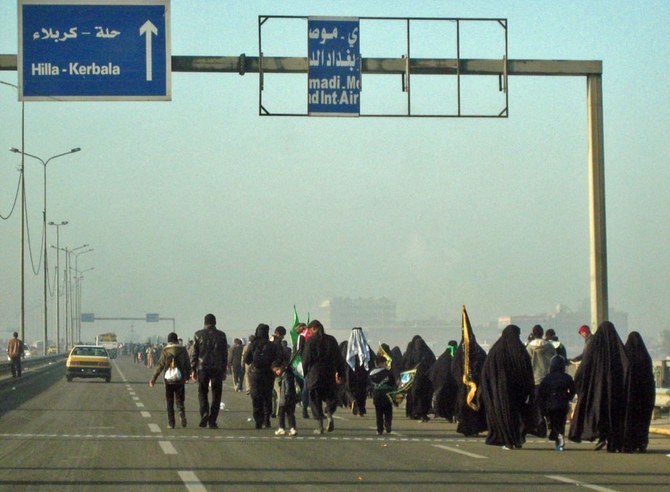
Shi'ite Muslim pilgrims walk on a main highway linking Baghdad to the central city of Karbala, 120 kilometers south of the capital, on January 20, 2011. (AFP/File photo)
Short Url
Updated 06 January 2020
Follow

Pakistan will ensure safety of its nationals in Iraq – foreign office

  • The country is closely monitoring the situation in the Middle East, informs foreign ministry spokesperson
  • Pakistan’s diplomatic mission in Iraq has issued an advisory to restrict the movement of its citizens in the Arab country

ISLAMABAD: Pakistan’s Ministry of Foreign Affairs said on Sunday the country was monitoring the situation in the Middle East and would do everything to guarantee the safety of its nationals in Iraq and the rest of the region.

“We are watching the situation in the Middle East closely which also includes the safety of our people there,” foreign office spokesperson, Aisha Farooqui, told Arab News.

Tensions between the United States and Iran escalated in the region after the American president, Donald Trump, ordered a drone strike in Baghdad that killed the top Iranian commander, Major General Qassem Soleimani, early Friday.

Soleimani was the head of his country’s elite Al Quds force and was thought to be the man behind Tehran’s growing military influence in the region.

“Pakistan has viewed with deep concern the recent developments in the Middle East, which seriously threaten peace and stability in the region,” said the country’s foreign ministry in an official handout circulated just a few hours after the incident on Friday.

The press secretary at the Pakistan embassy in Iraq, Mazhar Nisar Shami, told Arab News on phone from Baghdad that the country’s diplomatic mission was concerned about the safety of its citizens in the Arab country and in touch with them.

“We have asked them to restrict their movements, though a majority of our expats here [in Iraq] are unskilled laborers who cannot stop going to work. So we have issued an advisory to restrict their movement as much as possible. The embassy has asked Pakistani citizens to remain confined to their workplaces and houses only,” Shami said, adding that the situation had not escalated to a point where evacuation was required.

“The situation has not reached a level where it can be declared alarming and where evacuation becomes necessary,” he said.

He noted that things were relatively calm on Sunday, though the overall atmosphere in Iraq was quite intense.

“We have an office in Najaf which deals with Pakistani pilgrims in Najaf and Karbala,” he continued. “We are in contact with them as well, and all of our offices are ensuring complete safety of Pakistani nationals in Iraq.”


Pakistan finance minister touts debt discipline, export focus at Davos panel

Updated 5 sec ago
Follow

Pakistan finance minister touts debt discipline, export focus at Davos panel

  • Aurangzeb says debt must fund exports, not consumption, for sustainable growth
  • He says Pakistan used fiscal buffers to respond to floods without external appeals

KARACHI: Pakistan’s Finance Minister Muhammad Aurangzeb said on Wednesday disciplined borrowing, export-led growth and careful debt management were central to stabilizing the country’s economy, as Islamabad looks to unlock new sources of growth amid rising global debt levels.

Speaking at a panel discussion on the sidelines of the World Economic Forum (WEF) in Davos, he said debt was not inherently harmful if used productively, but warned that emerging economies such as Pakistan could not afford to deploy borrowed funds for consumption.

“For countries like Pakistan, debt must be channeled into investments that generate exportable surplus,” Aurangzeb said, according to a statement circulated by the Finance Division. “It is not about the availability of debt or funding, but how wisely and effectively it is steered to create long-term economic value.”

Pakistan has been pursuing fiscal reforms as part of an International Monetary Fund-backed stabilization program, including cutting subsidies, broadening the tax base and restructuring state-owned enterprises, as the government seeks to restore macroeconomic stability and revive growth.

Aurangzeb said Pakistan had reduced its debt-to-GDP ratio to 70 percent from 75 percent, achieved a primary fiscal surplus and brought inflation down from a peak of 38 percent to single digits, allowing the central bank to cut its policy rate to 10.5 percent.

He also flagged ongoing debt-management reforms, including liability management operations and buybacks, and said Pakistan plans to enter China’s capital markets with its first Panda bond, structured as a green bond.

Addressing climate risks, Aurangzeb said building fiscal buffers had allowed Pakistan to respond to recent floods using domestic resources rather than international emergency appeals, underscoring the need for resilience in climate-vulnerable economies.

He added that public-private partnerships and capital markets were playing a growing role in financing development, citing a $3.6 billion syndicated financing for a major copper mining project expected to generate $2.8 billion in annual exports from 2028.

The finance minister is part of Pakistan’s delegation visiting Davos for the annual gathering of global leaders and investors.

The delegation is led by Prime Minister Shehbaz Sharif, who highlighted the country’s shift toward an export-driven growth model, with a focus on minerals, information technology, artificial intelligence and digital services, while speaking at a breakfast event on the sidelines of the forum.