

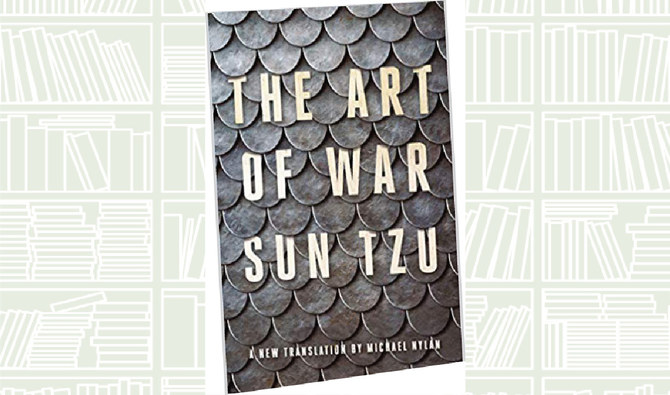
What We Are Reading Today: The Art of War

Short Url
Updated 05 January 2020
Follow

What We Are Reading Today: The Art of War

Author:  Sun Tzu, Michael Nylan

Sun Tzu’s The Art of War is one of the most talked about books on war or even business strategy.
Michael Nylan’s crisp translation “offers a masterly new evaluation of this classic work, which balances the overtly military content with a profound and thought-provoking analysis,” said a review in goodreads.com.
Nylan’s crisp translation “offers a masterly new evaluation of this classic work, which balances the overtly military content with a profound and thought-provoking analysis.”
“The ancient book of strategy and psychology has as much to tell us today as when it was first written 2,500 years ago. In a world forever at odds, his rules for anticipating the motivations and strategies of our competitors never cease to inspire leaders of all kinds,” added the review.
“Many have used and applied The Art of War into many different aspects of modern art and it is easy to see how it would work in everyday situations. It’s a straight-down-the-line book on basic strategy for diplomacy and conflict,” said the review.


What We Are Reading Today: Long Problems

Photo/Supplied
Updated 06 March 2026
Follow

What We Are Reading Today: Long Problems

  • In this pathbreaking book, Thomas Hale examines the politics of climate change and other “long problems”

Author: Thomas Hale

Climate change and its consequences unfold over many generations. Past emissions affect our climate today, just as our actions shape the climate of tomorrow, while the effects of global warming will last thousands of years.

Yet the priorities of the present dominate our climate policy and the politics surrounding it. Even the social science that attempts to frame the problem does not theorize time effectively. In this pathbreaking book, Thomas Hale examines the politics of climate change and other “long problems.”

He shows why we find it hard to act before a problem’s effects are felt, why our future interests carry little weight in current debates, and why our institutions struggle to balance durability and adaptability.