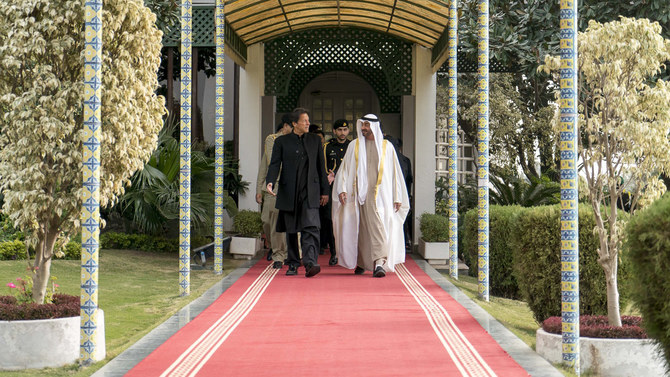

ISLAMABAD: Crown Prince of Abu Dhabi and Deputy Supreme Commander of the United Arab Emirates (UAE) Armed Forces Sheikh Mohammed bin Zayed Al-Nahyan departed for his country on Thursday after finishing his day-long official visit to Pakistan.
Prime Minister Imran Khan received the crown prince at the Nur Khan air base in Rawalpindi earlier in the day and drove the visiting royal to the Prime Minister House.
The UAE crown prince was accompanied by a high-level delegation and he held a one-on-one meeting with the PM that was followed by a luncheon.
Both the leaders exchanged views on bilateral matters and regional and international issues of common interest. The crown prince also instructed the Khalifa Fund for Enterprise Development to allocate $200 million to support small and medium enterprises (SMEs) in Pakistan, the UAE state news agency, WAM, reported.
"The Prime Minister expressed satisfaction at the frequent exchange of high-level visits between Pakistan and the UAE and the steady development of cordial ties between the two fraternal countries," said an official statement.
"The Prime Minister highlighted the positive contributions of more than 1.6 million expatriate Pakistani community, which considers UAE as their second home," the statement added. "Prime Minister Imran Khan also thanked the UAE leadership and its people for their commitment to Pakistan's socio-economic development, focused in particular on health, education and youth."
Islamabad said the visit illustrated the strength and substance of the Pakistan-UAE special relationship, based on commonalities of faith, cultural affinities, and a shared resolve to take mutual cooperation to a new level.
Pakistan’s Foreign Ministry Spokesperson Aisha Farooqui said on Thursday that “our relationship goes back decades. This is a relationship that is both wide and deep.”
She said at a weekly press briefing that the entire spectrum of bilateral relations and regional and international issues of common interest were discussed during the meeting.
“Frequent exchange of high-level visits between Pakistan and UAE is reflective of the importance that the two countries attach to their fraternal ties. Whenever the two leaderships meet all major issues are discussed in detail,” Farooqui said.
The UAE is Pakistan’s largest trading partner in the Middle East and a major source of investment. The Gulf country is also among Pakistan’s prime development partners in education, health, and energy sectors — hosting more than 1.6 million Pakistani expatriates, which contribute remittances of around $4.5 billion annually to the GDP, the foreign office said in a statement.
Dr. Vaqar Ahmed, senior economist and joint executive director of Sustainable Development Policy Institute (SDPI), told Arab News that this was a significant visit since Pakistan was seeking diplomatic support to extend its economic ties.
“Pakistan aims to win support of friendly countries on the FATF, Kashmir, and related matters of geo-strategic nature,” Ahmed said, adding that “the Board of Investment has already been pursuing investors from the UAE and we hope that the private sector of the Gulf state will show interest in special economic zones of Pakistan.”
“Pakistan already has strong economic ties with the UAE. However, there is a need to boost diplomatic efforts so that placement for skilled and unskilled labor can be ensured,” he continued.
Javed Hafeez, former ambassador and expert on foreign affairs, said that the visit of Crown Prince Zayed Al-Nahyan reaffirmed the importance the UAE attached to its ties with Pakistan.
“The UAE has made significant investments in the Pakistan’s banking and telecommunications sectors. It has been providing sizeable humanitarian assistance as well. Both South Asia and the Gulf region are passing through a crucial period,” Hafeez noted, adding that periodic consultations were necessary in the interest of regional peace and security.
“Pakistan will expect more investments from the UAE, particularly in the field of tourism. EXPO 2020 will be an opportune occasion for Pakistan to promote its exports to the world,” he said.
On Wednesday, UAE Ambassador to Pakistan Hamad Obaid Al-Zaabi said in a statement that the visit “will further strengthen the bonds of friendship between the two brotherly countries.”
The UAE crown prince last visited Islamabad in January 2019 on PM Khan’s invitation.
Khan visited the UAE several times since August 2018 after assumed the country’s top political office in order to secure financial assistance to tackle Pakistan’s economic crisis. The UAE pledged $3 billion in balance-of-payments support and oil supply on deferred payments.
Last week, UAE Culture Minister Sheikh Nahyan bin Mubarak Al-Nahyan met with PM Khan and President Arif Alvi in Islamabad.
“It was our endeavor to further strengthen the existing bilateral engagement at all levels and in all fields, including trade, investment, energy, culture and tourism,” the president said after the meeting.
He also highlighted that 1.6 million Pakistanis living in the Emirates were a bridge between the two countries and contributed to UAE’s development.