Philippines’ Duterte tells troubled media conglomerate owners to sell out

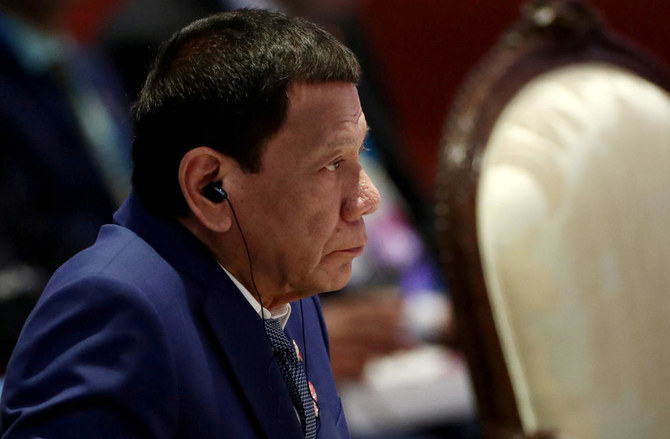
Philippine President Rodrigo Duterte attends a plenary session at a regional summit in Bangkok, Thailand. (File/Reuters)
Short Url
Updated 30 December 2019
Follow

Philippines’ Duterte tells troubled media conglomerate owners to sell out

  • The mercurial leader has a rocky relationship with the media, especially with those critical of his bloody anti-narcotics campaign
  • ABS-CBN is the country’s largest media conglomerate with dozens of local and national radio and television stations covering news, entertainment and public affairs

MANILA: Philippines President Rodrigo Duterte on Monday told owners of a media conglomerate that has drawn his ire to sell the company ahead of the network’s franchise expiry.
The mercurial leader has a rocky relationship with the media, especially with those critical of his bloody anti-narcotics campaign, and he has threatened numerous times to block the franchise extension of ABS-CBN Corp.
“This ABS, your contract will expire, and you try to renew. I don’t know what will happen to you,” Duterte said in a speech before earthquake victims in the southern province of North Cotabato.
The broadcast franchise of ABS-CBN, the country’s largest media conglomerate with dozens of local and national radio and television stations covering news, entertainment and public affairs, will expire in March 2020.
“If I were you, just sell it,” Duterte said of the network, which he had accused of not airing his paid advertisement during the presidential race in 2016.
A bill to extend its license is pending in congress, which is dominated by Duterte’s allies.
ABS-CBN did not immediately respond to request for comment on a public holiday.
Duterte, in numerous public speeches, has lashed out at the media, while his office has at times accused media companies of bias or distorting his statements.
The Philippine leader enjoys a high approval rating and is wildly popular on social media. His supporters, including bloggers, fiercely defend him and his policies, and have targeted journalists.


US moves to counter China in Bangladesh, plans to pitch defense alternatives

Updated 3 sec ago
Follow

US moves to counter China in Bangladesh, plans to pitch defense alternatives

DHAKA: The United States is concerned about China’s ​expanding presence in South Asia and is planning to offer Bangladesh’s next government US and allied defense systems as alternatives to Chinese hardware, Washington’s ambassador to Dhaka told Reuters. Bangladesh votes in a general election on Thursday after a Gen Z-led uprising toppled India-allied premier Sheikh Hasina in August 2024. She has since taken refuge in New Delhi, allowing China to deepen its influence in Bangladesh as India’s presence wanes. China recently signed a defense agreement with Bangladesh to build a drone factory near the India border, worrying foreign diplomats. Bangladesh is also in talks with Pakistan to buy JF-17 Thunder fighter jets, a multi-role combat ‌aircraft jointly developed with ‌China.
“The United States is concerned about growing Chinese influence in South ​Asia ‌and ⁠is committed ​to ⁠working closely with the Bangladeshi government to clearly communicate the risks of certain types of engagement with China,” US Ambassador Brent T. Christensen said in an interview on Tuesday.
“The US offers a range of options to help Bangladesh meet its military capability needs, including US systems and those from allied partners, to provide alternatives to Chinese systems,” he said without offering further details.
The Chinese foreign ministry did not immediately respond to a request for comment.
Christensen also said that President Donald Trump’s administration would “like to see a good relationship between Bangladesh and India ⁠to support stability in the region.” New Delhi-Dhaka relations have nosedived since ‌Hasina fled, badly affecting visa services and cricket ties between the ‌two neighbors.

COMMERCIAL DIPLOMACY IS PRIORITY
Christensen said many US businesses were looking ​at potentially investing in Bangladesh but would want ‌the next government to show early and clear signs that it is “open for business.”
“Commercial diplomacy is one ‌of our top priorities, and we look forward to working with the new government to build on progress made with the interim government, particularly in strengthening commercial, economic, and security ties,” he said.
Energy producer Chevron has been in Bangladesh for decades but not many other US companies are visible in the densely populated country of 175 million people, ‌as high taxes and difficulties repatriating profits have created some hurdles.
There are no Starbucks or McDonald’s outlets in Bangladesh.
The envoy said Washington would ⁠work with “whichever government is elected ⁠by the Bangladeshi people.” The race is between two coalitions led by former allies, the Bangladesh Nationalist Party (BNP) and the Islamist Jamaat-e-Islami, with opinion polls suggesting the BNP holds an advantage.

AID FOR ROHINGYA REFUGEES
Regarding the 1.2 million Rohingya refugees sheltered in Bangladesh, the ambassador said the United States remained the largest contributor to humanitarian operations.
“The US remains the largest contributor to the Rohingya refugee response and continues robust health programming in Bangladesh,” he said, noting a recent $2 billion worldwide funding framework signed with the United Nations to improve the effectiveness of such assistance, including in Bangladesh.
He urged other international donors to take on a greater share of the burden.
“The US cannot sustain the bulk of the effort alone. International partners need to increase their support for the Rohingya response,” he said. In recent years, the UN refugee agency has ​been struggling to raise sufficient funds to support ​the Rohingya community, leading to cuts in their rations and the closure of some schools for them.