

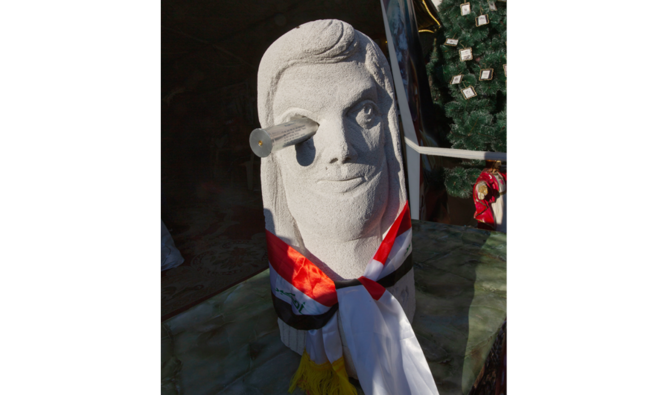
Iraqi artists pay tribute to dead protesters with sculptures

A sculpture of a protester is on show at Tahrir Square, Baghdad. (AP)
Short Url
Updated 30 December 2019
Follow

Iraqi artists pay tribute to dead protesters with sculptures

  • Tahrir Square has emerged as a focal point of the protests, with protesters camped out in tents

BAGHDAD: The sculptures carved by seven art trainees were lined up outside a makeshift workshop in Baghdad’s Tahrir Square. With them were posters depicting protesters who have been killed in anti-government demonstrations in the past three months.
One sculpture showed a protester with a tear gas canister in his eye. Another showed a volunteer tuk tuk driver next to his three-wheeled vehicle who was killed while evacuating wounded protesters during clashes. A third illustrated a protester’s hand flashing the victory sign and colored by the Iraqi flag.
For Iraqi artist Mahdi Qarnous, 53, the exhibition that was recently inaugurated in Baghdad’s central Tahrir Square — the epicenter of Iraq’s anti-government protest movement — is a personal contribution to the movement. It is aimed at immortalizing fellow protesters killed and kidnapped during the demonstrations that have engulfed Iraq since Oct. 1. It is also a way, he says, to allow young, talented Iraqis to channel their talents away from violence.
Iraq has been roiled by protests that have left at least 490 people dead, the vast majority of them demonstrators killed by security forces firing tear gas and live ammunition. The mass uprisings prompted the resignation of former Prime Minister Adel Abdul Mahdi late
last month.
Qarnous said he recruited seven uneducated and unemployed young protesters from Tahrir Square, put them through an intensive six-week course that he personally funded and after three weeks they were able to start their own art projects.

We see this activity as part of the ongoing protests and a memorial monument for our martyrs and our abducted fellow protesters.

Mahdi Qarnous, Iraqi artist

“We see this activity as part of the ongoing protests and a memorial monument for our martyrs and our abducted fellow protesters,” he said.
Tahrir Square has emerged as a focal point of the protests, with protesters camped out in tents. Dozens of people took part in the simple opening of the sculpture exhibition on a recent day. None of the art trainees who were presenting their work attended the event, however, and their names were withheld due to security concerns.
“The current regime produced a generation that is poor in producing and cherishing arts. ... You see here in this exhibition that our people have potential but lack the path,” said Qarnous.
Murtada Muthanna, 23, an artist and activist, said the exhibition is a message to the world.
“It says we are a people with inspirations for life not death. Our revolution is peaceful and we are seeking reform not destruction,” he said.


Ithra offers a glimpse of colorful Spain through fashion

Updated 27 January 2026
Follow

Ithra offers a glimpse of colorful Spain through fashion

DHAHRAN: Step into Spain without leaving Dhahran at the “Threads of Espana: Fashion Across the Spanish Regions” show currently on at the King Abdulaziz Center for World Culture.

From structured capes to swirling silhouettes, the show at Ithra brings the nation’s colorful fabric traditions to life.

Arab News spoke recently with Cecilia Revuelta, a co-organizer of the exhibition who flew in from Spain.

“We did a selection of traditional costumes of each area in Spain. So first of all, here we have the three costumes of a traditional torero. These suits are from a real torero who’s still active.”

A torero — from toro, meaning bull — is a Spanish bullfighter.

“His name is Jorge Garcia De La Pena, and thanks to our relationship with him, he lent us the three costumes and the two capes,” she added.

“Actually, one of the capes even has the bull blood in them; we decided not to wash it or anything because we think it’s totally more real like this.”

The clothes are on display until Jan. 31. (AN Photo)

Revuelta described the garments, split among different display areas, as “real art pieces, very heavy and delicate pieces. Also, we brought some flamenca dresses.”

“They’re from a private Spanish collector who dances flamenco and she’s a real fan of the flamenco culture. And she has a big, big, big collection of dresses and we did a small selection to bring it here to Ithra.”

Northern Spain is represented through costumes created stitch-by-stitch specifically for the Ithra exhibition.

“We also fabricated from scratch the costumes of Galicia. They’re the typical traditional costumes that they use in the north of Spain in the countryside, in the small villages. When it’s very cold and rainy and you can see they have a lot of layering and many details.”

“These dresses are very expensive because they are real, real pieces of art. One of these dresses costs more than 4,000 euros ($4,750). Most of them are handmade with a lot of details and stones and different colors and layers. It’s really amazing.”

For Revuelta, the exhibition reflects her love of fashion and its history. “It’s my favorite part (of the Spain Cultural Days festivities) because I love fashion. I love clothes since the beginning.”

Revuelta highlighted the cross-cultural nature of the event.

“I think it’s super positive for all the citizens of Dammam to come here, to get to know more about other countries, different cultures, traditions. They have a lot of workshops. And in the market, we have many different booths selling pieces of art, ceramics and traditional Spanish souvenirs.

“I feel very proud. It is my first time in Saudi Arabia and people here are really interested in knowing more about the different costumes and fashion history of Spain,” she added.

The pieces will remain on display until the completion of the Spain Cultural Days festivities on Jan. 31.