Egypt competition watchdog approves Uber acquisition of Careem with conditions

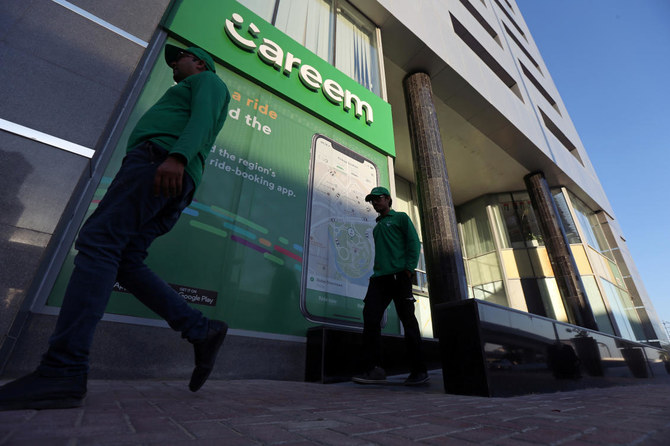
Careem employees walk past the company's headquarters in Dubai, UAE. Dec. 13, 2018. (Reuters)
Short Url
Updated 29 December 2019
Follow

Egypt competition watchdog approves Uber acquisition of Careem with conditions

  • Uber bought Careem for $3.1 billion in March in a deal expected to close in January
  • Careem will become a wholly owned subsidiary of Uber but will continue to operate as an independent brand with independent management

CAIRO: Egyptian regulators have approved Uber’s $3.1 billion acquisition of regional rival Careem after agreeing to a set of commitments proposed by the US-based ride-hailing service meant to reduce harm to competitors.

The Careem acquisition was announced in March after more than nine months of stop-start talks between the two companies, handing Uber a much-needed victory after a series of overseas divestments.

The deal is expected to close in January, depending on regulatory approval in various territories of which Egypt is among the most significant. Egypt, with a booming population seen swelling to 100 million, is the biggest in the Middle East for ridehailing services.

Careem will become a wholly owned subsidiary of Uber but will continue to operate as an independent brand with independent management.

“We welcome the decision by the Egyptian Competition Authority (ECA) to approve Uber’s pending acquisition of Careem,” a spokesman for Uber said. “Uber and Careem joining forces will deliver exceptional outcomes for riders, drivers, and cities across Egypt.”

Under a series of commitments Uber has made to the ECA, the San Francisco-headquartered company has agreed to abandon exclusivity provisions with partners and intermediaries and reduce barriers to entry into the market.

An independent monitoring trustee will be nominated by Uber and approved by the ECA to ensure adherence to the commitments. Uber will share random samples of trip data with the trustee monthly to ensure compliance.

The commitments must be adhered to for five years from the date the transaction closes, or when one or more ride-hailing providers achieves 20% of weekly rides individually or 30% collectively in overlapping areas excluding Cairo and Alexandria, Egypt’s biggest cities.

Excluding surge pricing and promotions, Uber will cap its yearly fare increases beyond inflationary costs at 10% for Uber X and Careem GO, the most popular services in Egypt.

Surge pricing, a mechanism that raises prices when demand far exceeds supply, will also be capped on Uber X and Careem GO at 2.5 times. Surge prices will be applied to a maximum of 30% of annual trips on the two services.


Saudi POS spending climbs 11% to $4.3bn in early March as retail activity broadens 

Updated 18 sec ago
Follow

Saudi POS spending climbs 11% to $4.3bn in early March as retail activity broadens 

RIYADH: Saudi Arabia’s total point-of-sale transactions rose 11 percent to SR16.1 billion ($4.3 billion) in the week ending March 7, with most sectors seeing positive weekly change. 

According to the latest data from Saudi Central Bank, the number of transactions increased 7.4 percent to 226.2 million. 

Spending on education saw the biggest uptick at 39.4 percent to SR130.7 million, followed by jewelry, which increased by 35.8 percent to SR693.11 million. 

Expenditure on clothing and apparel saw an rise of 31.7 percent to SR2.5 billion, and spending on pastries posted an 18 percent increase. Hotel outlays dropped by 11 percent to reach SR334.83 million. 

Spending in pharmacies on medical supplies was up 2.6 percent to reach SR261.06 million, while spending on medical services saw a 9 percent increase to SR579.33 million. 

Expenditure on food and beverages rose 7.5 percent to SR2.5 billion, while spending on restaurants and cafes increased by 14.7 percent to SR1.4 billion. 

The sharpest drop in spending occurred in freight transport, postal and courier services, which fell by 30.9 percent. This decline followed major disruptions in the region after the closure of the Strait of Hormuz, triggered by the ongoing armed conflict involving the US, Israel, and Iran. 

Prior to the hostilities, this category had seen a 50 percent increase in the week ending Feb. 28 —  the last day before the hostilities began, leading to the strait’s shutdown, causing significant disruptions in logistics and oil shipments across the region. 

The Kingdom’s key urban centers mirrored the weekly surge.

Riyadh, which accounted for the largest share of total POS spending, saw a 10 percent surge to SR5.35 billion, up from SR4.86 billion the previous week.

The number of transactions in the capital reached 69.6 million, up 5.9 percent week on week. 

In Jeddah, transaction values increased 17.6 percent to SR2.34 billion, while Dammam reported a 7.9 percent increase to SR743.65 million. 

POS data, tracked weekly by SAMA, provides an indicator of consumer spending trends and the ongoing growth of digital payments in Saudi Arabia. 

The data also highlights the expanding reach of POS infrastructure, extending beyond major retail hubs to smaller cities and service sectors, supporting broader digital inclusion initiatives. 

The growth of digital payment technologies aligns with Saudi Arabia’s Vision 2030 objectives, promoting electronic transactions and contributing to the Kingdom’s broader digital economy.