

Hard-line leader in Indian state defends ‘strict’ action to quell protests

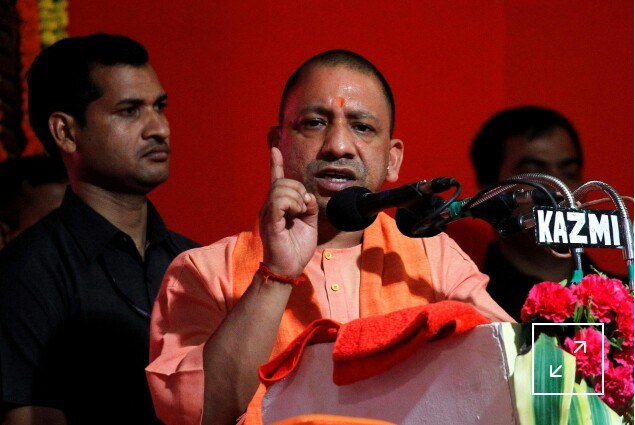
Yogi Adityanath, Chief Minister of India's most populous state of Uttar Pradesh, addresses the audience after inaugurating power projects in Allahabad, India, June 4, 2017. (Reuters/ File Photo)
Short Url
Updated 28 December 2019
Follow

Hard-line leader in Indian state defends ‘strict’ action to quell protests

  • Of the 25 people killed since protests began this month, 19 were in Uttar Pradesh
  • Clashes in the state have eased over the past week, though small demonstrations continue

LUCKNOW, India: The chief minister of India’s Uttar Pradesh state has rebuffed accusations from rights groups of police abuses during protests against a new citizenship law, crediting his tough stand with restoring calm to the streets.
The northern state has seen the most violent turmoil over Prime Minister Narendra Modi’s citizenship law, which activists say is discriminatory toward the Muslim community, which makes up some 14% of India’s population.

Out of at least 25 people who have been killed since the protests began this month, 19 were in Uttar Pradesh (UP), India’s most populous state.

The clashes in the state appear to have eased over the past week, however, though small-scale demonstrations continue.

The state’s chief minister, Yogi Adityanath, a hard-line Hindu priest who belongs to Modi’s Hindu nationalist party, said his tough policies had ended the trouble.

“Every rioter is shocked. Every troublemaker is astonished. Looking at the strictness of the Yogi government, everyone is silent,” one of Adityanath’s verified official accounts on Twitter said late on Friday.

“Do whatever you want to, but the damages will be paid by those who cause damages,” it added.

Last week, his government said it was demanding millions of rupees from more than 200 people, threatening to confiscate their property to pay for damage during the protests.
‘EXCESSIVE FORCE’
Rights groups have decried what they say have been mass detentions and excessive force in the state, where officers have arrested more than 1,000 people.

The citizenship legislation makes it easier for members of religious minorities from India’s Muslim-majority neighbors — Afghanistan, Bangladesh and Pakistan — who settled in India before 2015 get citizenship but does not offer the same concession to Muslims.

Critics say the law — and plans for a national citizenship register — discriminate against Muslims and are an attack on the secular constitution by Modi’s government.

The government has said no citizen will be affected and there is no imminent plan for a register.

Later on Saturday, the general secretary of the opposition Congress party, Priyanka Gandhi Vadra, added to criticism of UP police.

Vadra told reporters she was in a group driving to the home of a former police officer arrested in connection with the protests when a police vehicle blocked the way, so Vadra decided to continue on foot.

“(Police officers) encircled me, strangulated me, grabbed me ... and pushed me. I fell,” Vadra said. “I took a two-wheeler. They stopped me again and then I came here by walking.”

Lucknow’s Senior Superintendent of Police Kalanidhi Naithani later released a video saying an officer involved in the incident had submitted a report denying Vadra’s allegations.

A video circulating on social media is likely to compound the concerns of those worried about the plight of Muslims. It shows a senior UP police officer telling a demonstrator to “go to Pakistan if you don’t want to live here”.
The official, Akhilesh Narayan Singh, told Reuters that some protesters had been shouting pro-Pakistan slogans. “It is in this situation I told them to go to Pakistan,” he said.

Congress party officials led protests on Saturday under the slogan “Save Constitution-Save India”.

Meanwhile, Hindu activists linked to Modi’s party conducted workshops in slums in an effort to ease public discontent.


Government says Imran Khan’s ‘detailed’ medical report shared, family disputes claim

Updated 57 min 16 sec ago
Follow

Government says Imran Khan’s ‘detailed’ medical report shared, family disputes claim

  • Khan underwent an eye procedure last month, PTI says family was not informed
  • Ex-PM’s sister says only brief notes provided despite Supreme Court assurance

ISLAMABAD: Pakistan’s government said on Friday a “detailed” medical report of jailed former prime minister Imran Khan had been shared with his family following directions from the prime minister’s office, even as Khan’s relatives disputed the claim and accused jail authorities of withholding information.

Concerns over Khan’s health were raised by his family and the Pakistan Tehreek-e-Insaf (PTI) party last month after the government confirmed he was taken from prison to the Pakistan Institute of Medical Sciences (PIMS) for a brief eye procedure. Authorities said at the time that Khan’s condition was stable and the treatment routine, while PTI leaders said they were not informed in advance and questioned the lack of transparent medical disclosure.

Information Minister Attaullah Tarar said the report was prepared by PIMS and had been forwarded to the prison authorities and handed over to Khan’s family.

“A letter was written by the Leader of the Opposition to the Prime Minister and PTI Leaders also approached the Supreme Court of Pakistan regarding medical check up of Mr. Imran Ahmad [Khan] Niazi who is serving his sentences in Central Jail Rawalpindi (Adiala),” he said in a social media post on X.

“On directions from Prime Minister’s Office, a detailed report has been sent by Executive Director PIMS Hospital to the Superintendent of Central Jail Rawalpindi (Adiala) which has been handed over to the family,” he added.


However, the former prime minister’s sister Aleema Khan said they had not received complete medical reports, despite assurances given by the country’s top judge.

“The Chief Justice of the Supreme Court committed last Friday that Imran Khan’s medical reports would be provided to his family,” she said on X. “Today, when the jail superintendent appeared before the ATC [Anti-Terrorism Court], only two brief notes were submitted.”

She said the government’s conduct reflected a disregard for the court’s order, urging the Chief Justice of Pakistan to issue a contempt notice to the jail authorities and ensure that Khan’s medical reports were handed over to his family without further delay.

The dispute has renewed tensions surrounding Khan’s incarceration, which has become a flashpoint in Pakistan’s deeply polarized politics. 

Khan, who served as prime minister from 2018 to 2022, has been in prison since August 2023 following multiple convictions that he and his party say are politically motivated, a charge the government denies.