Queen Elizabeth II, close family celebrate Christmas

1 / 5
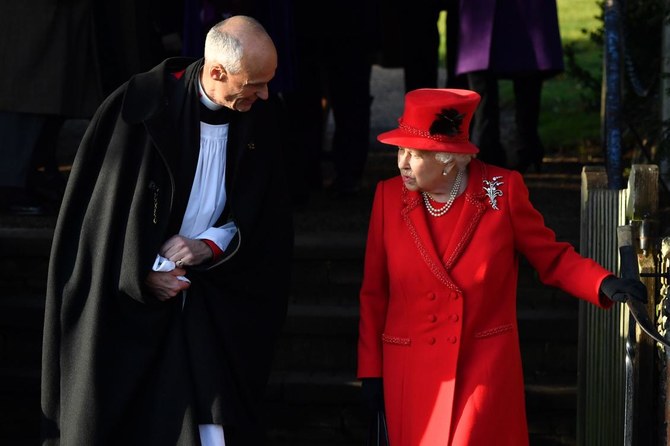
Britain's Queen Elizabeth II leaves after the Royal Family's traditional Christmas Day service at St Mary Magdalene Church in Sandringham, Norfolk, eastern England, on December 25, 2019. (AFP)
2 / 5
Britain's Princess Charlotte leaves the St Mary Magdalene's church after the Royal Family's Christmas Day service on the Sandringham estate in eastern England, Britain, December 25, 2019. (Reuters)
3 / 5
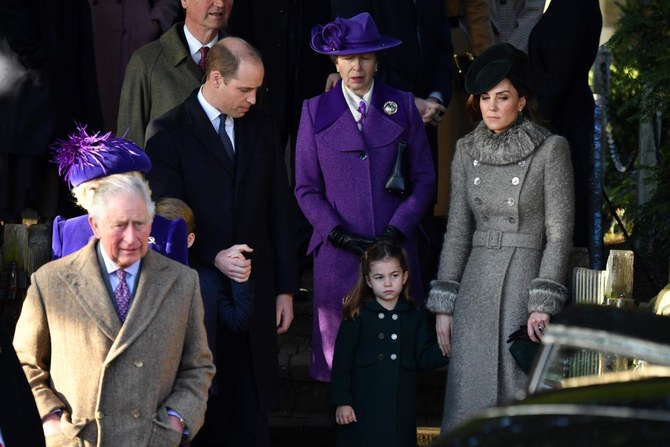
(L-R) Britain's Prince Charles, Prince of Wales, Britain's Prince William, Duke of Cambridge, Britain's Princess Anne, Princess Royal, Britain's Princess Charlotte of Cambridge and Britain's Catherine, Duchess of Cambridge, leave after the Royal Family's traditional Christmas Day service at St Mary Magdalene Church in Sandringham, Norfolk, eastern England, on December 25, 2019. (AFP)
4 / 5
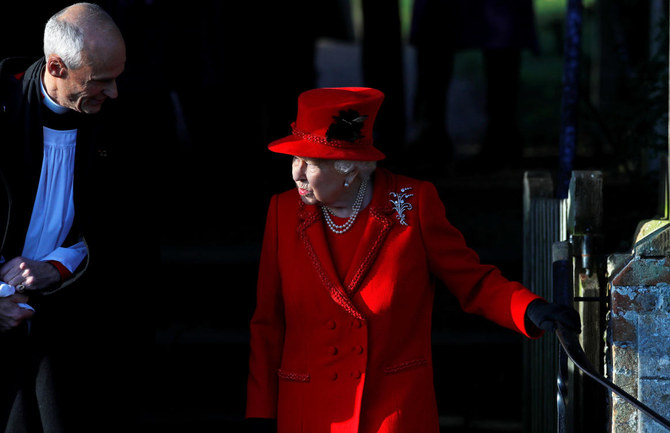
Britain’s Queen Elizabeth leaves the St Mary Magdalene's church after the Royal Family's Christmas Day service on the Sandringham estate in eastern England, Britain, December 25, 2019. (Reuters)
5 / 5
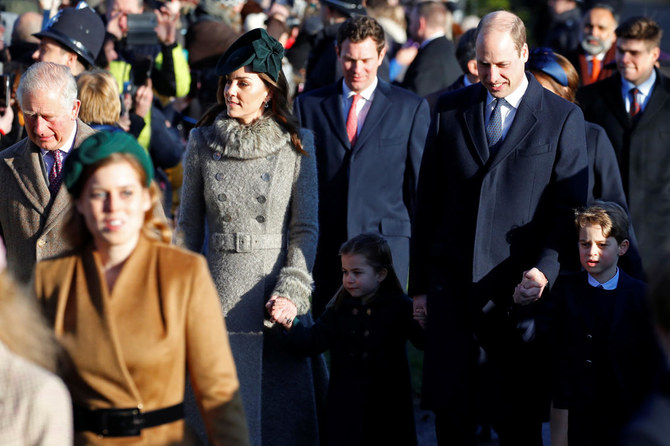
Britain’s Prince Charles, Princess Beatrice of York, Britain's Prince William, Catherine, Duchess of Cambridge, Prince George and Princess Charlotte arrive at St Mary Magdalene's church for the Royal Family's Christmas Day service on the Sandringham estate in eastern England, Britain, December 25, 2019. (Reuters)
Short Url
Updated 25 December 2019
Follow

Queen Elizabeth II, close family celebrate Christmas

  • Prince Harry, his wife, Meghan, and their 7-month-old son, Archie, are spending the holiday in Canada with Meghan’s mother
  • The royals were greeted by several hundred well-wishers who had gathered outside the church grounds

SANDRINGHAM: Queen Elizabeth II and her close family celebrated Christmas with a morning service at St. Mary Magdalene Church near her rural retreat at Sandringham in eastern England.
It was a festive event Wednesday as the queen was joined for the first time by Prince George, 6, and Princess Charlotte, 4, the two eldest children of Prince William and his wife, Kate. They left 1-year-old Prince Louis at home.
George and Charlotte walked to church hand in hand with their parents. Prince Charles, their grandfather, walked next to them.
The queen arrived in a Bentley with Charles’ wife, Camilla. Her elderly husband, Prince Philip, stayed at home. He was discharged from a hospital Tuesday after treatment for an undisclosed ailment. Philip, 98, has retired from public duties.
Prince Andrew, who has stepped down from royal duties because of his association with a convicted sex offender, attended an earlier church service with his brother Charles at his side.
Prince Harry, his wife, Meghan, and their 7-month-old son, Archie, did not attend. They are spending the holiday in Canada with Meghan’s mother, Doria Ragland.
The royals were greeted by several hundred well-wishers who had gathered outside the church grounds.
The queen’s traditional pre-recorded Christmas message will be broadcast throughout Britain and the Commonwealth nations Wednesday afternoon. Excerpts released ahead of time reveal that the queen plans to acknowledge it has been a challenging year.
Talking about the need for reconciliation and forgiveness, Elizabeth says: “The path, of course, is not always smooth, and may at times this year have felt quite bumpy, but small steps can make a world of difference.”
She is thought to be referring both to Britain’s laborious exit from the European Union, which is now almost certainly going to happen on Jan. 31 after voters gave the pro-Brexit Conservative Party a comfortable majority in Parliament, and to the royal family’s difficulties.
The problems this year included Andrew’s retreat from public duties following a disastrous TV interview in which he defended his friendship with sex offender Jeffrey Epstein and failed to show empathy for Epstein’s young female victims.
The family has also endured what many close observers think is a rift between William and Harry. Both Harry and Meghan have complained about constant scrutiny by the media as they settle into family life with Archie.


2025 among world’s three hottest years on record, WMO says

Updated 14 January 2026
Follow

2025 among world’s three hottest years on record, WMO says

  • All eight datasets confirmed that the last three years were the planet’s three hottest since records began, the WMO said
  • The slight differences in the datasets’ rankings reflect their different methodologies and types of measurements

BRUSSELS: Last year was among the planet’s three warmest on record, the World Meteorological Organization said on Wednesday, as EU scientists also confirmed average temperatures have now exceeded 1.5 degrees Celsius of global warming for the longest since records began.
The WMO, which consolidates eight climate datasets from around the world, said six of them — including the European Union’s European Center for Medium-Range Weather Forecasts (ECMWF) and the British national weather service — had ranked 2025 as the third warmest, while two placed it as the second warmest in the 176-year record.
All eight datasets confirmed that the last three years were the planet’s three hottest since records began, the WMO said. The warmest year on record was 2024.

THREE-YEAR PERIOD ABOVE 1.5 C AVERAGE ⁠WARMING LEVEL
The slight differences in the datasets’ rankings reflect their different methodologies and types of measurements — which include satellite data and readings from weather stations.
ECMWF said 2025 also rounded out the first three-year period in which the average global temperature was 1.5 C above the pre-industrial era — the limit beyond which scientists expect global warming will unleash severe impacts, some of them irreversible.
“1.5 C is not a cliff edge. However, we know that every fraction of a degree matters, particularly for worsening extreme weather events,” said Samantha Burgess, strategic ⁠lead for climate at ECMWF.
Burgess said she expected 2026 to be among the planet’s five warmest years.

CHOICE OF HOW TO MANAGE TEMPERATURE OVERSHOOT
Governments pledged under the 2015 Paris Agreement to try to avoid exceeding 1.5 C of global warming, measured as a decades-long average temperature compared with pre-industrial temperatures.
But their failure to reduce greenhouse gas emissions means that target could now be breached before 2030 — a decade earlier than had been predicted when the Paris accord was signed in 2015, ECMWF said. “We are bound to pass it,” said Carlo Buontempo, director of the EU’s Copernicus Climate Change Service. “The choice we now have is how to best manage the inevitable overshoot and its consequences on societies and natural systems.”
Currently, the world’s long-term warming level is about 1.4 C above the pre-industrial era, ECMWF said. Measured on a short-term ⁠basis, average annual temperatures breached 1.5 C for the first time in 2024.

EXTREME WEATHER
Exceeding the long-term 1.5 C limit would lead to more extreme and widespread impacts, including hotter and longer heatwaves, and more powerful storms and floods. Already in 2025, wildfires in Europe produced the highest total emissions on record, while scientific studies confirmed specific weather events were made worse by climate change, including Hurricane Melissa in the Caribbean and monsoon rains in Pakistan which killed more than 1,000 people in floods.
Despite these worsening impacts, climate science is facing political pushback. US President Donald Trump, who has called climate change “the greatest con job,” last week withdrew from dozens of UN entities including the scientific Intergovernmental Panel on Climate Change.
The long-established consensus among the world’s scientists is that climate change is real, mostly caused by humans, and getting worse. Its main cause is greenhouse gas emissions from burning fossil fuels like coal, oil and gas, which trap heat in the atmosphere.