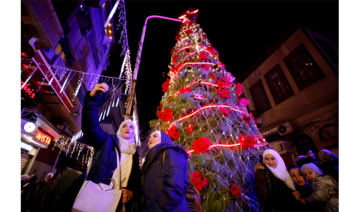
BEIRUT: Rafi Tabakian’s clothing store in a Beirut suburb is usually buzzing with customers during the holiday season, but with Lebanon’s economy in ruins, shoppers are in short supply.
“We’ve been in business for 30 years, and I’ve never seen anything like this,” he said, adding that sales have dropped 80 percent in December even though he has cut his prices.
“Now we see customers entering, asking for the price, and then leaving. It’s scary,” Tabakian, who produces and sells clothes in the densely populated, commercial Burj Hammoud neighborhood of the capital, said.
Lebanon is suffering its worst economic crisis, rooted in decades of state corruption and waste, since the 1975-1990 civil war, leaving streets dimmer and shopping centers emptier, with many stores and restaurants void of customers.
The economic woes have sparked huge protests against the ruling elite, banks are imposing capital controls, pressure has piled on the pegged Lebanese pound, and a hard currency crunch has pushed importers to hike prices.
Hotel bookings, flights and events have plunged during what is usually a busy commercial season for Lebanon, which has the Arab world’s biggest proportion of Christians.
Many from Lebanon’s large diaspora normally return home to streets packed with cars and decked out with lights.
But Pierre Ashkar, the head of Lebanon’s hotel association, said December bookings have plummeted from a usual 65-75 percent occupancy to 7-15 percent this year.
“Hotels have closed some parts of their buildings, are giving employees unpaid leave and removing services such as free shuttle transportation to the airport to minimize losses.”
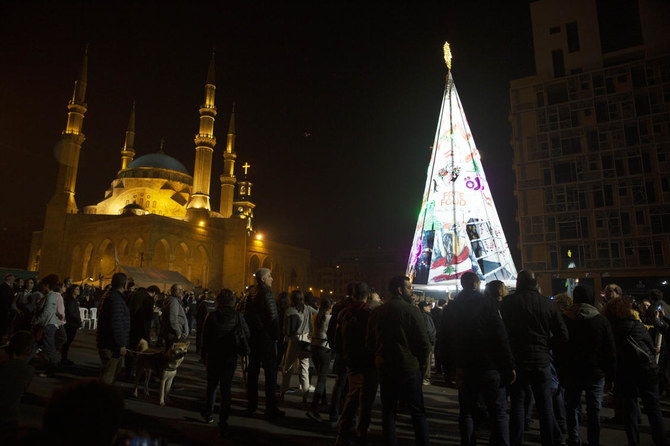
Some local councils have opted to either re-use old decorations or do without.
“We put up last year’s decorations, without adding anything because these are exceptional circumstances,” said Raymond Atieh, head of the Jdeideh municipality, north of Beirut.
“The holidays are coming, but they’re coming with a pinch. People are angry ... People are getting fired, paid half-salaries, or not working,” Atieh added.
Charbel Daccache, a priest in Mount Lebanon’s largely Christian town of Adma, said it was better to help feed the poor in tough times “than to decorate and throw glitter.”
“Some days are harsh; others are better but it’s not the end. That’s why I tell people, let it be a joyous time.”

Christmas in Lebanon not so merry as economic crisis bites
https://arab.news/m5ujx
Christmas in Lebanon not so merry as economic crisis bites
- Lebanon is suffering its worst economic crisis, rooted in decades of state corruption and waste
- The economic woes have sparked huge protests against the ruling elite
Abu Ali Al-Hadrami: the shadowy figure who controlled Hadramaut, then vanished
- Uncovering the details behind his mysterious profile, and how he built a security force beyond state control
HADRAMAUT, Yemen: Throughout Hadramaut in Yemen, the mere mention of Abu Ali Al-Hadrami conjures images of secrecy and fear.
Some dubbed him “Hadramaut’s Qassem Soleimani,” though he preferred the alias Abu Mohammed. His true identity — Saleh bin Al-Sheikh Abu Bakr — remained hidden until roughly a year ago, a testament to a man who deliberately operated from the shadows.
Abu Ali Al-Hadrami emerged on Hadramaut’s landscape without warning, carrying no visible credentials or traceable past, cloaked in an impenetrable aura of mystery. His exit proved equally abrupt: he boarded an Emirati plane at Mukalla’s Al-Rayyan Airport without saying goodbye to anyone.
Once, he described himself — according to multiple witnesses — as “a world-class intelligence operative.” This self-characterization matched the impression he cultivated among those in his orbit.
BACKGROUND
Al-Hadrami practiced extreme operational security in every aspect. He avoided conventional phones and refused proximity to anyone during communications. When using Emirati communication lines, he insisted on complete privacy.
One former associate of Al-Hadrami who agreed to share unprecedented details about a figure whose name alone inspired widespread apprehension across the region emphasized that this man was accustomed to working in the shadows, specializing in leaving minimal footprints.
The source, speaking on condition of anonymity, characterized Al-Hadrami as “extraordinarily secretive, calculating, and ruthless — you could barely extract any personal information from him.”
He added: “His full name only surfaced about a year ago. We knew him solely as Abu Mohammed until individuals from Dhale arrived who recognized him from earlier encounters, and his interactions with them displayed unusual warmth.”
According to the source, Al-Hadrami practiced extreme operational security in every aspect. He avoided conventional phones and refused proximity to anyone during communications. When using Emirati communication lines, he insisted on complete privacy. “His secrecy extended even to family,” the source noted. “He once told us: ‘Even my relatives remain unaware of my whereabouts.’”
Al-Hadrami first surfaced in Hadramaut around 2022, when the Security Support Brigade was formed — a military unit operating under Emirati forces based at Al-Rayyan with a stated counterterrorism mandate.
According to the source, the brigade consisted of approximately 1,200 personnel, with Hadramaut locals representing about 90 percent of the force, though the elite strike units came from Dhale and surrounding provinces.
Al-Hadrami immediately implemented an iron-fisted management approach marked by severe discipline and unconventional regulations. Most notably, he completely prohibited khat chewing.
The source confirmed: “Anyone discovered with khat, even a single leaf, faced immediate dismissal and detention pending execution of the termination.” This policy drove away many who found the restrictions intolerable.
When asked about the “Hadramout’s Qassem Soleimani” moniker, the source replied: “Yes, we heard that label, along with ‘Abu Ali the ruler.’ His background remained unknown to us, and we were not even certain he was Hadrami. Many assumed he was Emirati, particularly given their use of cover names, and nothing about his demeanor or dialect suggested Hadramaut origins.”
Though publicly tasked with counterterrorism, the Security Support Brigade’s reputation within Hadramaut soon nosedived, as confirmed by the official with close ties to Al-Hadrami.
“Public perception of the Security Support forces turned predominantly negative,” the source explained, noting that several locals working with Emirati forces “seriously contemplated resignation due to the organization’s tarnished reputation.”
He added: “We eventually requested that the Emiratis moderate his tactics and adopt a gentler approach, but these appeals went ignored.” This indifference reflected the extensive latitude granted to him for managing security operations by his own methods, disregarding social or community concerns.
The source discloses that the Emiratis specifically sought Security Support Brigade recruits aged 18 to 24, “because molding young minds at that stage proves simpler.”
Among the stringent requirements was rejecting applicants with family members in “Shield of the Nation” forces. Al-Hadrami personally interviewed every candidate, never delegating this responsibility regardless of circumstances. “Even when Emiratis nominated someone for enrollment, he personally vetted them — either accepting or finding grounds for exclusion. He placed absolute trust in no one.”
The vetting process gained additional layers through a specialized Emirati officer dedicated to personality assessment who remained silent throughout, simply observing facial expressions and behavioral patterns.
According to the source, “acceptance rates barely reach 7 percent of total candidates,” noting that roughly 6,000 people underwent screening, with only about 300 ultimately selected.
According to the source, the Emirati forces in Hadramaut created a parallel structure comprising local intellectuals operating under the “External Projects” designation, reportedly numbering 19 academics who served as a civilian facade for developmental and service programs ostensibly planned for the region.
However, the source confirms these civilian initiatives never materialized, suggesting this entity existed primarily as camouflage for security operations rather than genuine development work. “In my assessment, this group was assembled to buy time, create appearances and exploit their credentials to demonstrate representation from diverse Hadramaut communities, without delivering tangible outcomes.”
This evaluation corresponds with earlier public statements by Sheikh Amr bin Habrish, first deputy governor of Hadramaut and commander of Hadramaut Protection Forces, who expressed to Asharq Al-Awsat his confusion over Al-Hadrami’s name appearing “from nowhere” without legitimate official standing, discussing development and stability while controlling the security landscape through command of unofficial forces.
He went further, suggesting these activities indicated “an agenda more extensive than visible,” confirming they “undermine southern interests and the broader southern cause.”
According to the source, Al-Hadrami maintained direct communication with Emirati committees while cultivating connections within Southern Transitional Council circles, including individuals close to council leadership such as Munif Al-Zubaidi, secretary to Aidarous Al-Zubaidi.
During one instance, the source recalled, Al-Hadrami revealed a statement encapsulating the persona he cultivated: “I am a world-class intelligence operative.” Those present interpreted this not as an inadvertent disclosure but as calculated confirmation of an identity he intended to establish — a veiled warning that what remained unsaid about him posed greater danger than what was known.
The source referenced substantial quantities of new motorcycles with unusual specifications warehoused inside Al-Rayyan Airport, formerly an Emirati military base, observing they were “entirely unlike motorcycles commonly seen on Mukalla streets.” He refrained from speculating about their purpose, offering only: “Maybe they were brought for service-related uses.” Local sources, however, view these motorcycles as preparation for a wave of assassinations to come in the governorate.”
The withdrawal unfolded not in one night but across several nights in Al-Mukalla, with Emirati forces and Southern Transitional Council units retreating as legitimate Yemeni government forces, backed by Saudi air support, advanced toward Seiyun and subsequently Al-Mukalla.
“The night Saudi Royal Air Force launched strikes against Emirati vehicles at Al-Mukalla port, Abu Ali Al-Hadrami vanished and failed to appear at his Al-Rayyan Airport office the following morning, though he returned that evening. He ate dinner, then left.”
The source continued: “We encountered him again entering the airport before boarding an Emirati aircraft. He offered no farewells or conversation with us — we were conducting equipment inventory. He exited the vehicle and proceeded to the terminal with a group, clearly departing, carrying a backpack and dressed in civilian attire.
“Subsequently, we observed Emiratis removing photographs from offices. They similarly withheld notification of their departure plans, and the night following Abu Ali Al-Hadrami’s exit, Abu Taher Al-Shuaibi, Southern Ground Forces commander, arrived and stated plainly: ‘I am in charge now.’”
The source described confusion over how Al-Shuaibi’s forces handled airport personnel at Al-Rayyan before Emirati forces withdrew, portraying the situation as severely disorganized and chaotic.
“If you questioned one of them, he would immediately discharge his weapon overhead as intimidation, and they branded anyone not following their directives a traitor,” he explained.
“Everyone moved about armed, some displaying signs of intoxication. We witnessed them loading weapons while facing each other, and during this period, vehicle thefts occurred within Al-Rayyan.”
According to his testimony, these hours reflected a total security breakdown where coherent command disappeared and armed force became an immediate danger to everyone present — the “most perilous” situation since events commenced.
According to the source, as the final Emirati aircraft departed Al-Rayyan, Al-Shuaibi’s forces began sealing gates and allocating vehicles, a process that rapidly devolved into heated conflicts over distribution procedures with the Command and Control Center operated by Faisal Badabis.
“Abu Taher and his contingent commandeered numerous vehicles. Approximately 200 vehicles were designated for their distribution, 20 for personnel inside the airport, and 47 for Faisal Badabis, head of the Command and Control Center.
“The confrontation erupted between them regarding this allocation, culminating in complete closure of all gates and access points.”