

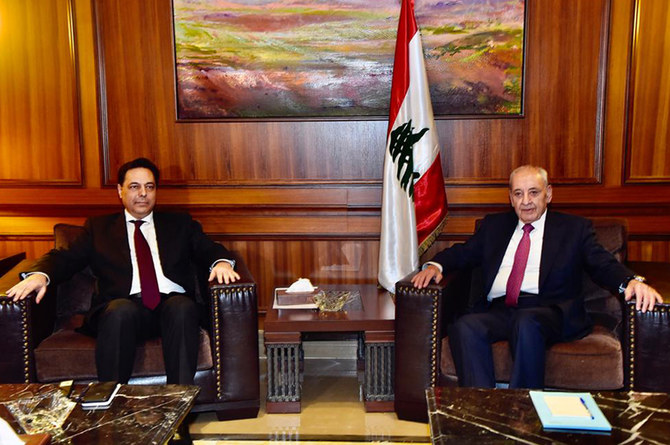
Diab expresses commitment to forming Lebanese government

Newly-assigned Lebanese Prime Minister Hassan Diab, right, meets with Parliament Speaker Nabih Berri in Beirut, Lebanon, on Dec. 21, 2019 as he began consultations on forming a government of experts and independents to deal with the country's crippling economic crisis. (Dalati Nohra via AP)
Short Url
Updated 22 December 2019
Follow

Diab expresses commitment to forming Lebanese government

  • However, four political parties reject direct and indirect participation

BEIRUT: The challenges he must overcome became clear however from the onset of Saturday’s talks with various officials and lawmakers.

Parliament speaker Nabih Berri said he “insists on securing representation for all parliamentary groups,” in the next government — a position shared by his Shiite Amal party and Hezbollah.

Samir Al-Jisr, a deputy from Hariri’s Future Movement, urged Diab to form a government “of independent experts not affiliated with established political parties,” to rescue Lebanon from the brink of collapse.

“Considering that this government, just like Diab’s nomination, will be supported by only one political stripe, then its formation should take less than” a month or six weeks, he said after meeting the premier-designate.
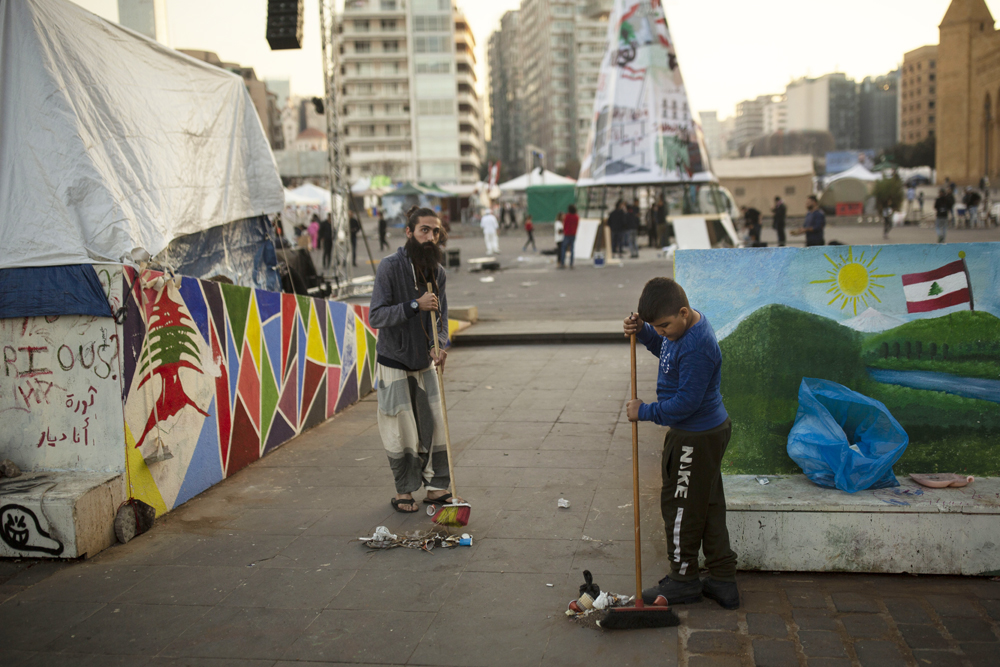


Volunteers sweep trash in the central square where anti-government protesters have set up camp in downtown Beirut, Lebanon, on Dec. 21, 2019, as Lebanon's newly designated prime minister began his consultations with parliamentary blocs to discuss the shape of the future government. (AP Photo/Maya Alleruzzo)

He was referring to allies Hezbollah, Amal and the Free Patriotic Movement founded by Christian President Michel Aoun who chose Diab to form a cabinet.

Such backing has sparked an uproar, with Sunni supporters of Hariri blocking roads and scuffling with security forces in Beirut and other cities for the past two consecutive nights to voice their opposition for Diab.

Some roads remained blocked on Saturday in Sunni-majority second city Tripoli and in the northern Akkar region.

HIGHLIGHTS

According to the Lebanese constitution, the government is formed through consultations between the president, the prime minister-designate and Parliament.

The new government later presents its political program to the president for approval, before being presented for a parliamentary vote of confidence.

Hezbollah sought to appease the anger of the protesters on Saturday, insisting that the next government will not be lopsided.

“No one should think the government will be one of confrontation or one endorsed by only one political stripe,” said Hezbollah MP Mohammad Raad after meeting Diab.

The new government, he said, will seek to “revitalize” the economy that has taken a beating since the unprecedented protests began on October 17.

Since then, tensions have been heightened by the looming bankruptcy of the debt-burdened Lebanese state.
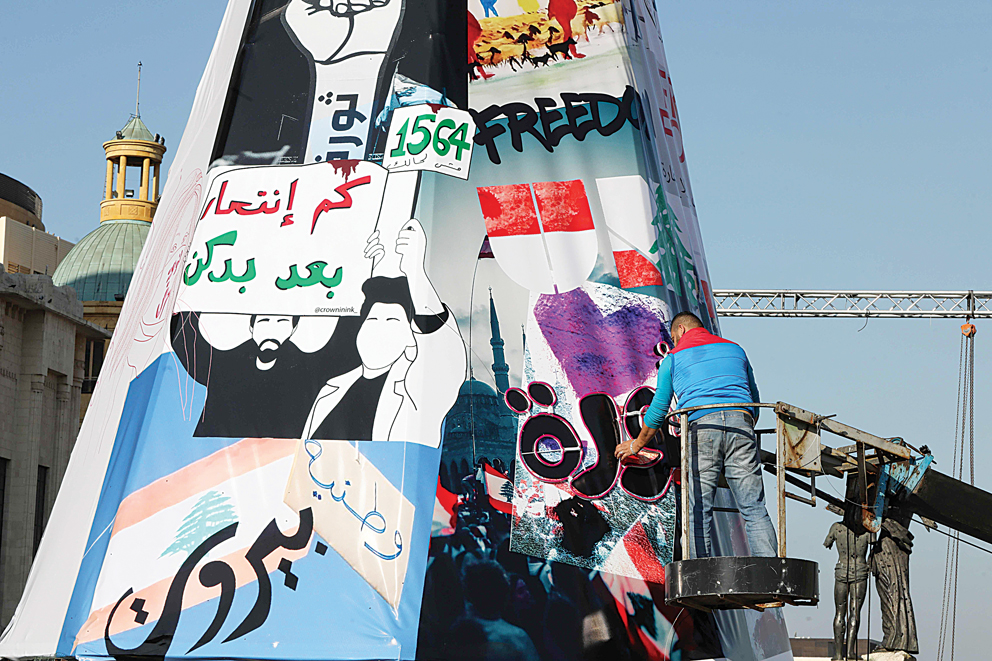


Lebanese anti-government protesters erect a Christmas tree made of protest banners in Beirut’s Martyr Square on Saturday. (AFP)


A dollar-liquidity crisis has pushed banks to impose informal capital controls on dollar deposits and the Lebanese pound, officially pegged to the US dollar, has lost around 30 percent of its value on the black market.

The faltering economy has pushed several companies to close, while surviving businesses try to stay open by paying half-salaries and laying off employees.

A recession of more than 0.2 percent is expected for this year, the World Bank says.

The international community, donors, and financial organizations have warned that debt-saddled Lebanon could ill afford any delay in getting a new government.

The United States, France and other allies of Lebanon have warned they would withhold financial support until a government that can demonstrate willingness to reform can be formed.

Multi-confessional Lebanon is ruled by a complex political system that seeks to maintain a fragile equilibrium between political parties representing the country’s major confessional sects.

It usually takes months to form a government as political groups haggle over the allocation of cabinet seats and the distribution of ministerial portfolios.


As Iran conflict spills over, Iraq’s Kurds say ‘this war is not mine’

Updated 58 min 7 sec ago
Follow

As Iran conflict spills over, Iraq’s Kurds say ‘this war is not mine’

  • The Kurds, an ethnic minority with a distinct culture and language, are rooted in the mountainous region spread across Turkiye, Syria, Iraq and Iran
  • “This isn’t my war,” said 58-year-old Satar Barsirini

SORAN, Iraq: On a deserted road not too far from the border between Iran and Iraqi Kurdistan, Satar Barsirini looked up at the sky, now streaked with jets and drones.
Iraq’s Kurdish region has found itself caught in the crossfire of a regional war triggered by US and Israeli attacks on the Islamic republic.
Dressed like the Kurdish fighters he once served alongside, Barsirini still wears the khaki shalwar, fitted jacket and scarf wrapped around his waist.
Though recently retired, he refuses to give up his peshmerga uniform as he tills his small plot of land.
The rumble of jets and hum of drones “come from everywhere. Especially at night,” he told AFP in the hamlet of Barsirini, dozens of kilometers from the border.
He described the “shiver in our flesh” as the drones hit the ground outside.
“I feel bad for the people, because we have paid a lot in blood to liberate Kurdistan... We just want to live.”
Irbil, the autonomous region’s capital, and the valleys leading to the border have been targeted by Tehran and the Iraqi armed groups it supports.
American bases there have come under fire, as have positions held by Iranian Kurdish parties — the same ones US President Donald Trump said it would be “wonderful” to see storm Iran.
But Iran warned on Friday it would target facilities in Iraqi Kurdistan if fighters crossed into its territory.
“This isn’t my war,” said 58-year-old Barsirini.
He recalled the brutal repression and flight into the snowy mountains after the 1991 Kurdish uprising that followed the first Gulf War.

- ‘Dangerous people’ -

The uprising was repressed, leading to an exodus of two million Kurds to Iran and Turkiye.
“When we fled the cities for our lives, we went to Iran. They helped us, they gave us shelter and food,” he said.
The Kurds would not forget that, Barsirini stressed, adding that they could not just “turn against them” now to support the US and Israel.
“I don’t trust (Americans). They are dangerous people,” he said.
The Kurds, an ethnic minority with a distinct culture and language, are rooted in the mountainous region spread across Turkiye, Syria, Iraq and Iran.
They have long fought for their own homeland, but for decades suffered defeats on the battlefield and massacres in their hometowns.
They make up one of Iran’s most important non-Persian ethnic minority groups.
A week of war has gripped daily life in Iraqi Kurdistan, residents told AFP.
“People are afraid,” said Nasr Al-Din, a 42-year-old policeman who, as a child, lived through the 1991 exodus — “thrown on a donkey’s back with my sister.”
“This generation is different from the older ones” that have seen “seen fighting.”
Now, he said, you could be “sitting down in your home... and all of a sudden a drone hits your house.”
“We may have to go into town or somewhere safer,” said Issa Diayri, 31, a truck driver waiting in a roadside garage, his lorry idle for lack of deliveries from Iran.

- ‘Shouldn’t get involved’ -

Soran, a small town of 3,000 people about 65 kilometers (40 miles) from the border, was hit Thursday by a drone that fell in the middle of a street.
There, baker Yussef Ramazan, 42, and his three apprentices, hurriedly made bread before breaking their fast.
But, living so close to the Iranian border, he said “people are afraid to come and buy it.”
He told AFP he did not think it was a good idea “for the Kurdish region to get involved in this war.”
“We are not even an independent country yet. We would like to become one, but we are nothing for now, so we shouldn’t get involved in these situations.”
Across the street, Hajji watched from his empty dry cleaning shop as the road cleared.
Before the war, the town was crowded as evening fell, he said, declining to give his full name.
“But after the drone explosion, no one was here. In five minutes, everyone left the street and no one was out.”