BARGO, Australia: A scorching heatwave intensified bushfires ravaging parts of Australia on Saturday, and out-of-control blazes surrounding Sydney worsened under “catastrophic” conditions.
Australia’s eastern coast has been hit by a record-breaking heatwave, which has moved in from the west of the country, fanning hundreds of fires in its path.
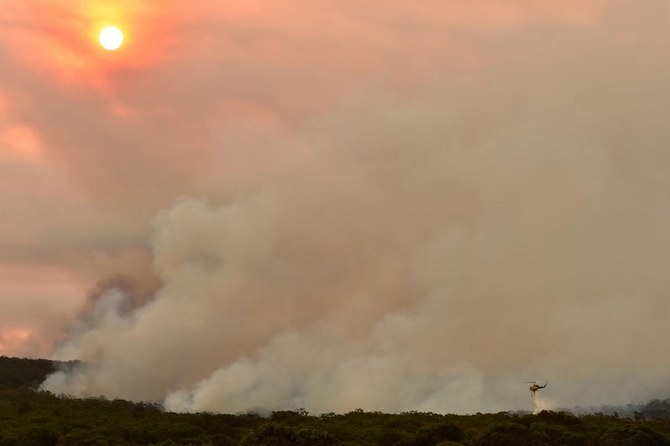
Sydney was shrouded in toxic smoke as blazes flared to its north, south and west, some just 130 kilometers (80 miles) from Australia’s largest city.
“Today has been an awful day,” New South Wales state fire commissioner Shane Fitzsimmons said Saturday afternoon.
Temperatures were expected to peak at 47 degrees Celsius (116 Fahrenheit) in parts of the state — the country’s most populous — including in parts of west Sydney.
Australia endures bushfires every year but the early and intense start to this season, along with the record temperatures, has fueled concerns about global warming.
The fires have torched at least three million hectares (7.4 million acres) of land across the country — an area equivalent to the size of Belgium — with at least 10 people killed and more than 800 homes destroyed.
A “mega fire” burning over 460,000 hectares north of Sydney escalated Saturday, as did a fire burning on multiple fronts in the Blue Mountains, where authorities said an unknown number of properties were burning.
Some 3,000 firefighters across the state were bracing for a wind change in the afternoon, expected to bring “dangerous and difficult, volatile conditions,” Fitzsimmons added.
“We will not get on top of these fires until we get some decent rain,” Fitzsimmons said of the outlook.
“We are seeing a relentless pattern of hot, dry air dominating the weather features at the moment,” he added.
Evacuations were being carried out in the town of Bargo, on the front of a 185,000-hectare blaze which tore through the nearby area on Thursday.
“It’s horrific, it’s devastating driving around. We feel pretty isolated where we are with the roadblocks. Loved ones can’t come and see us,” Bargo resident Corey Cartes said.
Cartes was told to leave two days ago, but has stayed behind to defend his property.
“Everyone is offering to help, but there is nothing they can do. Not for us now, just stay out and stay safe and we hope the fireies (firefighters) can do their job.”
In the state of South Australia, which in the past few days has borne the brunt of the heat wave, more than 1,500 firefighters have been battling fires that ripped through more than 40,000 hectares.
Two people died in fires there over the past two days, and dozens of firefighters and residents have been treated for injuries and smoke inhalation.
Emergency crews were also on alert in the southern state of Victoria, where fires were burning following days of scorching temperatures.
Leading doctors have warned of a “public health emergency” given the unprecedented toxic smoke pollution choking Sydney.
“It is pretty much the whole New South Wales population being exposed to prolonged smoke and because we have never experienced this before, we don’t know what the eventual outcome will be,” Kim Loo said.
“It probably won’t be obvious for months, or even years,” added Loo, also a member of advocacy group Doctors for the Environment.
Hospitals have been recording sharp increases in emergency room visits for heat exhaustion and respiratory problems.
Loo said elderly patients, as well as children and outdoor workers were the most at risk, warning the health sector is “not prepared” to deal with such cases.
Vulnerable people in New South Wales have been urged to stay indoors amid worries the scorching heat combined with the toxic smoke could cause “severe illness, hospital admissions and even death.”
Sydney resident Len Renekov said Saturday he was most worried about “getting all the smoke particles into my lungs and into my heart.”
The 67-year-old was wearing a mask, still a rare sight, while nearby a dozen Sydneysiders sweated through their regular Saturday morning workout under the harbor bridge, without face coverings.
“A week ago, it was worse, I couldn’t see the Opera House,” he said.


‘Catastrophic’ conditions as bushfires rage in Australia
https://arab.news/megam
‘Catastrophic’ conditions as bushfires rage in Australia

- Sydney was shrouded in toxic smoke as blazes flared to its north, south and west
- The fires have torched at least three million hectares of land across the country — an area equivalent to the size of Belgium


‘Somali fraud’ in Minnesota has ‘pillaged an estimated $19bn from the American taxpayer’: Trump
- ‘This is the kind of corruption that shreds the fabric of a nation,’ he says during State of the Union address
- Vice President J.D. Vance will head ‘war on fraud’ that will expand nationwide
CHICAGO: “Somali fraud” in Minnesota has stolen at least $19 billion in state and federal funds, US President Donald Trump said during his State of the Union address on Tuesday night.
He announced that Vice President J.D. Vance will head the “war on fraud,” beginning with Minnesota.
Trump was expanding on an announcement he made several months ago creating a National Fraud Enforcement division in the Justice Department.
The new division will target allegations of “massive and complex fraud” involving misused federal funds in state programs in Minnesota and elsewhere, he said.
“But when it comes to the corruption that’s plundering America … there’s been no more stunning example than in Minnesota, where members of the Somali community have pillaged an estimated $19 billion from the American taxpayer,” he added.
“We have all the information, and in actuality the number is much higher than that, and California, Massachusetts, Maine and many other states are even worse.”
Trump said: “This is the kind of corruption that shreds the fabric of a nation, and we’re working on it like you wouldn’t believe.”
Regarding the “war on fraud,” he said Vance will “get it done,” adding: “Find enough of that fraud (and) we’ll actually have a balanced budget overnight. (The budget deficit) will go very quickly. That’s the kind of money you’re talking about.”
He said: “The Somali pirates who ransacked Minnesota remind us that there are large parts of the world where corruption and lawlessness are the norm, not the exception.
“Importing these cultures through unrestricted immigration and open borders brings those problems right here to the USA, and it’s the American people who pay the price in higher medical bills, car insurance, rent, taxes, and perhaps most importantly, crime.”
Trump vowed: “We’ll take care of this problem … We aren’t playing games.”
Under his announcement, the new division will report directly to the White House through Vance, rather than through traditional Justice Department channels.
While starting in Minnesota, Trump emphasized that the anti-fraud initiative will expand nationwide, including California, Washington State and Ohio.
More than 260,000 Somalis living in the US, nearly 100,000 of them in Minnesota. About 50,000 live in the 5th Congressional District, represented by Somali-American Congresswoman Ilhan Omar.
In 2024, then-President Joe Biden ordered investigations into allegations of Somali fraud, mainly involving the misuse of COVID-19 funding intended to help businesses harmed by the pandemic. Trump expanded the investigations immediately after taking office in January 2025.
Somalis in Minnesota have been implicated in the theft of billions of dollars in state and federal funds intended to support childcare, food programs for families and seniors, and healthcare and mental health programs. Losses are estimated to range between $1 billion and $9 billion.
Of 98 people charged in connection with fraud involving one program, food for the poor in Minnesota, 85 were identified as Somali Americans.
Allegations of fraud also include state and federal money used for personal reasons, such as the purchase of vehicles, vacations, clothes and personal expenses, rather than to provide childcare or food services for seniors.
Other accusations focus on fraud by some Somali-run childcare centers that had no children, or far fewer children than what was claimed in government funding applications.


