

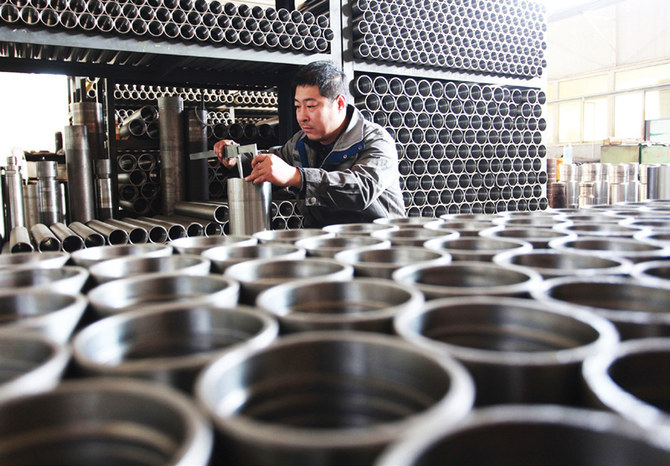
China announces new tariff exemptions for US chemical, oil products

The trade war between China and the US has slowed global growth. (AFP)
Short Url
Updated 20 December 2019
Follow

China announces new tariff exemptions for US chemical, oil products

  • Beijing and Washington reach agreement to cancel barriers set to take effect from mid December

SINGAPORE: China unveiled a new list of import tariff exemptions for six chemical and oil products from the US on Thursday, days after the world’s two largest economies announced a Phase 1 trade deal.

The exemptions will be for one year from Dec. 26, the Finance Ministry said, without providing a value for the imports excluded from duties.

Duties already imposed on US products would not be refunded, the ministry added.

The tariff waivers will apply to four chemical products, such as metallocene high-density polyethylene (HDPE) and a special grade of linear low-density polyethylene (LLDPE), and refined oil products that include white oil and food-grade petroleum wax.

Kelly Cui, principal analyst with consultancy Wood Mackenzie, said the exemptions on the chemical products would benefit companies such as Dow Chemical Co, Exxon Mobil Corp. and Chevron Phillips Chemical Co, which have since 2017 been adding shale-based ethylene production facilities and targeting China as the prime export market.

Cui also pointed out that the listed products, metallocene HDPE and LLDPE, were high-end special grade plastic raw materials used for packaging and pipes. China is the world’s largest importer of polyethylene.

“The exemptions could see China resume buying more HDPE and LLDPE from the US, reversing the trade flow, as the US supplies have been diverted to Latin America and Europe while China has been importing mostly from the Middle East,” said Cui.

In 2018, China imported some 6.86 million tons of HDPE and 4.46 million tons of LLDPE, according to Cui, who cited Chinese customs data. The data does not provide a breakdown for different grades of each polymer.

These imports had a combined total value of about $14 billion, according to Reuters calculations based on the delivered cost for these two products.

For petroleum wax, China imported from the US 1,108 tons, worth only $3.2 million in the first 10 months of 2019, one-tenth of China’s total imports of the product, according to Chinese customs data and consultancy JLC Network Technology.

White oil imports from the US were 3,490 tons or worth only $8.7 million during the same period, roughly 6 percent of China’s total imports.

China waived import tariffs for some soybeans and pork shipments from the US on Dec. 6, before the two sides reached a Phase 1 trade deal to cancel tariffs planned to take effect on Dec. 15.

China said it will continue to work on the product exemptions and release the second batch of waivers at an appropriate time.

The Sino-US trade war has been a major headache for global policymakers as it slowed economic growth worldwide and chilled business investment and confidence.

US Trade Representative Robert Lighthizer last week acknowledged there remained hard work ahead in the next phase of negotiations.

He gave no specific timetable, but said US President Donald Trump did not want to wait until after the 2020 presidential election to wrap up a more comprehensive agreement.


Up to $600m in additional tariffs on Saudi exports to the US

Updated 12 sec ago
Follow

Up to $600m in additional tariffs on Saudi exports to the US

RIYADH: Gulf exports have become targets of US President Donald Trump’s tariffs, which he raised from 10 percent to 15 percent on all countries.

The increase comes after the US Supreme Court ruled that the legal basis Trump had used to impose earlier tariffs was unlawful.

Previously, Gulf countries were among the few that had not raised their tariffs above 10 percent, while many other countries, most notably China, had already been subject to higher tariffs. However, with this latest increase, the Gulf states will be among those affected.

According to the financial analysis unit of Al-Eqtisadiah newspaper, Gulf exports to the US in 2024 amounted to about $26.2 billion, with Saudi Arabia accounting for roughly half of that, at $12.7 billion. These exports are subject to potential additional tariffs of SR637 million ($169 million).

It is likely that tariffs on Saudi exports will grow from $1.3 billion annually to $1.9 billion, a rise of 50 percent, following Trump’s recent increase.

Customs duties on Gulf exports will also increase, from $2.6 billion annually to $3.9 billion.

In 2024, Gulf exports are distributed as follows: $7.5 billion from the UAE, $1.8 billion from Qatar, and $1.6 billion from Kuwait, as well as $1.3 billion from Oman, and finally, $1.2 billion from Bahrain.

Gulf trade with the US in 2024 reached approximately $86 billion, comprised of $26.2 billion in exports and approximately $60 billion in imports, resulting in a Gulf trade deficit of $33.5 billion.

Trump responds to Supreme Court ruling

US President Donald Trump raised the global tariffs from 10 percent to 15 percent in response to the US Supreme Court ruling that his previous tariff implementation mechanism was unlawful.

Trump said in a post on his Truth Social account today: “As President of the US, I will, effective immediately, raise the global tariffs imposed on countries that have been taking advantage of the US for decades with impunity (until I took over!) to the legally permitted and tested level of 15 percent.”

Hours after the Supreme Court ruling on Feb. 20, Trump imposed a 10 percent global tariff on foreign goods, a move aimed at maintaining his trade agenda.

Trump had expressed his displeasure with the Supreme Court’s decision to overturn the tariffs imposed by his administration, asserting that the ruling would not restrict him. He vowed to impose tariffs far exceeding those struck down by the court, indicating that he had stronger alternatives to tariffs, raising questions about his future trade strategy.

The US Supreme Court struck down Trump’s sweeping global tariffs, undermining his signature economic policy and inflicting his biggest legal defeat since returning to the White House.

By a six-three vote, the court ruled that Trump exceeded his authority by invoking the federal emergency powers law to impose his reciprocal tariffs worldwide, in addition to targeted import duties that the administration claims are intended to combat fentanyl smuggling.