

Pakistan’s tallest mural has a beautiful climate message

This mural painted by Italian artist Giuseppe Percivati at the Karachi Port Trust will be registered with the Guinness World Records as the tallest public mural in the world, Ambareen Thompson of “I AM KARACHI” told Arab News on December 19, 2019. (AN Photo)
Short Url
Updated 19 December 2019
Follow

Pakistan’s tallest mural has a beautiful climate message

  • Painted by an Italian artist, it depicts the relationship between humans and nature
  • The mural that will be completed on Saturday is said to be the world’s tallest

KARACHI: A 285 feet tall mural by an Italian painter, Pepe Gaka, in this seaside metropolis may soon be declared the world’s tallest – and it highlights the urgency of protecting mangroves along Karachi’s coastline.

The wall painting, which will be completed on Saturday, “celebrates Karachi’s coastline and highlights the importance of mangroves, both of which are unfortunately endangered by environmental degradation,” Ambareen Thompson, Executive Director of “I AM KARACHI,” a non-government organization which has taken the initiative in collaboration with the International Public Art Festival, told Arab News on Thursday.
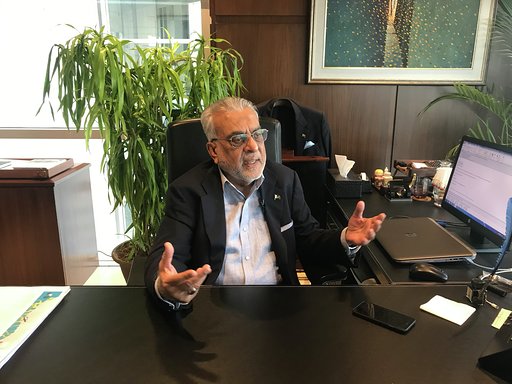


Jameel Yusuf, Chairman of International Public Art Festival, is talking to Arab News on December 19, 2019. (AN Photo)

“Karachi’s coast is rich in resources, but there is a lot of pollution with untreated water flushing into it,” she said. “We want to use this mural to remind our policymakers that this is an invaluable asset that needs to be protected.”

The artist, Giuseppe Percivati, popularly known as Pepe Gaka, has been producing artworks that depict the relationship between humans and nature. He creates pieces that are in harmony with their surroundings, Thompson added.
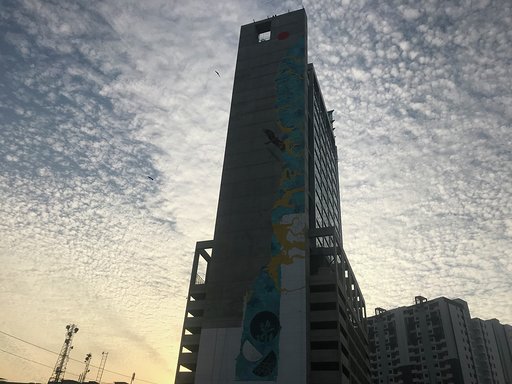


This mural painted by Italian artist Giuseppe Percivati at the Karachi Port Trust will be registered with the Guinness World Records as the tallest public mural in the world, Ambareen Thompson of “I AM KARACHI” told Arab News on December 19, 2019. (AN Photo)

The life of public murals was about 20 to 25 years, the artist revealed, adding that high-quality paint was used to create such pieces.

“In this mural, we have depicted Karachi’s coastline that goes up to India. The message we have here is about protecting the environment,” Gaka told Arab News, adding he had visited Karachi five times before and liked it a lot.

Tracing the beautiful Karachi coastline, the bird shown in the mural is found in the city's mangroves.

According to Thompson, the world’s second-tallest mural is 250 feet high and was painted by Sean Martindale in St. James Town, 200 Wellesley Street in Downtown Toronto, Canada.

“Ours is 285 feet high and thus the tallest one, or at least the tallest by any single artist,” Jameel Yusuf, Chairman of International Public Art Festival, which supported the initiative, said, adding that his organization had researched and found it to be the tallest public mural.

“We will record it with the Guinness World Records and have filled out a form for that purpose. We are confident that this will be the tallest mural,” he told Arab News.

The theme, Yousuf said, was selected among four ideas, including one on a hijab, due to its “beautiful and strong message.”

“We want to put Pakistan, and our city, Karachi, on the map for right reasons,” Thompson said, adding: “The world will see a different Pakistan, a country with immense beauty and positive image.”


Pakistan urges equal application of international law, flags Indus treaty at UN debate

Updated 4 sec ago
Follow

Pakistan urges equal application of international law, flags Indus treaty at UN debate

  • Pakistani envoy says silence over violations of international law are fueling conflicts from South Asia to Gaza
  • He urges the UN secretary-general to use the Charter’s preventive tools more proactively to help avert conflicts

ISLAMABAD: Pakistan’s UN ambassador on Monday called for equal application of international law in resolving global conflicts, warning that India’s decision to hold the 1960 Indus Waters Treaty in abeyance and the unresolved dispute over Kashmir continued to threaten stability in South Asia.

Speaking at an open debate of the UN Security Council on “Leadership for Peace,” Ambassador Asim Iftikhar Ahmad said selective enforcement of international law and silence in the face of violations were fueling conflicts worldwide, undermining confidence in multilateral institutions.

His remarks come months after a brief but intense military escalation between India and Pakistan in May, following a gun attack on tourists in Indian-administered Kashmir. India blamed the attack on Pakistan, a charge Islamabad denied while calling for a transparent international probe.

The attack triggered a military standoff between the two South Asian nuclear neighbors and prompted New Delhi to suspend the World Bank-brokered Indus Waters Treaty, a move Pakistan says has no basis in international law and has described as “an act of war.”

“India’s unilateral suspension of the Indus Waters Treaty — a rare and enduring example of successful diplomacy — is yet another blatant breach of international obligations that undermines regional stability and endangers the lives and livelihoods of millions,” Ahmad told the council.

He said Jammu and Kashmir remained one of the oldest unresolved disputes on the Security Council’s agenda and required a just settlement in line with UN resolutions and the wishes of the Kashmiri people, a position India has long rejected.

Ahmad broadened his remarks to global conflicts, citing Gaza, Ukraine, Sudan and other crises, and said peace could not be sustained through “selective application of international law” or by sidelining the United Nations when violations occur.

The Pakistani envoy also referred to the Pact for the Future, a political declaration adopted by UN member states this year aimed at strengthening multilateral cooperation, accelerating progress toward the 2030 development goals and reforming global governance institutions.

While welcoming the pact, Ahmad warned that words alone would not deliver peace, pointing to widening development financing gaps, rising debt distress and climate shocks that he said were reversing development gains across much of the Global South.

He called for a stronger and more proactive role for the UN Secretary-General, including earlier use of preventive tools under the UN Charter, and urged the Security Council to demonstrate credibility through consistency, conflict prevention and greater respect for international court rulings.

“No nation can secure peace alone,” Ahmad said. “It is a collective endeavor, requiring leadership, cooperation and genuine multilateralism.”