

Libyan force attacking Tripoli gives militias 3-day deadline

1 / 2
For months, the LNA and the militias have been locked in fierce clashes on Tripoli's southern outskirts, with the fighting mostly stalemated. (Screenshot)
2 / 2
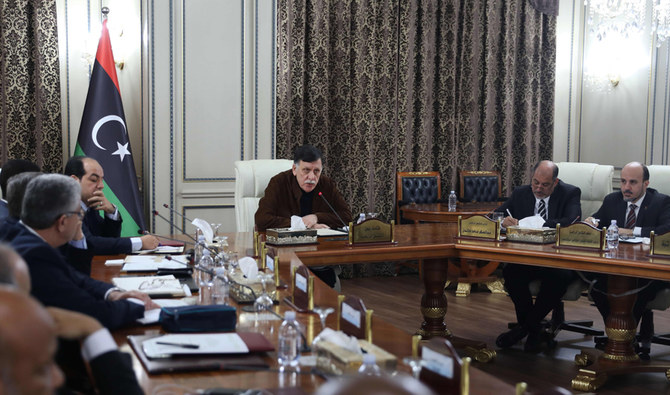
Libya's UN-recognized Prime Minister Fayez Al-Sarraj (C) holds a cabinet meeting in the Libyan capital Tripoli on Dec. 19, 2019. (AFP/Tripoli. (AFP)
Short Url
Updated 21 December 2019
Follow

Libyan force attacking Tripoli gives militias 3-day deadline

  • Libya’s Government of National Accord (GNA) approved the implementation of a military deal with Turkey
  • Erdogan said on Dec. 10 that Ankara was ready to send troops to Libya to support the GNA

TRIPOLI: A Libyan force fighting to capture the country's capital from the U.N.-supported government based there on Friday gave the militias defending Tripoli a three-day deadline to pull out.

The self-styled Libyan National Army issued a statement demanding that the powerful Misrata militias, which are fighting on behalf of the government in the Libyan capital, withdraw from both Tripoli and the coastal city of Sirte.

The Misrata militias are named after the western Libyan town of Misrata, which saw some of the heaviest fighting during the 2011 uprising that led to the ouster and killing of longtime dictator Moammar Qaddafi. The militias played a key role in Qaddafi's ouster.

The rebirth of AlUla
Hegra, ancient city of the Nabataeans in Saudi Arabia’s historic AlUla Valley, is emerging from the mists of time to take its rightful place as one of the wonders of the world

Enter


keywords

For months, the LNA and the militias have been locked in fierce clashes on Tripoli's southern outskirts, with the fighting mostly stalemated.

Last week, LNA commander Khalifa Haftar declared the “zero hour” of the battle for Tripoli had begun, nearly eight months after he began his offensive to take the city. The announcement triggered a fresh bout of clashes around Tripoli.

Friday's LNA statement warned that if the militias do not withdraw, their town Misrata will continue to be targeted “every day, non stop and in an unprecedentedly intensive way.”

The warning came shortly after an LNA airstrike targeted sites where Turkish weapons and military equipment had been stored, said the statement. The Tripoli-based government led by Prime Minister Fayez Sarraj condemned the attack, saying it caused civilian casualties but without providing details.

Turkey and Qatar, as well as Italy, have been allied with Sarraj's government, while Haftar is backed by France, Russia and key Arab countries, including Egypt, the United Arab Emirates and Saudi Arabia.

The U.N. mission in Libya tweeted Friday that it regrets the recent escalation in fighting and all foreign interference, and urged Libyans to return to political dialogue.

Since Haftar's forces launched their offensive on Tripoli in April, both sides have exchanged accusations of deploying allied foreign forces in the ongoing civil war, which has seen Libya divided since 2015 between two governments, one based in the west, in Tripoli, and the other based in the east. Haftar is allied with the east-based government.

Haftar was particularly angered after Sarraj signed a maritime deal and security pact with Turkish President Recep Tayeb Erdogan last month. That pact also angered Egypt. Erdogan later said that Ankara could dispatch Turkish troops to assist the Tripoli-based government — if Sarraj's Cabinet asks for them.

Erdogan renewed his support of Sarraj's government on Friday by criticizing the alleged presence of Russian-backed fighters in Libya.

“It would not be right for us to remain a spectator in the face of this. We have done whatever we can until now and will continue to do so,” he told Turkish reporters at the end of a trip to Malaysia.

The Tripoli-based government has recently said that it had evidence Russia was deploying fighters through a private security contractor to back Haftar's forces in key battleground areas in the past months.

Moscow has repeatedly denied playing any role in Libya’s fighting.


US mediating prisoner exchange talks between Damascus and Druze: source to AFP

Updated 6 sec ago
Follow

US mediating prisoner exchange talks between Damascus and Druze: source to AFP

  • The talks aim to “get the authorities to release 61 civilians from Sweida who have been detained,” held by the National Guard
  • Aid trucks have entered the province several times since July

BEIRUT: The United States is leading negotiations between a prominent Druze leader and the Syrian government to secure an exchange of prisoners held since sectarian clashes in a Druze-majority Syrian province last year, a source with knowledge of the matter told AFP Tuesday.
Thousands are estimated to have been killed when clashes erupted between Druze fighters and Sunni Bedouin tribes in the southern Sweida province in July.
The Syrian government in the capital Damascus said their forces intervened to stop the clashes, but witnesses and monitors accused them of siding with the Bedouin.
The Druze source, who requested anonymity, told AFP that “there are currently negotiations mediated by the United States between Sheikh Hikmat Al-Hijri and the Damascus government.”
The talks aim to “get the authorities to release 61 civilians from Sweida who have been detained... since the events of July, in exchange for 30 personnel of the interior and defense ministries” held by the National Guard, the armed group that operates under prominent Druze leader Hijri.
The Syrian Observatory for Human Rights said the fighting in Sweida left more than 2,000 people dead, including 789 Druze civilians who were “summarily executed by defense and interior ministry personnel.”
While a ceasefire was reached later in July, the situation remained tense and the province difficult to access.
Residents accuse Syrian authorities of imposing a siege on Sweida, which Damascus denies, and tens of thousands of people remain displaced from the violence.
Aid trucks have entered the province several times since July.
In August, dozens of small factions in Sweida announced they would join the National Guard, seeking to unify military efforts under Hijri, who is considered the Druze figure most hostile to Damascus.
Hijri has since demanded the creation of a separate region for his minority community, and has formed a de facto authority in Sweida city and its surrounding areas outside of the central government’s grasp.
Israel bombed Syria during the violence, striking the Syrian army headquarters and near the presidential palace, saying it was acting to defend the minority group.