MACAU: Chinese president Xi Jinping landed in Macau on Wednesday as the city prepares to mark 20 years since the former Portuguese colony was returned, a celebration that stands in stark contrast to months of unrest in neighboring Hong Kong.
Security has been ramped up ahead of Xi’s three-day visit which culminates on Friday’s anniversary.
China’s authoritarian leadership is keen to showcase Macau as a successful example of its “one country, two systems” model, with party leaders heaping praise on a pliant city of 700,000 that has grown rich on gambling and deference to authoritarian rule.
“The Chinese people and the central government are proud of the achievements and progress Macau has made in the past 20 years since its return to the motherland,” Xi said on arrival at the city’s airport, a troupe of school children waving Chinese and Macau flags behind him.
Since the 1999 handover by Lisbon, Macau has witnessed little of the dissent that has exploded in Hong Kong during six months of often violent pro-democracy protests as large chunks of the population seethes under Beijing’s rule.
Like Hong Kong it maintains its own currency, judiciary and free market. But it has long since passed mainland style anti-sedition laws that have been successfully resisted by Hong Kongers.
Limited details have been released by authorities on Xi’s schedule.
He will meet local leaders and attend a dinner and a cultural performance on Thursday. The following day Xi will preside over the inauguration of the city’s new leader Ho Iat-seng.
A former member of China’s top lawmaking body, Ho won a one-horse race this summer to become chief executive — a position that is chosen by a 400-member committee stacked with Beijing loyalists.
Bunting and banners hailing the anniversary were erected across the city, including on some of the casinos that serve as the territory’s lifeblood.
Security has been dramatically tightened ahead of Xi’s visit.
Police set up checkpoints and extra screenings for passenger arrivals while authorities said some major roads would see closures.
The city’s first light rail line announced it would shut down for the duration, just a week after it was first opened to the public while the airport said some flights would be rescheduled.
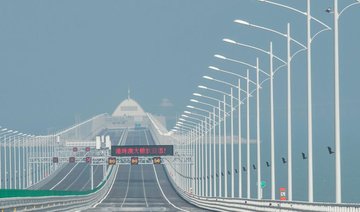
Security checks were also ramped up in Hong Kong’s ferry terminals and on a huge bridge and tunnel system linking the two cities.
Since last week police from mainland China have been manning a newly created checkpoint on an artificial island that links the bridge and tunnel system between Hong Kong, Macau and Zhuhai, the first time they have done so.
Multiple journalists with Hong Kong passports working for local and international media have been denied entry to Macau in the run up to the anniversary while a group of pro-democracy lawmakers were denied permission to board a ferry on Wednesday.
Earlier this month the president and chairman of Hong Kong’s American Chamber of Commerce were also denied entry to Macau without explanation.
“It’s totally one country, one system,” a 34-year-old local who regularly travels to Hong Kong told AFP, adding that protesting in Macau was “pointless and dangerous.”
“The reason it looks like it’s working well is because Macau people don’t protest.”
But he said there was local anger about the wealth of the city’s elites, the limited transport infrastructure and severe overcrowding, even though the population have become wealthier.
Macau’s skyline and economy have changed beyond recognition since four centuries of Portuguese rule ended in 1999, with glittering casinos the backbone of the city’s dramatic rise.
As the only place in China where gambling is allowed, Macau’s GDP has soared from $6.4 billion in 1999 to more than $55 billion.
Per capita GDP is the third highest in the world behind Luxembourg and Switzerland, according to the International Monetary Fund, while its casinos now rake in each week the same as Las Vegas makes in a month.
But while Macau has grown rich and been politically stable in the 20 years of Chinese rule, it has many vulnerabilities.
Much of the city’s wealth is concentrated in the hands of a small elite and all its economic chips are in the gambling basket which still accounts for 80 percent of government revenue.

Xi lands in Macau for China handover anniversary party
https://arab.news/g7khf
Xi lands in Macau for China handover anniversary party
- Macau’s celebration stands in stark contrast to months of unrest in neighboring Hong Kong
- China’s authoritarian leadership is keen to showcase Macau as a successful example of its one country, two systems model
Epstein files reveal links to cash, women, power in Africa
- Documents attest to Epstein’sclose ties with Karim Wade, son of former Senegalese president Abdoulaye Wade
- They also reveal his ties to Nina Keita, niece of Ivorian president Alassane Ouattara
PARIS: Jeffrey Epstein built close ties with powerful figures in Senegal and Ivory Coast, files released by the US government last month show, detailing the late sex offender’s influence network across Africa.
Emails, scheduled meetings, investment projects, and loans reviewed by AFP attest to the disgraced New York financier’s close relationship with Karim Wade, son of former Senegalese president Abdoulaye Wade.
They also reveal his ties to Nina Keita, niece of Ivorian president Alassane Ouattara.
Wade and Epstein met in 2010 through Emirati businessman Sultan Ahmed bin Sulayem, who recently resigned as CEO of port giant DP World after mounting pressure over his close friendship with Epstein.
The pair quickly struck up a rapport.
“Thanks for coming. I think there are many things to consider... I feel confident that we will have fun,” Epstein wrote to Wade on November 15, 2010 after their first meeting in Paris.
“Have a safe trip back to your paradise Island,” Wade replied.
While Wade’s exchanges show no link to Epstein-related sex trafficking crimes, they do reveal conversations on potential business ventures in various sectors, such as finance and energy.
Nicknamed the “Minister of Heaven and Earth” for the multiple portfolios he held including international cooperation, energy, and air transport, Wade was a powerful figure in Senegal until April 2012, when his father’s bid for a third term sparked deadly riots.
Epstein saw him as “one of the most important players in africa” and invited him to meet close contacts such as Ehud Barak, then Israel’s defense minister.
He also put him in touch with Chinese businessman Desmond Shum to discuss “offshore banking.”
The US Department of Justice documents show Shum and Wade met in Beijing on May 9, 2011.
That same month, Wade planned an African tour through Senegal, Mali, and Gabon for Epstein.
‘You will not suffer’
Epstein and Wade’s relationship became even more apparent after the latter’s fortunes reversed when his father left office in 2012.
That autumn, Epstein proposed that his “friend” — under the Dakar authorities’ scrutiny over his assets — use his house in Florida.
“You and your family are welcome to use my house in palm beach, staff is there, pool etc. you will not suffer,” Epstein wrote.
“Txs a lot Brother for the advise,” Wade replied a few weeks later to another email, in which Epstein urged him to “stay mentally strong.”
Numerous files suggest Epstein became financially involved on Karim Wade’s behalf after his arrest in 2013 and his 2015 sentencing to six years in prison for corruption.
Karim Wade’s lawyer, Mohamed Seydou Diagne, sent two invoices in May 2014 and July 2015 of $500,000 to one of Epstein’s companies.
Contacted by AFP on Monday, Diagne said he “did not consider it useful to comment.”
Other archives suggest that Epstein covered at least $50,000 in fees for the US lobbying firm Nelson Mullins, hired by Wade’s entourage to secure his release.
Epstein regularly exchanged emails with Robert Crowe, a partner at the firm who kept him informed of their efforts in the US and Senegal.
In a June 16, 2016 email thread where Epstein and Crowe discussed whether then Senegalese president Macky Sall would pardon Wade, Crowe writes: “He has told my friends high up at State that he was going to do it. They have been putting pressure on him!“
Karim Wade was released from prison eight days later, on June 24, and went into exile in Qatar, which he credited for efforts toward his release.
Jeffrey Epstein was told by Sultan Ahmed bin Sulayem and Nina Keita.
‘A very interesting person!’
The DOJ documents show Nina Keita was close to both Epstein and Karim Wade and that she acted as a regular intermediary while Wade was in prison.
Keita also helped put Epstein in contact with her uncle, president of Ivory Coast since May 2011, and his team.
“He thought you were a very interesting person! ... they were all very happy to have you here,” she wrote on January 20, 2012, after the financier’s visit to Abidjan.
She had booked him the “ministerial suite” of the luxury Hotel Ivoire for that trip.
Ahead of the visit, Epstein had said he hoped to see “very pretty girls there, as well as interesting places.”
“You will!” Keita replied.
Emails show Keita, a former model, at least once sent photos and the phone number of a young woman to Epstein.
He then met this woman at the Ritz hotel in Paris on August 31, 2011.
“ask sadia to send pictures of her sister. i prefer under 25,” Epstein wrote to Keita after the meeting.
Now the deputy general director of Ivorian petroleum stocks company GESTOCI, Keita also appears in a February 2019 will in which Epstein requested that debts owed to him by a number of people be canceled upon his death.
AFP received no response to its requests for comment from both Keita and the Ivorian presidency, or from Karim Wade, who was contacted through his entourage.
The mere mention of a person’s name in the Epstein files does not in itself imply wrongdoing.


