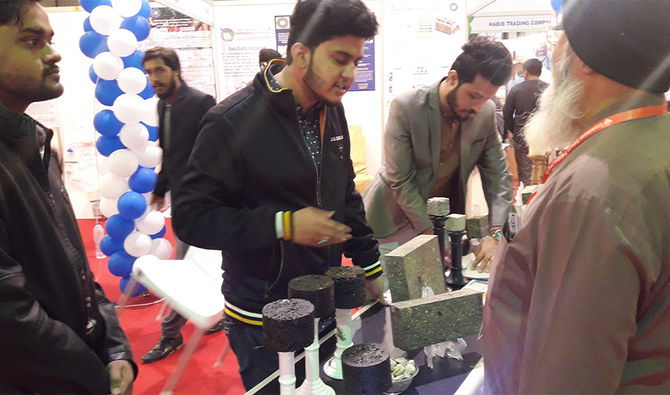

KARACHI: To prove that nothing is useless, young Pakistani engineers have created durable and pressure-resistant building blocks and pavers from recycled plastic, offering an innovative solution to the country’s burgeoning waste problem.
“Our project is research-based and all we want to do is to utilize waste material generated all over Pakistan. We want to turn the waste into building and construction materials,” Danish Ahmed, a final-year student of Sir Syed University of Engineering and Technology in Karachi, told Arab News on Monday.
The building blocks and pavers, made by melting plastic waste and mixing it with sand, are not only durable and environmentally friendly, but also cheaper than conventional building materials.
According to the students, while the price of conventional blocks varies from Rs26 to Rs56 per block, their product costs only Rs15. It is cheaper but its endurance is higher at 1350 psi, compared with conventional blocks that cannot endure stress higher than 600-800 psi.

Bricks made from recycled plastic waste are displayed by Sir Syed University of Engineering and Technology students in Karachi on Dec. 16, 2019. (AN photo)
“We have made this construction material from garbage, mostly shopping bags,” Ahmed explained. “This material is load-resistant and could bear more than double the weight without cracking or bending, and it is also heat-resistant,” Ahmed said.
But this is not all about the cost and durability, the students argued. “We are looking for a solution to the country’s chronic problem of garbage, which mostly remains unhandled.”
Although there is no official data on garbage production in Pakistan, estimates suggest that it is between 20 million tons and 50 million tons per year, growing around 2 percent annually.
Plastic makes 9 percent of the country’s total garbage. Food waste contributes 30 percent, ash, bricks and dirt 18 percent, and organic waste 14 percent, according to Export.gov, an initiative by the US Department of Commerce, which says Pakistan generates about 48.5 million tons of solid waste a year.
Waste management in Pakistan is a serious problem for urban and rural dwellers and poses serious health hazards.
“The Karachi city, the largest urban center of the country, produces 15,000 to 20,000 tons every day, and this does not include industrial waste. Only around 9,000 tons is properly disposed off while remaining garbage is thrown in open areas, on streets or drained. Authorities (start to) pay attention when health issues arise,” Aarish Ali, chief executive of waste management company Alico Waste Experts, told Arab News on Wednesday.
Many areas of the metropolitan city remain unaccounted as far as trash disposal is concerned. “Lack of awareness and proper infrastructure are a major cause of worsening garbage issues. Proper collection and transportation of waste are the key areas where the focus is required,” he said.
Faced with public health and environmental challenges posed by improper waste management, Pakistani authorities have been contemplating various utilization options, including power generation. An agreement was signed between K-Electric and Engro Energy in November 2019 to set up a $175 million waste-to-energy power plant with a capacity of 50 MW.
Meanwhile, as such power generation facilitates have yet to become reality, the Karachi students argue their eco-building blocks “are one of the best (means of) waste utilization,” and many investors have already shown interest in their commercial production.