Musharraf ‘can surely never be a traitor’: Pakistan army

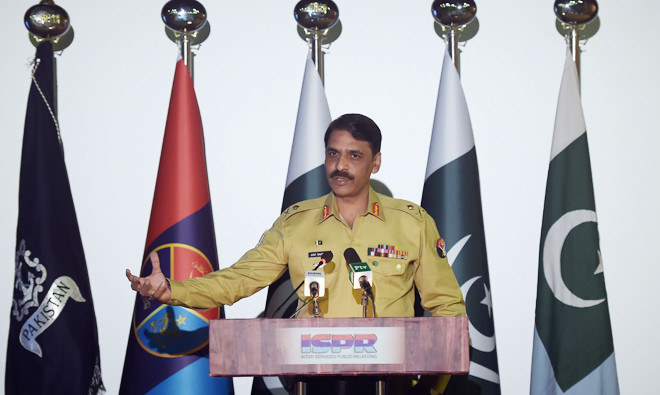
Pakistan's army spokesman Major General Asif Ghafoor speaks with media representatives as he gives details of a captured would-be female suicide bomber Noreen Leghari during a press conference in Rawalpindi on April 17, 2017. (AFP)
Short Url
Updated 17 December 2019
Follow

Musharraf ‘can surely never be a traitor’: Pakistan army

  • The military criticized court decision as concluded in haste
  • Given his service for Pakistan, Musharraf cannot be a traitor, says ISPR

ISLAMABAD: The Pakistan Army has received with “pain and anguish” a court decision that convicted former President Gen. Pervez Musharraf of high treason and sentenced him to death.

The former military ruler received the death sentence in absentia on Tuesday, following a six-year legal case.

The decision has been received with a “lot of pain and anguish by rank and file of Pakistan Armed Forces,” the Pakistan Army’s media wing, Inter-Services Public Relations, said in a statement.

“An ex-Army Chief, Chairman Joint Chief of Staff Committee and President of Pakistan, who has served the country for over 40 years, fought wars for the defense of the country can surely never be a traitor,” the ISPR said in reference to Musharraf.

The military also criticized the legal process behind the ruling by saying the case was concluded “in haste” and was marred by “denial of the fundamental right of self-defense.”

Musharraf’s lawyer Salman Safdar also said the judgment was “announced in haste,” and the conviction of his client in absentia “doesn’t have any legal foundation to stand on,” he told Arab News. He referred to the sentence as “unconstitutional and illegal” and called the case “politically motivated.”

“The sentence will be overturned in appeal,” he said, adding that he had yet to consult Musharraf regarding the appeal process.

Musharraf seized power in October 1999 by toppling the civilian government of former Prime Minister Nawaz Sharif in a bloodless coup. He remained in power until 2008.


EU criticizes Pakistan over jailing of rights lawyers, flags free speech concerns

Updated 24 min 3 sec ago
Follow

EU criticizes Pakistan over jailing of rights lawyers, flags free speech concerns

  • EU says the convictions of Imaan Mazari-Hazir, Hadi Ali Chattha violate freedom of expression
  • Both lawyers were arrested last week over social media posts under Pakistan’s cybercrime laws

KARACHI: The European Union on Thursday criticized Pakistan over the conviction of two human rights lawyers for their social media activity, saying the ruling ran counter to freedom of expression and the independence of the legal profession, core democratic principles that Islamabad is committed to uphold under international law.

Imaan Mazari-Hazir and her husband Hadi Ali Chattha were arrested last Friday as they were on their way to a court appearance and were later remanded to two weeks in judicial custody.

Authorities accused them of violating the Prevention of Electronic Crimes Act (PECA) over posts on X that they said incited ethnic divisions and portrayed the military as being involved in “terrorism.” Both deny the allegations.

“The conviction of human rights lawyers Imaan Mazari and Hadi Ali Chattha over social media activity goes against freedom of expression and independence of lawyers,” Anouar El Anouni, the EU’s spokesperson for foreign affairs and security policy, said in a post on X. “These are not only key democratic principles but also part of Pakistan’s international human rights commitments.”

Pakistan is one of the largest beneficiaries of the EU’s Generalized Scheme of Preferences Plus (GSP+), which grants duty-free access to most European markets in return for implementing 27 international conventions covering human rights, labor standards, environmental protection and good governance.

Pakistan’s GSP+ status came under scrutiny in the past after, in April 2021, the European Parliament adopted a resolution calling for an immediate review, citing concerns over violence against religious minorities, curbs on media freedom and broader human rights issues.

Earlier this week, lawyers in Pakistan’s capital went on strike and announced plans to stage a protest against the court ruling, which handed Mazari-Hazir and Chattha a cumulative 17-year sentence.

The Pakistani government has not yet responded to the EU statement.