In Karachi, a new street library fosters a love of reading

Karachi authorities have decorated the wall surrounding the Metropole building with portraits of figures crucial to Pakistan's history. Photo taken in Karachi on Dec. 16, 2019. (AN photo)
Short Url
Updated 17 December 2019
Follow

In Karachi, a new street library fosters a love of reading

  • The library will be inaugurated on Dec. 25 – Muhammad Ali Jinnah’s birthday
  • Authors welcome the initiative to address a decline in the city’s reading culture

KARACHI: For a city that is proud of its unique history and culture, Karachi is like an open book.
And to encourage more people to find joy in the rich literature on offer, authorities have devised a unique solution to foster a love of reading – street libraries.
For the purpose, the Karachi Commissioner’s Office has decorated the wall surrounding the Metropole building with portraits of Pakistan’s founder Muhammad Ali Jinnah, his sister Fatima Jinnah, celebrated poet Allama Iqbal, and the first Prime Minister Liaquat Ali Khan. Between the portraits, wooden bookshelves have been installed.
“The idea behind this first street library of Pakistan is to promote the habit of book reading, which is very essential for any society,” Commissioner Iftikhar Shalwani told Arab News.
The first of its kind street library will be inaugurated on Dec. 25 on Jinnah’s birthday.
“We are also working on upgrading public libraries in different districts of the city. One of those will be named as the city’s central library,” Shalwani said, explaining that the bookshelves have yet to be filled and that the symbolic library will operate on the “take a book and leave a book” basis.


Wooden bookshelves will be filled upon the inauguration of Karachi's first street library on Dec. 25 – the birthday of Muhammad Ali Jinnah. Photo taken in Karachi on Dec. 16, 2019. (AN photo)

Writers and bibliophiles have welcomed the initiative.
“Any efforts for reviving the culture of book reading should be appreciated,” said Sahar Ansari, a renowned poet and member of the commissioner’s library committee.
“Although promoting book reading in this era of the Internet is a difficult task, sincere and well thought efforts never fail,” he said.
He recalled the city’s rich culture of book reading and “aik ana” (one penny) libraries in the past, which worked on the principle of affordable reading whereby a book could be borrowed for a penny.
“The city had many public and private libraries where thousands would throng to read books on history, literature, science and other subjects of their interest,” Ansari said, adding that personal libraries used to be considered “a status symbol.”
Nowadays, however, although the website of the Karachi Metropolitan Corporation lists 41 libraries in the city, only a few remain fully functional. “The libraries of different (foreign) consulates in Karachi would attract a good number of readers,” Ansari said, but security measures often discourage readers from visiting.
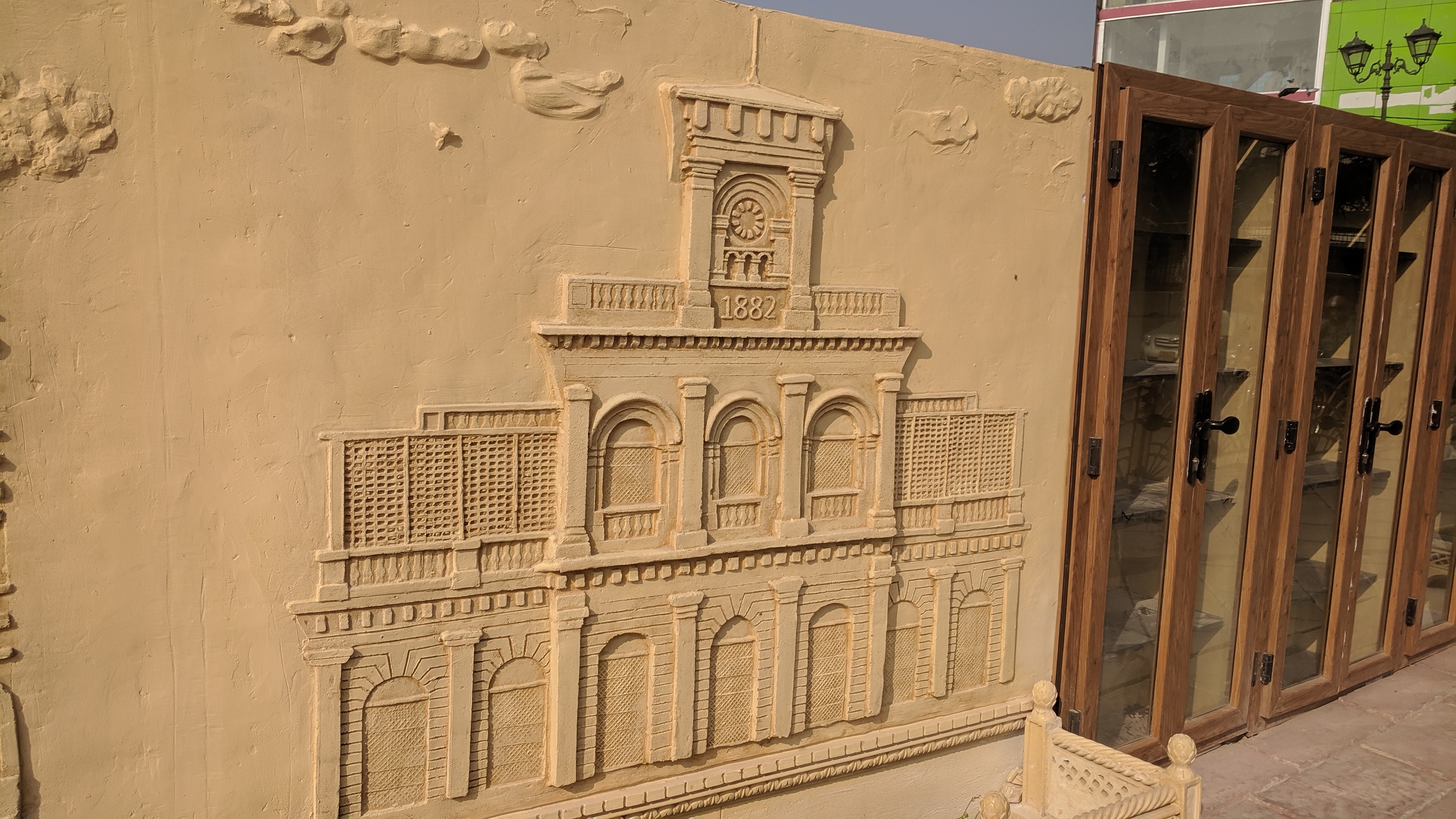


The Metropole building's wall is also decorated with reliefs presenting the city's heritage sites. Photo taken in Karachi on Dec. 16, 2019. (AN photo)

Among those who keep the culture of letters alive, he said, are sellers at Regal Chowk, Frere Hall, and next to Baitul Mukarram Mosque, who every Sunday offer old books.
Journalist and writer Ghazi Salahuddin, who used to host a book show on a Pakistani news channel, also appreciated the street library initiative, but offered a caveat.
“Quality and newer titles should be added to the library to make it more attractive to the readers,” he said.



Pakistan, Iraq agree on tighter coordination over pilgrims under new regulated travel system

Updated 4 sec ago
Follow

Pakistan, Iraq agree on tighter coordination over pilgrims under new regulated travel system

  • New system requires all Iraq-Iran pilgrimages to be organized by licensed groups under state oversight
  • Long-running “Salar” model relied on informal caravan leaders, leading to overstays and missing pilgrims

ISLAMABAD: Pakistan and Iraq this week agreed to closely coordinate on the management and security of Pakistani pilgrims, as Islamabad rolls out a new, tightly regulated travel system aimed at preventing overstays, undocumented migration and security breaches during religious visits to Iraq and Iran.

The understanding was reached during a meeting between Pakistan’s Interior and Narcotics Control Minister Mohsin Naqvi and Iraq’s Interior Minister General Abdul Amir Al-Shammari on Thursday evening, where both sides discussed measures to facilitate pilgrims while strengthening oversight, Pakistan’s interior ministry said.

The agreement comes as Pakistan dismantles its decades-old pilgrim travel model and replaces it with a centralized, licensed system after authorities confirmed that tens of thousands of Pakistani pilgrims had overstayed or gone missing abroad over the past decade, triggering concerns from host governments.

“You have, for the first time during your tenure, taken effective measures to organize pilgrim groups, which are commendable,” Al-Shammari told Naqvi, according to Pakistan’s interior ministry.

“All pilgrims included in the list provided by Pakistan’s Ministry of Interior will be allowed to enter Iraq,” he added, making clear that only travelers cleared under the new system would be permitted.

Naqvi said Pakistan would strictly enforce return timelines under the revised framework.

“Pilgrims traveling to Iraq will not be allowed to stay beyond the designated period,” he said, adding that relevant authorities in both countries would remain in close coordination.

Both interior ministers also agreed to strengthen information-sharing and joint mechanisms on security cooperation, counterterrorism and the prevention of human smuggling, officials said.

“The safety, dignity, and facilitation of Pakistani pilgrims is the top priority of the Government of Pakistan,” Naqvi said.

Al-Shammari said he would visit Pakistan soon to finalize a joint roadmap to further improve pilgrim facilitation, security coordination and broader bilateral cooperation, according to the interior ministry.

Pakistan’s government has overhauled its pilgrim travel regime this year, abolishing the long-running “Salar” system under which informal caravan leaders managed pilgrimages. The move followed official confirmation that around 40,000 Pakistani pilgrims had overstayed or disappeared in Iran, Iraq and Syria over the past ten years.

Under the new Ziyarat Management Policy, only licensed Ziyarat Group Organizers (ZGOs) are allowed to arrange pilgrimages, with companies held directly responsible for ensuring pilgrims return on time. Authorities have completed security clearance for 585 companies seeking registration, while scrutiny of applications remains ongoing.

Islamabad has also barred overland travel for major pilgrimages, including Arbaeen, citing security risks in Pakistan’s southwestern Balochistan province, meaning all travel to Iraq and Iran is now restricted to regulated air routes.

Tens of thousands of Pakistani pilgrims travel each year to Iraq and Iran to visit some of the most revered shrines in Shia Islam, including the mausoleums of Imam Ali in Najaf and Imam Hussain in Karbala in Iraq, and major religious sites in Mashhad and Qom in Iran. Pilgrimages peak during religious occasions such as Arbaeen, when millions of worshippers converge on Karbala from across the region. The scale of travel, often involving long stays and cross-border movements, has long posed logistical, security and migration-management challenges for Pakistani authorities and host governments alike.