

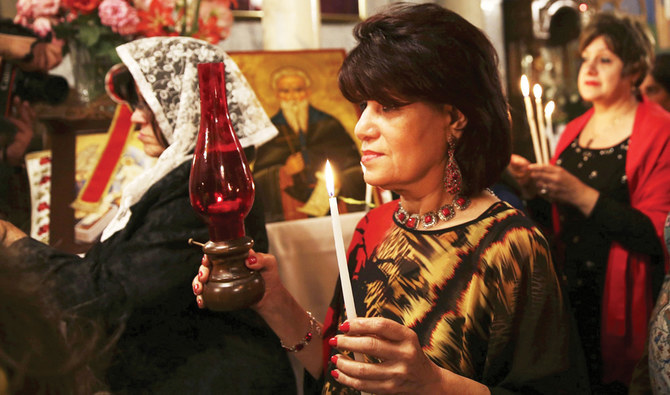

GAZA CITY: Hatem Al-Far, 51, and his family seem nervous. They are awaiting the issuance of Israeli permits to visit the rest of his family and the holy places in Bethlehem and Jerusalem.
Al-Far lives in Gaza, but he has not been able to visit Bethlehem for four years, while Israel sometimes allows his wife and one of his children to travel to the West Bank during the Christmas and Easter.
Israel announced earlier that Christians in Gaza would not be allowed to visit the holy places for the first time, while 100 Palestinians would be allowed out of the Gaza Strip to Jordan.
The announcement has affected Al-Far, his family and Christians in Gaza who will not be able to go to the West Bank.
“I don’t trust anything until I get the permit in my hands, or at least my wife and children get the permits to travel and meet my daughter and son who are currently living in the West Bank.” Al-Far said.
He added: “Christmas is the most prominent opportunity for us as a family to meet. I do not know what is the reason for preventing me from obtaining a permit to visit the Church of the Nativity and do prayers there. The West Bank is part of Palestine, there is no logical reason to prevent any Christian from traveling and even staying there if he wishes.”
Israel tightly restricts movements out of the Gaza Strip, a territory controlled by the extremist group Hamas since 2007.
Gaza has only around 1,000 Christians — most of them Greek Orthodox — among a population of 2 million in the narrow coastal strip.
Driven by the shattered economic situation, the siege, and the Israeli wars, the number of Christians in Gaza has shrunk in recent years, some of whom have moved to live in the West Bank or emigrate abroad.
I do not know what is the reason for preventing me from obtaining a permit to visit the Church of the Nativity and do prayers there.
Hatem Al-Far, Palestinian Christian
A number of Christians in Gaza mentioned that when Israel grants permits it does not grant them to all family members, which makes traveling difficult in the holiday season.
Hani Farah, secretary-general of the YMCA in Gaza, said: “Israel practices all forms of repression and violations against the Palestinians, regardless of their religion or gender.”
He added: “Just as Israeli bombs and missiles do not differentiate between the Palestinians, the blockade of Israel and its repressive measures do not differentiate between a Muslim and a Christian. We are all trapped in Gaza and we share pain and suffering.”
Like hundreds of other Christian Gazans who had applied for permits, Farah — who is a lay member of the Greek Orthodox community — had not received one for himself, his wife or their four children.
With the exception of the holiday seasons, Christians suffer from severe restrictions imposed by Israel on the movement of Gazans to the West Bank, according to Farah.
The number of Christians in Gaza is shrinking due to several factors, according to Farah, the most important of which are economic conditions.
“When young people do not find work they are forced to travel abroad. The same is true for girls when they want to be associated with a husband but do not find someone to approach them, so they travel in order to marry.”
Gisha, the Israeli legal center for freedom of movement, said: “The decrease in the number of holiday permits issued to Christians in Gaza over the years, and the fact that this Christmas Israel has not allocated any permits for Christians to travel between Gaza and the West Bank, point to the intensifying of access restrictions between the two parts of the Palestinian territory, a deepening of Israel’s separation policy.”




