ISLAMABAD: Pakistani authorities on Friday impounded a truck carrying a huge arms cache coming from Afghanistan via Torkham border, an anti-narcotics official said on Sunday.
The illicit crossing over of arms, drugs and other illegal materials at Torkham, the major border crossing between Afghanistan and Pakistan, is not uncommon.
In January this year, hundreds of weapons were seized concealed inside a coal truck entering Pakistan from Afghanistan. In June last year, Afghan forces seized a huge bomb-making cache in the back of a vegetable truck crossing over from Pakistan.
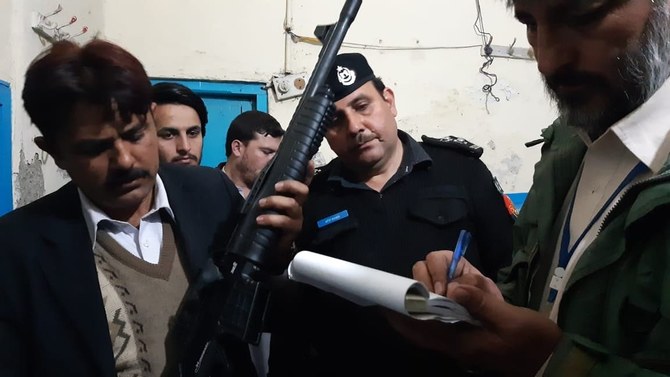
“While passing through the transit scanners, the truck coming from Afghanistan was found suspicious on Friday. A thorough search of the truck led the customs department, Anti-Narcotics Force (ANF) and other security officials to recover 207 weapons of different brands including Tomahawk and Maverick guns with Turkish made seals,” Raffaqat Hussain, a sub-inspector of the ANF, told Arab News at the busy Pak-Afghan Torkham border in northwestern Khyber Pakhtunkhwa province.
However, the arms smugglers inside the truck, including the driver of the vehicle, managed to flee after the truck was seized. A passport belonging to the driver was found on the dashboard of the vehicle, Hussain said. He added that the weapons were masterfully concealed inside the truck’s hidden cavities.
KP’s provincial Information Minister Shaukat Yousafzai told Arab News that his government had ‘zero tolerance’ for banned items including arms and narcotics to and from Afghanistan.
“Yes, a truck carrying arms from Afghanistan has been impounded but investigations are in initial process and its findings cannot be made public at this point,” Yousafzai said.
“The officials concerned suspect an organized group behind the botched arms’ smuggling attempt. A looming threat of terror has been foiled but investigations are underway to reach to the depth of the issue,” he added.
Authorities said that a case had been lodged and all concerned departments from police to Khasadar and counter-terrorism forces, were involved in the investigation.
Yousafzai said Pakistan and Afghanistan shared a long porous border but provincial authorities had intensified efforts to discourage illegal business and smuggling along the border areas.
In July this year, Prime Minister Imran Khan had directed all concerned departments to initiate a countrywide crackdown on smuggling, in an Islamabad meeting.
Also in that meeting, it was unanimously decided that a committee would be formed, to be headed by the interior minister, to systemize transit trade and curb smuggling at Pak-Afghan and Pak-Iran border areas.


Pakistan foils terror bid, seizes arms smuggled from Afghanistan
https://arab.news/rj7en
Pakistan foils terror bid, seizes arms smuggled from Afghanistan

- KP information minister says authorities suspect an organized group behind the smuggling
- 207 weapons of different brands were concealed in a truck crossing Torkham border to enter Pakistan

Rating firm S&P says it won’t rush Iran war downgrades, sees risks for countries like Pakistan
- Agency says it is monitoring indebted energy importers as higher oil prices strain finances
- Gulf economies seen better placed to weather shock, though Bahrain flagged as vulnerable
LONDON: S&P Global said it would not make any knee-jerk sovereign rating cuts following the outbreak of war in the Middle East, but warned on Thursday that soaring oil and gas prices were putting a number of already cash-strapped countries at risk.
The firm’s top analysts said in a webinar that the conflict, which has involved US and Israeli strikes against Iran and Iranian strikes against Israel, US bases and Gulf states, was now moving from a low- to moderate-risk scenario.
Most Gulf countries had enough fiscal buffers, however, to weather the crisis for a while, with more lowly rated Bahrain the only clear exception.
Qatar’s banking sector could also struggle if there were significant deposit outflows in reaction to the conflict, although there was no evidence of such strains at the moment, they said.
“We don’t want to jump the gun and just say things are bad,” S&P’s head global sovereign analyst, Roberto Sifon-Arevalo, said.
The longer the crisis was prolonged, though, “the more difficult it is going to be,” he added.
Sifon-Arevalo said Asia was the second-most exposed region, due to many of its countries being significant Gulf oil and gas importers.
India, Thailand and Indonesia have relatively lower reserves of oil, while the region also had already heavily indebted countries such as Pakistan, Bangladesh and Sri Lanka whose finances would be further hurt by rising energy prices.
“We are closely monitoring these (countries) to see how the credit stories evolve,” Sifon-Arevalo said.


