54 injured as Lebanese security forces and Hezbollah supporters clash in central Beirut

1 / 4
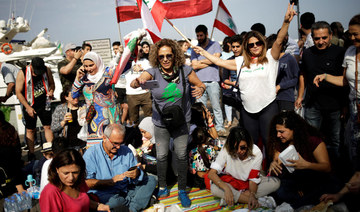
Clashes broke out on Saturday between Lebanese security forces and Hezbollah supporters in downtown Beirut. (AP)
2 / 4
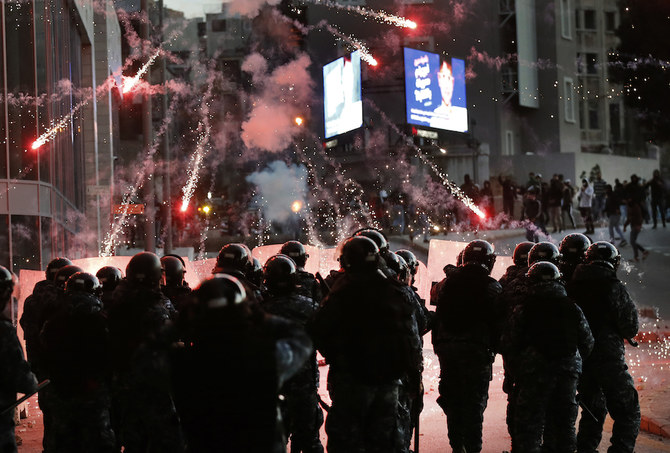
Clashes broke out on Saturday between Lebanese security forces and Hezbollah supporters in downtown Beirut. (AFP)
3 / 4
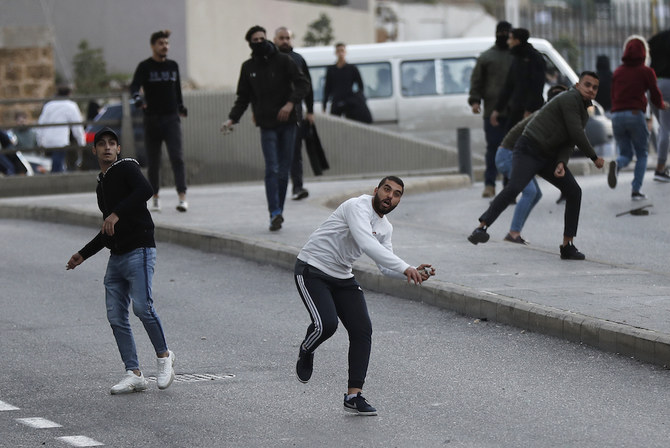
Clashes broke out on Saturday between Lebanese security forces and Hezbollah supporters in downtown Beirut. (AP)
4 / 4
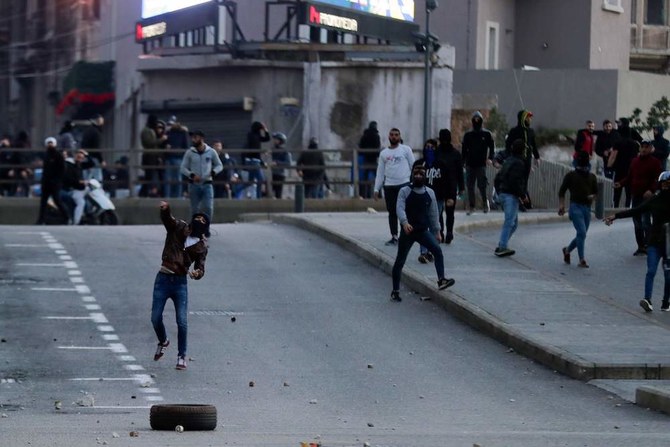
Clashes broke out on Saturday between Lebanese security forces and Hezbollah supporters in downtown Beirut. (AP)
Short Url
Updated 15 December 2019
Follow

54 injured as Lebanese security forces and Hezbollah supporters clash in central Beirut

  • Attackers threw stones and firecrackers at security forces, who responded by firing tear gas and rubber bullets
  • The Internal Security Forces said at least 20 police were wounded, some of them badly

BEIRUT: Security forces fired tear gas and rubber bullets at Lebanese protesters in central Beirut on Saturday in clashes that went on into the night and wounded dozens of people.

Among the badly injured were policeman after Hezbollah and Amal Movement supporters clashed with anti-government protesters, less than 32 hours before a key parliamentary meeting to nominate a new Lebanese leader.

Attackers threw stones and firecrackers at security forces, who responded by firing tear gas and rubber bullets.

State news agency NNA said the tear gas made several people faint. The Lebanese Civil Defense said it treated 54 people for injuries, taking more than half to hospital.

The Internal Security Forces said at least 20 police were wounded.

Riot police took more than 90 minutes to contain the attackers in areas surrounding Riad El-Solh and Martyrs squares, forcing them to retreat to the Khandak El-Ghamik and Zqaq El-Blat neighborhoods, where Hezbollah and the Amal Movement have strong support.

Clashes have become more frequent in recent weeks, with supporters of Hezbollah and Amal attacking protest camps in several cities amid counter-demonstrations.

The renewed attacks on protesters came a day after Hezbollah leader Hassan Nasrallah claimed that both the militant group and Amal “are exercising control over their supporters and that attackers do not belong to them.”

Khandak El-Ghamik residents told reporters that the attackers are not from the area.

“We do not know who they are,” one resident said.

The counter-protests have taken place in the capital and other Lebanese cities in recent weeks, prompting the leader of Hezbollah on Friday to urge his supporters — and those of Amal — to stay calm.

Following the violence, a local sheikh went to the minaret of a neighborhood mosque and called on the attackers to “go back to their homes.”

Abu Ali, an elder of the region, said that the attackers came from areas outside Beirut and infiltrated Khandak El-Ghamik before launching attacks on protesters in Riad El-Solh and Martyrs squares.

Activist Mahmoud Fakih told Arab News: “The attackers were chanting slogans showing their political affiliations. These attacks are repeated after every speech by Nasrallah. They want to spread fear in our ranks.”

The attacks coincided with plans by protesters to stage a sit-in in Nejmeh Square, near the Parliament. Activists said they wanted “to rescue the Parliament from corrupt authority.”

Security forces blocked the square to prevent protesters getting close to Parliament.

Hundreds of people had been marching in the capital as part of a historic wave of protests that has swept Lebanon since Oct. 17, furious at a ruling elite that steered the country toward its worst economic crisis in decades.

Since the protests pushed Saad Al-Hariri to resign as prime minister, talks between the main parties have been deadlocked for weeks over forming a new cabinet.

Lebanon urgently needs a new government to pull it out of the crisis. Foreign donors say they will only help after the country gets a cabinet that can enact reforms.

The unrest erupted in October from a build-up of anger at the rising cost of living, new tax plans and the record of sectarian leaders dominating the country since its 1975-90 civil war. Protesters accuse the political class of milking the state for their own benefit through networks of patronage.

Lebanon’s economic crisis, long in the making, has now come to a head: Pressure has piled on the pegged Lebanese pound. A hard currency crunch has left many importers unable to bring in goods, and banks have restricted dollar withdrawals. 

(With Reuters)


Kurds in Turkiye protest over Syria Aleppo offensive

Updated 5 sec ago
Follow

Kurds in Turkiye protest over Syria Aleppo offensive

  • Several hundred people gathered in Diyarbakir while hundreds more joined a protest in Istanbul
  • In the capital, Ankara, DEM lawmakers protested in front of the Turkish parliament

DIYARBAKIR, Turkiye: Protesters rallied for a second day in Turkiye’s main cities on Thursday to demand an end to a deadly Syrian army offensive against Kurdish fighters in Aleppo, an AFP correspondent said.
Several hundred people gathered in Diyarbakir, southeastern Turkiye’s main Kurdish-majority city, while hundreds more joined a protest in Istanbul that was roughly broken up by riot police who arrested around 25 people, the pro-Kurdish DEM party said.
In the capital, Ankara, DEM lawmakers protested in front of the Turkish parliament, denouncing the targeting of Kurds in Aleppo as a crime against humanity.
The protesters demanded an end to the operation by Syrian government forces against the Kurdish-led SDF force in Aleppo, where at least 21 people have been killed in three days of violent clashes.
It was the worst violence in the northwestern city since Syria’s Islamist authorities took power a year ago. The fighting erupted as both sides struggled to implement a March agreement to integrate autonomous Kurdish institutions into the new Syrian state.
In Istanbul, hundreds of protesters waving flags braved heavy rain near Galata Tower to denounce the Aleppo operation under the watchful eye of hundreds of riot police, an AFP correspondent said.
But some of the slogans drew a sharp warning from the police, who moved to roughly break up the gathering and arrested some 25 people, DEM’s Istanbul branch said.
“We condemn in the strongest terms the police attack on the Rojava solidarity action in Sishane. This brutal intervention, oppression, and violence against our young comrades is unacceptable!” the party wrote on X, demanding the immediate release of those arrested.
At the Diyarbakir protest during the afternoon, protesters carried a huge portrait of the jailed PKK militant leader Abdullah Ocalan, an AFP video journalist reported.
“We urge states to act as they did for the Palestinian people, for our Kurdish brothers who are suffering oppression and hardship,” Zeki Alacabey, 64, told AFP in Diyarbakir.
Although Turkiye has embarked on a peace process with the PKK, it remains hostile to the SDF, which controls swathes of northeastern Syria, seeing it as an extension of the banned militant group and a major threat along its southern border.
It has repeatedly demanded that the SDF merge into the main Syrian military. A defense ministry official said on Thursday that Ankara was ready to “support” Syria’s operation against the Kurdish fighters if needed.
Demonstrators had already taken to the streets in several major Turkish cities with Kurdish majorities on Wednesday, including Diyarbakir and Van, according to images broadcast by the DEM.