

Pakistan’s Hafiz Saeed indicted on ‘terror financing’ charges

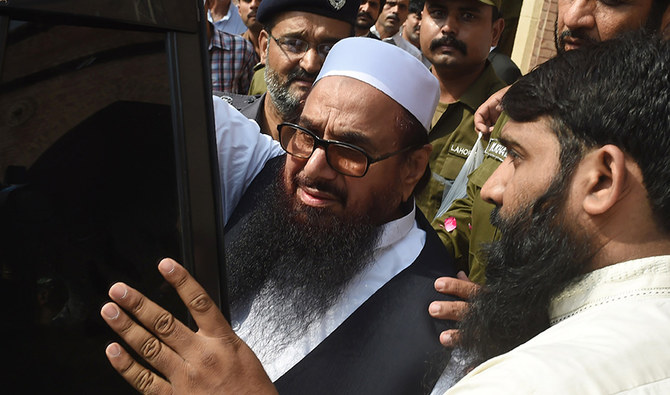
Pakistani policemen escort the head of the Jamaat-ud-Dawa (JuD) organisation Hafiz Saeed (C) as he leaves the court after the expiry of his three-month detention period, in Lahore on October 17, 2017. (AFP)
Short Url
Updated 12 December 2019
Follow

Pakistan’s Hafiz Saeed indicted on ‘terror financing’ charges

  • The alleged Mumbai attacks mastermind denies all allegations of abetting terrorism
  • Pakistan is on FATF’s grey list and risks being blacklisted if it fails to curb terror-financing 

LAHORE – An anti-terrorism court in Lahore indicted Hafiz Muhammad Saeed, chief of the proscribed Jamaat-ud-Dawa (JuD) organization and a UN-declared global terrorist, on terror-financing charges on Wednesday.

“The court has indicted Hafiz Muhammad Saeed in case no 30/19 registered at [the Counter-Terrorism Department] CTD Lahore pertaining to financing terror while has fixed the date December 18, 2019, for indictment in another case of the same nature registered at CTD Gujranwala,” Advocate Imran Fazl Gill, Saeed’s counsel told Arab News.

Saeed and co-accused, Malik Zafar Iqbal, were produced before the court amidst high security on Wednesday where the charges were read out to them.

“Hafiz Muhammad Saeed denied all the charges saying he has never been involved in any terror activities,” Gill said.

The court will hear the case on a day-to-day basis with Saeed’s prosecution to produce evidence against him on Thursday.

Advocates Gill and Naseerud Din Khan Nayyar will defend the accused.

Several cases of terror financing have been registered against Saeed, who was declared a global terrorist by the US and the UN in 2008. 

Four other JuD leaders— Abdul Ghaffar, Hafiz Masood, Ameer Hamza, and Malik Zafar Iqbal are also on the UN list.

On July 1, the CTD registered 23 cases related to terror-financing in Gujranwala and Lahore in the Punjab province.

Authorities say that probes into two charities – that act as a front for the banned Lashkar-e-Taiba group which Saeed founded, namely Jamaat-ud-Dawa and Falah-e-Insaniat Foundation –are underway. 

Counterterrorism officials submitted their findings in court as evidence that these charities were involved in raising money for terrorism.

According to the prosecution, Saeed collected funds using various trusts and non-profit organizations. 

Under pressure from the international community, Pakistan has been probing the JuD and its affiliated organizations since July 2019.

Pakistan formally banned Saeed’s two charities earlier this year. Addressing his case is being considered as a renewed effort by the country to comply with the requirements of the Financial Action Task Force (FATF), a global watchdog on terror-financing.

Pakistan is on the FATF’s grey list and risks being blacklisted, which would result in global sanctions if it fails to curb terror-financing within the country.

Saeed is accused of being the mastermind of the 2008 Mumbai attacks which claimed the lives of nearly 160 people in India’s commercial capital. 

In 2012, the United Nations Security Council placed sanctions on his organization and declared its office bearers as terrorists.

Implementing the UN resolution, Prime Minister Imran Khan recently directed the authorities to implement the National Action Plan while chairing the National Security Committee’s meeting. 


Pakistan reports decline in polio cases in 2025

Updated 4 sec ago
Follow

Pakistan reports decline in polio cases in 2025

  • Cases drop to 30 from 74 in 2024, with no new infections recorded since September
  • Authorities plan intensified targeted drives in 2026 to halt remaining transmission

ISLAMABAD: Pakistan reported a sharp decline in polio cases in 2025, with infections falling to 30 from 74 a year earlier, as intensified vaccination campaigns and improved surveillance helped curb the spread of the virus, health authorities said on Wednesday.

No new polio cases have been recorded anywhere in the country since September, said a statement, as Pakistan carried out six polio campaigns, including five nationwide drives, trying to reach children in high-risk areas and improve monitoring of virus circulation.

Despite the decline, the authorities cautioned that poliovirus continues to circulate in some districts, requiring sustained vigilance to prevent a resurgence.

“Targeted interventions, robust community engagement, and ongoing vaccination efforts remain essential to reach every missed child and prevent any resurgence,” the official statement said.

“Frontline health workers, security personnel, and local authorities continue to work in close coordination to maintain high immunity levels and ensure that Pakistan remains on course toward becoming polio-free,” it added.

The most recent nationwide campaign, conducted from Dec. 15 to 21, achieved more than 98 percent coverage across the country, including all four provinces, Azad Jammu and Kashmir, Gilgit-Baltistan and the capital, Islamabad.

Authorities reported an 18 percent reduction in the number of missed children compared with the previous round, with notable improvements in access and operations in southern Khyber Pakhtunkhwa, a longstanding challenge area.

Pakistan’s polio eradication drive relies on close coordination between health workers, security personnel and local authorities, amid ongoing resistance in some communities and access constraints in remote or insecure regions.

Officials said district-specific interventions, including improved microplanning, better deployment of vaccination teams and enhanced community outreach, were being used to address remaining gaps, particularly in parts of southern Khyber Pakhtunkhwa.

The statement said Pakistan plans to intensify targeted efforts in 2026 to interrupt the remaining transmission chains and move closer to eliminating the disease.