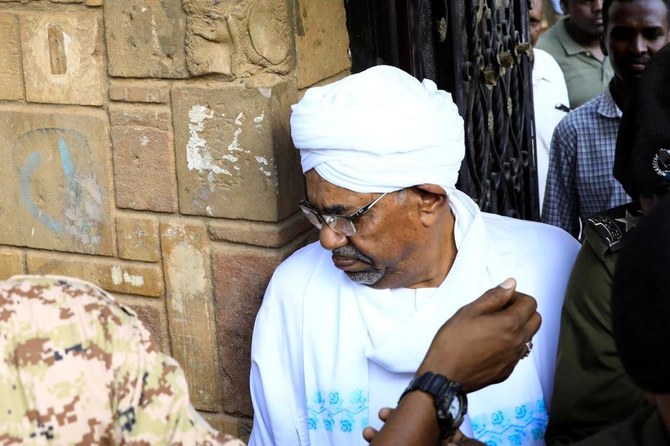
KHARTOUM: Sudan’s former president Omar Al-Bashir appeared on Tuesday before a prosecutors’ committee over the 1989 coup that brought him to power, his lawyer said.
Bashir was “brought to be investigated in the case of the alleged 1989 coup,” said his lawyer, Mohamed Al-Hassan, who did not attend the hearing.
The lawyer also told reporters that in his view the hearing was “not a judicial matter, it’s a political matter.”
In 1989, Bashir, a brigadier at the time, seized power in an Islamist-backed coup that toppled the elected government of prime minister Sadiq Al-Mahdi.
The former president was himself ousted by the army in April of this year after months of nationwide protests against his iron-fisted rule of three decades.
On November 12, Sudanese authorities filed charges against Bashir and some of his aides for “plotting” the 1989 coup. The prosecution established a special committee for the case.
If found guilty, he could face the death penalty or life imprisonment under Sudanese law.
Sudan is now ruled by a joint civilian and military sovereign council, which is tasked with overseeing a transition to civilian rule as demanded by the protest movement.
Bashir is being held in Kober prison in a separate case, for which he has been on trial since August, on charges of illegally acquiring and using foreign funds.
A verdict is due in that case on Saturday.
On Tuesday, Bashir was taken from Kober prison to the prosecutor’s office in a convoy under strong armed protection.
After the hearing, which lasted about an hour, a crowd gathered in front of the prosecutor’s office, chanting “Kober prison — the best place for you!” and “you killed people!“
Wearing the traditional white Sudanese jalabiya and turban, Bashir raised his hands to the crowd, before he set off back toward Kober in the convoy.
The veteran leader is also wanted by The Hague-based International Criminal Court on charges of genocide, war crimes and crimes against humanity over his role in the war in Sudan’s western Darfur region.
To date, Sudanese transitional authorities do not want to extradite the former leader to The Hague.

Sudan’s deposed Bashir questioned over 1989 coup: lawyer
Iran urges US to drop ‘excessive demands’ to reach deal
- Longtime adversaries Iran and the United States held their third round of Omani-mediated nuclear talks on Thursday in Geneva
- Both Iran and Oman cited progress after the talks, with technical discussions scheduled for Monday in Vienna
TEHRAN: Iran’s Foreign Minister Abbas Araghchi said on Friday that in order to reach a deal, the United States will have to drop its “excessive demands,” after the two sides held talks in Geneva.
In a phone call with Egypt’s top diplomat Badr Abdelatty, Araghchi said “success in this path requires seriousness and realism from the other side and avoidance of any miscalculation and excessive demands.”
Araghchi did not clarify what demands he was referring to, but Washington has pointed to Iran’s ballistic missile program and has repeatedly described Tehran’s uranium enrichment capability as a red line.
US President Donald Trump said on Wednesday that Tehran had “already developed missiles that can threaten Europe and our bases overseas, and they’re working to build missiles that will soon reach the United States of America.”
Also on Wednesday, US Secretary of State Marco Rubio said Iran is “not enriching right now, but they’re trying to get to the point where they ultimately can,” adding that Tehran “refuses” to discuss its ballistic missile program and “that’s a big problem.”
Iran has repeatedly said its missile program is part of its defensive capabilities and has ruled out abandoning uranium enrichment, insisting its nuclear program is solely for peaceful purposes.
Longtime adversaries Iran and the United States held their third round of Omani-mediated nuclear talks on Thursday in Geneva, seeking to avert military escalation as Washington expands its military build-up in the region.
Both Iran and Oman cited progress after the talks, with technical discussions scheduled for Monday in Vienna ahead of a fourth round expected next week.
In a phone call with Egypt’s top diplomat Badr Abdelatty, Araghchi said “success in this path requires seriousness and realism from the other side and avoidance of any miscalculation and excessive demands.”
Araghchi did not clarify what demands he was referring to, but Washington has pointed to Iran’s ballistic missile program and has repeatedly described Tehran’s uranium enrichment capability as a red line.
US President Donald Trump said on Wednesday that Tehran had “already developed missiles that can threaten Europe and our bases overseas, and they’re working to build missiles that will soon reach the United States of America.”
Also on Wednesday, US Secretary of State Marco Rubio said Iran is “not enriching right now, but they’re trying to get to the point where they ultimately can,” adding that Tehran “refuses” to discuss its ballistic missile program and “that’s a big problem.”
Iran has repeatedly said its missile program is part of its defensive capabilities and has ruled out abandoning uranium enrichment, insisting its nuclear program is solely for peaceful purposes.
Longtime adversaries Iran and the United States held their third round of Omani-mediated nuclear talks on Thursday in Geneva, seeking to avert military escalation as Washington expands its military build-up in the region.
Both Iran and Oman cited progress after the talks, with technical discussions scheduled for Monday in Vienna ahead of a fourth round expected next week.
© 2026 SAUDI RESEARCH & PUBLISHING COMPANY, All Rights Reserved And subject to Terms of Use Agreement.