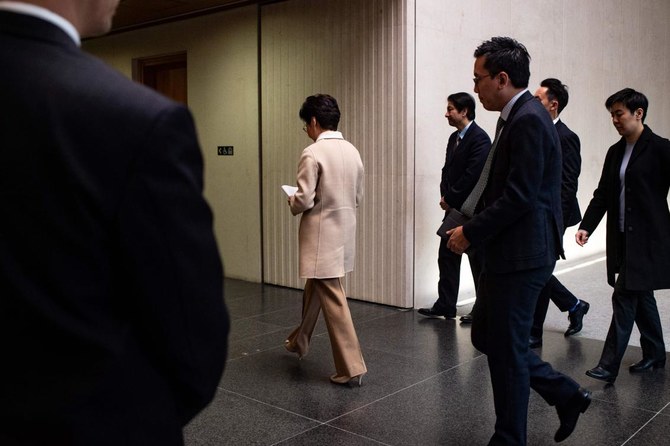
Hong Kong leader Carrie Lam rules out protest concessions ahead of Beijing visit

Hong Kong leader Carrie Lam on Tuesday refused to accept protesters’ demands further to the extradition bill’s withdrawal ahead of her weekend visit to Beijing. (AFP)
Updated 10 December 2019
Follow

Hong Kong leader Carrie Lam rules out protest concessions ahead of Beijing visit

  • In a rare lull in police-protester clashes, around 800,000 people marched peacefully through the city’s streets Sunday
  • ‘How can we completely ignore the rule of law just to fulfill the demands’

HONG KONG: Hong Kong leader Carrie Lam on Tuesday ruled out further concessions to the city’s pro-democracy movement ahead of her weekend visit to Beijing, despite a landslide election defeat for the government and a peaceful mass march.
The movement, which marked its six-month anniversary on Monday, was initially sparked by a now-abandoned attempt to allow extraditions to mainland China but has since morphed into a popular revolt against Beijing’s rule.
In a rare lull in police-protester clashes, around 800,000 people marched peacefully through the city’s streets Sunday, urging the government to respond to their five demands — which include an independent inquiry into the police, an amnesty for those arrested, and fully free elections.
An end to violence is something the city’s pro-Beijing leadership has insisted must be a precursor to meaningful dialogue — but in her weekly press conference on Tuesday, Lam refused to accept protesters’ demands further to the extradition bill’s withdrawal.
“If a particular demand requires us to deviate from the law... I could not agree to accept those demands simply for the purpose of reaching people’s aspirations.”
Lam argued that an amnesty for those arrested — more than 6,000 people since June, 40 percent of them students — would violate the spirit of the rule of law.
“How can we completely ignore the rule of law just to fulfill the demands ... So we have no way to make the response, but we are still willing to examine the social problems reflected by this incident in hope of relieving residents’ grievance,” she added.
Lam said would give a “full account” of what has happened in the city when she goes to Beijing on Saturday for her regular duty visit, which typically involves a meeting with President Xi Jinping.
In late November, the city’s pro-democracy camp won a landslide victory in local elections, which critics described as a referendum for the movement, but Lam and her government remained unrattled.
The movement has upended the semi-autonomous Chinese hub’s reputation for stability and blanketed its streets with unprecedented scenes of political violence.
Despite a lull in clashes in the past two weeks, tension bubbled under the surface as police defused two improvised mail bombs discovered near a school and seized firearms including a pistol during overnight raids.


Venezuela to debate historic amnesty bill for political prisoners

Updated 3 sec ago
Follow

Venezuela to debate historic amnesty bill for political prisoners

  • Venezuela could pass a landmark bill on Thursday granting amnesty to political prisoners, marking an early milestone in the transition from the rule of toppled leader Nicolas Maduro
CARACAS:Venezuela could pass a landmark bill on Thursday granting amnesty to political prisoners, marking an early milestone in the transition from the rule of toppled leader Nicolas Maduro.
The legislation, which covers charges used to lock up dissidents under Maduro and his predecessor Hugo Chavez, aims to turn the page on nearly three decades of state repression.
It was spearheaded by interim president Delcy Rodriguez, who replaced Maduro after he was captured by US forces in Caracas last month and flown to New York to face trial.
Rodriguez took Maduro’s place with the consent of US President Donald Trump, provided she does Washington’s bidding on access to Venezuelan oil and expanding democratic freedoms.
She has already started releasing political prisoners ahead of the pending amnesty. More than 400 people have been released so far, according to rights group Foro Penal, but many more are still behind bars.
Rodriguez also ordered the closure of the notorious Helicoide prison in Caracas, which has been denounced as a torture center by the opposition and activists.
Lawmakers voted last week in favor of the amnesty bill in the first of two debates.
The second debate on Thursday coincides with Youth Day in Venezuela, which is traditionally marked by protests.
Students from the Central University of Venezuela, one of the country’s largest schools and home to criticism of Chavismo, called for a rally on campus.
Venezuela’s ruling party also announced a march in the capital Caracas.
’We deserve peace’
Venezuela’s attorney general said Wednesday that the amnesty — which is meant to clear the rap sheets of hundreds of people jailed for challenging the Maduro regime — must apply to both opposition and government figures.
He urged the United States to release Maduro and his wife, both in detention in New York.
“We deserve peace, and everything should be debated through dialogue,” Attorney General Tarek William Saab told AFP in an interview.
Delcy Rodriguez’s brother Jorge Rodriguez, who presides over the National Assembly, said last week that the law’s approval would trigger the release of all political prisoners.
“Once this law is approved, they will all be released the very same day,” he told prisoners’ families outside the notorious Zona 7 detention center in Caracas.
’We are all afraid’
Venezuelan opposition leader Juan Pablo Guanipa was one of the detainees granted early release.
But he was re-arrested less than 12 hours later and put under house arrest.
Authorities accused him of violating his parole after calling for elections during a visit to Helicoide prison, where he joined a demonstration with the families of political prisoners.
Guanipa is a close ally of Nobel Peace Prize laureate and opposition leader Maria Corina Machado, who was in hiding for over a year before she fled the country to travel to Oslo to receive the award.
“We are all afraid, but we have to keep fighting so we can speak and live in peace,” Guanipa’s son told reporters outside his home in Maracaibo.