

Pakistan’s ‘Lion King’ rears 11 big cats at Peshawar home

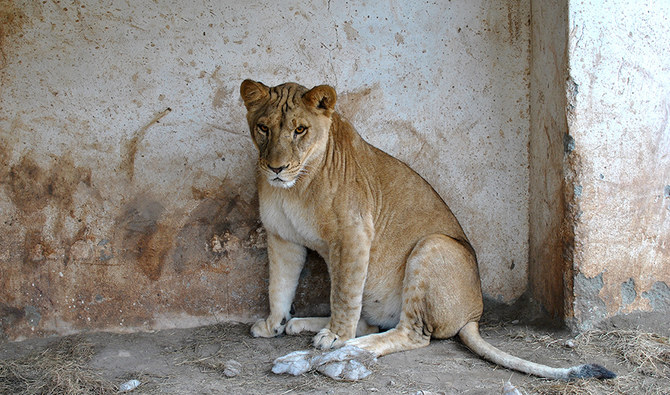
Pictured here is Gul's African lion, Maily. (AN Photo by Saba Rehman)
Short Url
Updated 10 December 2019
Follow

Pakistan’s ‘Lion King’ rears 11 big cats at Peshawar home

  • Arab Gul says there is a separate place to house each one of his cherished pets
  • They include two white lions which are a rare breed in the world

Peshawar: There’s a Mufasa and a Simba, but it’s 50-year-old Arab Gul who is the undisputed ‘lion king’ of the Muslim Town in Peshawar, capital of Pakistan’s Khyber Pakhtunkhwa province.
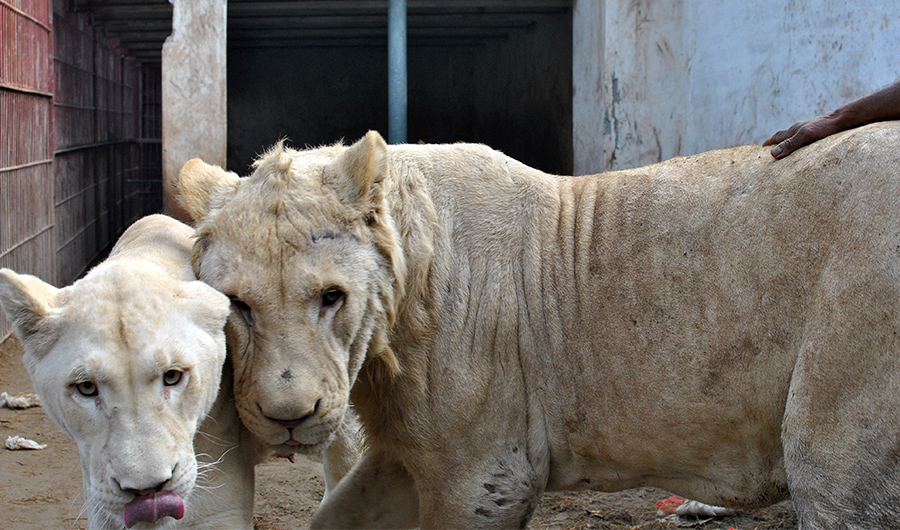


Both Mufasa and Simba are unique because they are a rare breed of white lions. Only a few are found in Lahore, Pakistan, but except for Gul, there's no one else who keeps them at home. (AN Photo by Saba Rehman)

With three lions currently in Islamabad for training, Gul has a total of 11 big cats under his care.
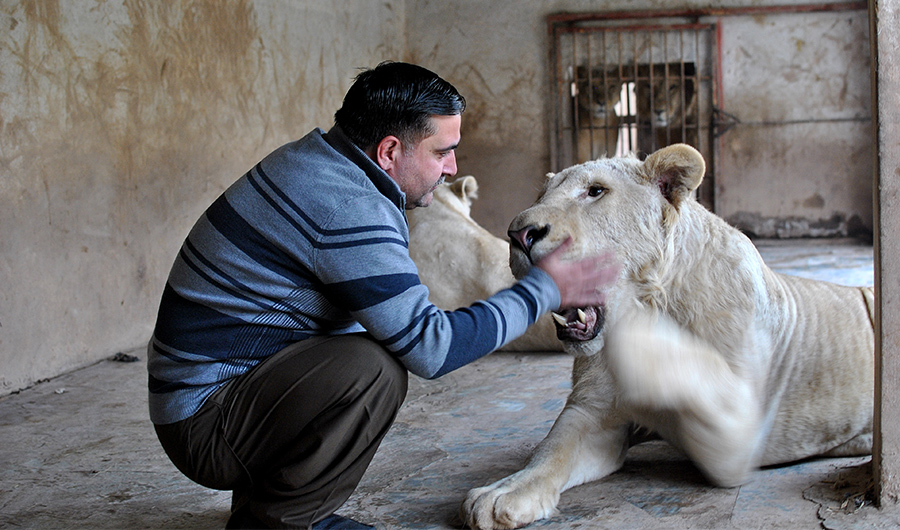


Arab Gul, who said he grew fond of lions from a very early age, is seen here interacting with his pets during a routine morning visit at his home in Peshawar on Monday. (AN Photo by Saba Rehman)

It’s a love, he says, which he’s nurtured from childhood.

“I started rearing them four years ago with two white lions who were imported from Sri Lanka. White lions are a rare breed in the world. In Pakistan, two of them – Mufasa (male) and Simba (female) – are with me. A dealer imported them from Sri Lanka. Later, I bought them from him,” he said.
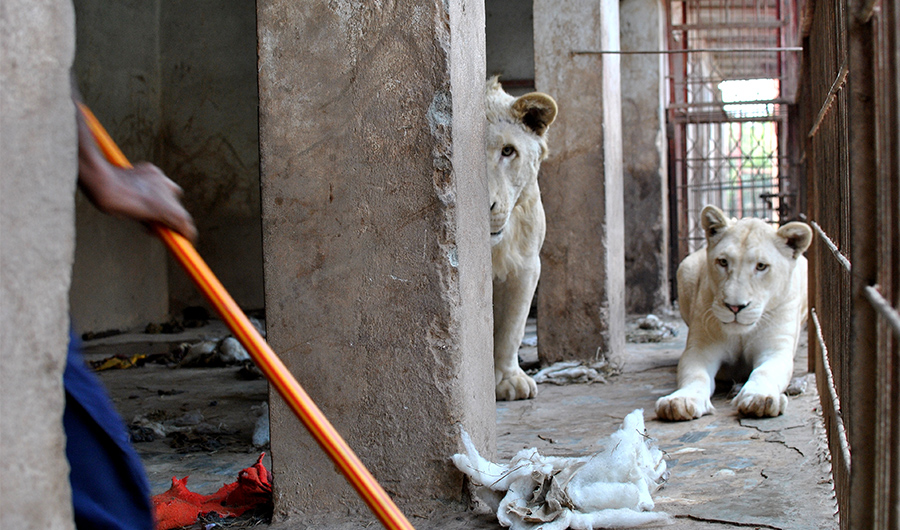


The two white lions seen here, Mufasa and Simba, were imported from Sri Lanka, and have three cubs. (AN Photo by Saba Rehman)

White lions are a rare breed in Pakistan, too, with only a few in Lahore. However, unlike Gul, no one keeps them at home.

That, however, doesn’t seem to bother residents of his locality who treat Gul like a celebrity for keeping unique pets at home.

Located along Dilazak road on the outskirts of Peshawar, his residence in Muslim Town is spread over an area of 0.375 acres and houses a separate place for each of the lions.

Feeding his “family members,” however, is no piece of cake, Gul says.
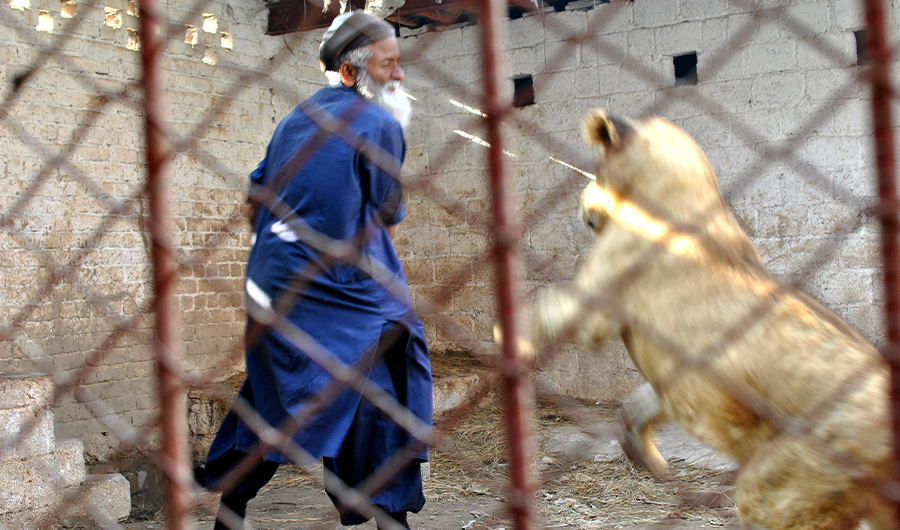


Enhaj Khan is one of the caretakers of the lions. (AN Photo by Saba Rehman)

“In one week, we give them beef for four days and chicken for two, with a one day break. Each lion consumes about six kgs of beef and 10 kgs of chicken, in addition to one liter of milk on a daily basis,” he said.

After their scheduled meals, the lions are unchained for two hours every day for a walk in the residential lawns.

EnHajj Khan, one of Gul’s employees, is responsible for the lions’ care and said he’s never been afraid of taking care of the “king of the jungle.”
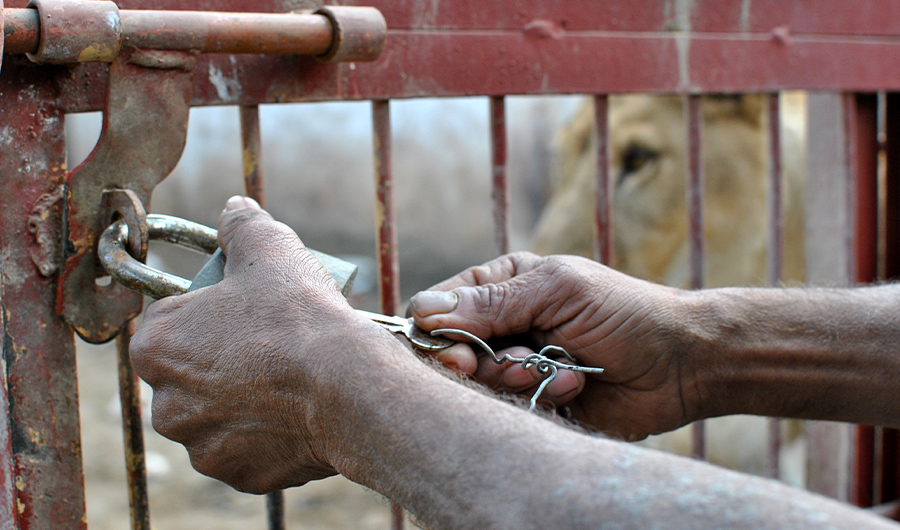


At Arab Gul’s home in Peshawar, there is a separate place for every lion which is secured from outside. (AN Photo by Saba Rehman)

“I am working here from the past four years. I haven’t received any training but take care of them on my own,” Khan, 60, said, adding that’s it wonderful to see people visiting the house to see the lions for free.

Gul says he’s unperturbed by the flow of visitors who usually visit at noon.

“CCTV cameras ensure the animals’ security and I keep watch on my phones,” he said.


Pakistan to begin first phase of Hajj 2026 trainings from today

Updated 18 sec ago
Follow

Pakistan to begin first phase of Hajj 2026 trainings from today

  • Training programs to be held in phases across Pakistan till February, says religion ministry
  • Saudi Arabia allocated Pakistan a total quota of 179,210 pilgrims for Hajj 2026

ISLAMABAD: Pakistan’s religious affairs ministry has said that it will begin the first phase of mandatory Hajj 2026 training for pilgrims intending to perform the pilgrimage from today, Thursday.

The one-day Hajj training programs will be held in phases across the country at the tehsil level until February. The ministry directed intending pilgrims to bring their original identity cards and the computerized receipt of their Hajj application to attend the training sessions.

“Pilgrims should attend the one-day training program according to their scheduled date,” Pakistan’s Ministry of Religious Affairs (MoRA) said in a statement.

The ministry said training schedules are being shared through the government’s Pak Hajj 2026 mobile application as well as via SMS. It added that details of the schedule are also available on its website.

According to the ministry, training programs will be held in Abbottabad on Jan. 2; Ghotki, Thatta and Kotli on Jan. 3; and Tando Muhammad Khan and Khairpur on Jan. 4.

Hajj training sessions will be held in Rawalakot, Badin and Naushahro Feroze on Jan. 5, while pilgrims in Fateh Jang, Dadu and Tharparkar will receive the training on Jan. 6.

The ministry said training programs will be conducted in Umerkot and Larkana on Jan. 7, followed by sessions in Mirpurkhas, Shahdadkot and Mansehra on Jan. 8.

Pakistan’s religious affairs ministry has previously said these trainings will be conducted by experienced trainers and scholars using multimedia.

It said the training has been made mandatory to ensure that intending pilgrims are fully aware of Hajj rituals and administrative procedures.

Saudi Arabia has allocated Pakistan a quota of 179,210 pilgrims for Hajj 2026, of which around 118,000 seats have been reserved under the government scheme, while the remainder will be allocated to private tour operators.

Under Pakistan’s Hajj scheme, the estimated cost of the government package ranges from Rs1,150,000 to Rs1,250,000 ($4,049.93 to $4,236), subject to final agreements with service providers.