DUBAI: Dubai hosts the 12th edition of the Arab Strategy Forum (ASF) on Monday with “Forecasting the Next Decade” as its theme.
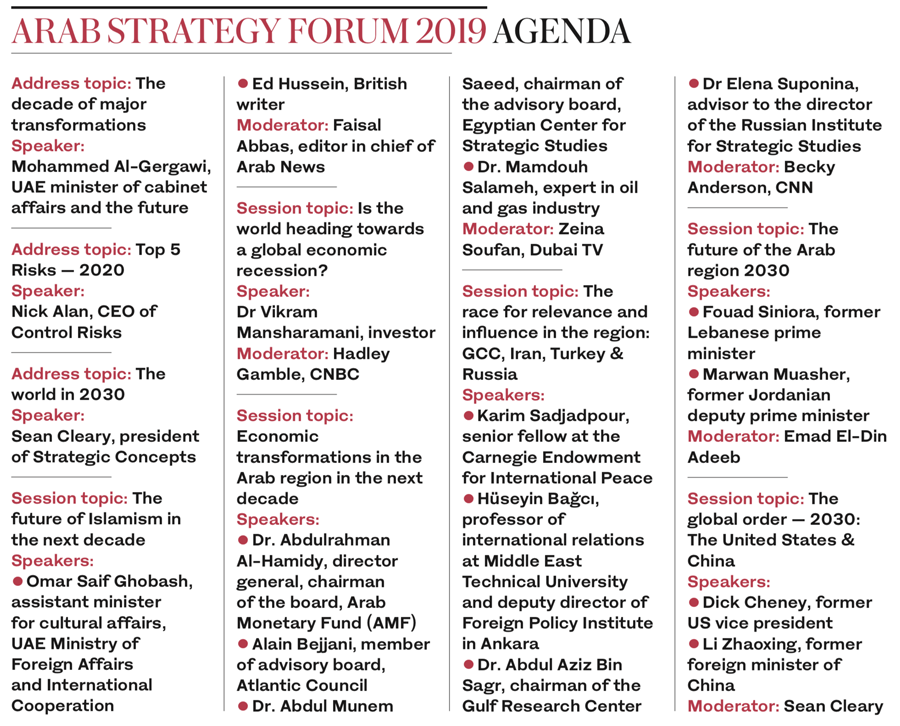
Panel discussions and speeches at the one-day event will explore and forecast the events and trends anticipated to unfold over the next 10 years, and their impact on politics, socio-economic frameworks, international relationships and diplomacy.
In addition, ASF will issue three reports that attempt to predict the social conditions of the next decade.
Held under the patronage of Dubai’s ruler, Sheikh Mohammed bin Rashid Al-Maktoum, at the Ritz Carlton DIFC, this year’s edition will draw the participation of 18 keynote speakers, including former ministers, government officials, industry experts, international strategists, writers and media professionals.
Omar Saif Ghobash, assistant minister for cultural affairs at the UAE’s Ministry of Foreign Affairs and International Cooperation, and British writer Ed Hussein, will take part in a panel discussion moderated by Faisal J. Abbas, editor-in-chief of Arab News, on the findings of a pan-Arab study titled “Mosque and state: How Arabs see the future.”
The research, whose findings will be unveiled at the ASF, was commissioned by Arab News and conducted by YouGov using online interviews of 3,079 Arabic speakers aged 18 years or above, and residing across 18 countries of the Middle East and North Africa (MENA) region.
The findings suggest Arabs harbor deep dissatisfaction at religion being misused by politicians. It also portends the decline of religion-based political parties and extremist organizations in 10 years' time.
The study sought the views and concerns of Arabs on the top problems for their countries, the MENA region’s main conflict drivers, women’s empowerment and the intersection of religion and politics in their lives.
“The findings of this study, which are perhaps backed with the reality unfolding on the ground in Lebanon and Iraq today, is that Arabs will no longer forgive political exploitation and corruption, and religious parties are no longer an exception,” Faisal J. Abbas said.
“When you dive into the findings of this poll, perhaps the events unfolding should come as no surprise. Yes, the Arab world is predicted to remain religious, but people overwhelmingly want religion to be a private matter and source for spiritual guidance, not political decision making.”
A separate ASF discussion will debate whether the world is heading into the next decade by starting with a global economic recession and what can be done to mitigate its effect.
“The forum presents today’s challenges and opportunities to the world’s leading decision-makers who can address them in a precise, balanced and politically scientific manner, so we can best learn how to anticipate, manage and maintain socio-political equilibrium in the region and beyond,” said Saeed Al-Etr, assistant secretary-general of the Mohammed bin Rashid Al-Maktoum Global Initiatives Foundation.
“Hosting this tolerant, open-minded, future-forward approach to tackling the big issues that face our world, is paramount to our aims to bring greater harmony and unity to the world, and a testament to the UAE’s continuous efforts to spread a culture of tolerance and coexistence by forecasting and preparing for the future.”