

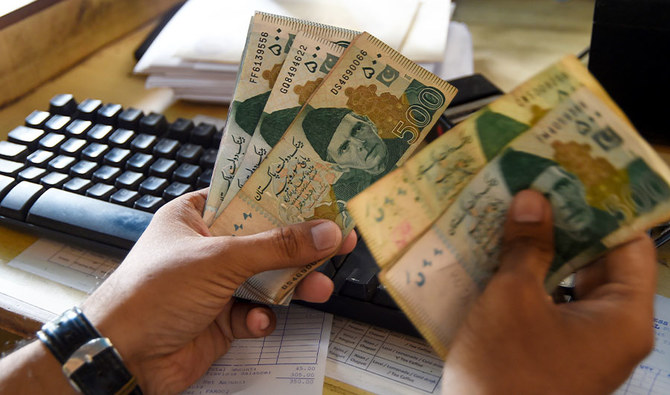

KARACHI: The recent surge of the Pakistani rupee against the US dollar can be attributed to slowing imports and declining demand for the greenback, said currency dealers and economic experts while talking to Arab News on Sunday.
The US dollar traded at Rs154.70 in the open market on Saturday, its highest value since June 26, 2019, when it stood at Rs164.
In the interbank market, the rupee went up by 3.1 percent against the greenback.
“The Pak rupee closed at 155.07 against the US dollar in the interbank market, appreciating by 3.1 percent,” Samiullah Tariq, who works as the director of research at the Arif Habib Limited, told Arab News while looking at the interbank rates. “The bid for US dollar closed at 154.87, breaching the psychological level of Rs155 and making the national currency surge to a five-month high.”
The rupee is stabilizing due to a 19.2 percent decline in the country’s imports which was recorded during the first four months of the current fiscal year (FY20, July-October 2019) as compared to the corresponding period of the last fiscal year (FY19).
The recent investment inflows of more than $1 billion by international businesspeople who want to benefit from higher interest rates in the country have also jacked up the value of the local currency against the dollar.
These inflows have also strengthened Pakistan’s currency reserves after it decided to go for the $6billion bailout package offered by the International Monetary Fund (IMF) and borrow money from other lending agencies, such as the Asian Development Bank (ADB).
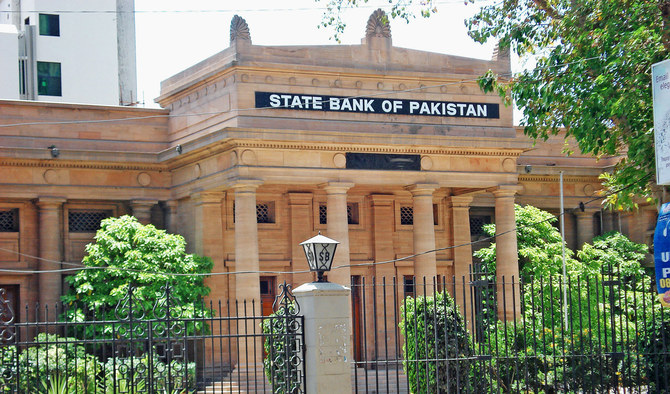
The total liquid foreign reserves held by the country stood at $15.99 billion on November 29, 2019, the State Bank of Pakistan said this week.
Pakistan is also benefiting from deferred oil payments, a $3 billion facility offered by Saudi Arabia which was activated in July this year.
Currency dealers say that customers are now purchasing rupees instead of dollars since the gains on investment in the former currency are much higher.
“Exchange companies are now buying dollars from the public and feeding the interbank market with around $10-12 million daily,” President Forex Association of Pakistan Malik Bostan told Arab News. “Since May this year, we have given $2 billion to the interbank market and $3 billion since December 2018.”
Currency dealers say they are depositing dollars in the interbank market despite low-profit margins and high cost of doing business.
“The government gives Rs6 on the inflow of each dollar to banks, but we don’t get such incentives. We are also contributing to the national reserve. Yet, it is becoming extremely difficult for us to do business,” he continued.
Bostan said that the expected inflow of £190 million ($244 million) recovered from a business tycoon by the United Kingdom’s National Crime Agency (NCA) has also improved sentiment in the currency market. “This is very positive for Pakistan and those who have stashed money abroad illegally will be forced to bring it back since the concept of safe havens abroad is gradually fading away.”
He added that he expected the rupee to further appreciate in the coming days due to higher inflows of dollars and increased buying of Pak rupees.
However, some analysts said the national currency would not appreciate further.
“The Pakistani rupee will remain stable. There are little chances of it appreciating from here,” Samiullah Tariq told Arab News.


