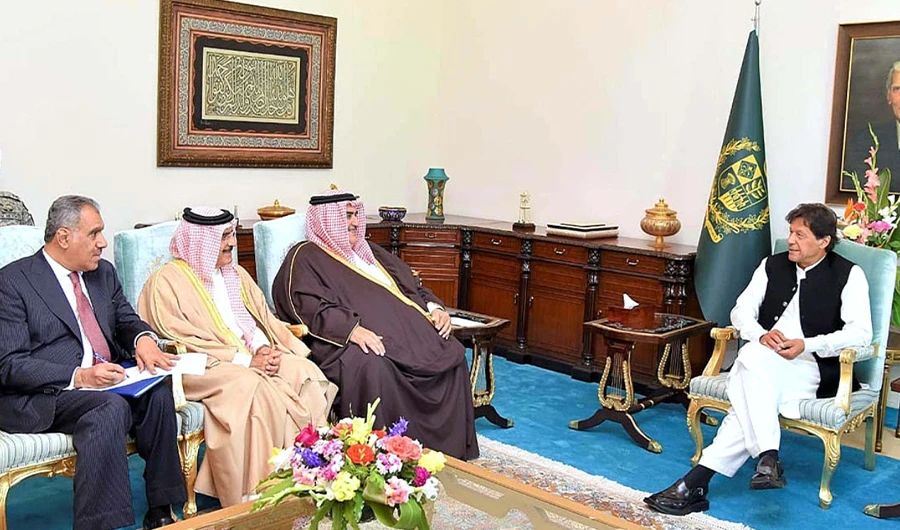
ISLAMABAD: Pakistan’s Prime Minister Imran Khan will receive Bahrain’s highest civil award, the King Hamad Order of the Renaissance, during an upcoming visit to the Kingdom, a senior aide said on Thursday.
“Prime Minister is going on an official visit to Bahrain in the mid of December where he will be conferred Bahrain’s highest civilian award,” Special Assistant to the Prime Minister for Overseas Pakistanis, Sayed Zulifkar Bukhari, told Arab News, adding that Khan would receive the award at a special ceremony to be held during his visit.
On August 25, Indian Prime Minister Narendra Modi was also conferred the King Hamad Order of the Renaissance by Bahraini King Hamad bin Isa bin Salman Al Khalifa during a visit to the Kingdom.
The Pakistani premier is expected to leave on a three-country tour on December 15, starting with Bahrain, followed by Switzerland where he will address a global conference on refugees in Geneva, and finally Malaysia.
During this visit to Bahrain, Khan will meet his counterpart Khalifa bin Salman Al Khalifa and King Hamad bin Isa Al Khalifa. He will also participate in Bahrain’s national day celebrations.
Earlier this year during a visit to Islamabad, the National Guard of the Kingdom of Bahrain, Lt. General Sheikh Mohammed bin Isa bin Salman Al Khalifa, extended an invitation to Khan to visit Bahrain on behalf of the prime minister of the Kingdom of Bahrain.
Bahrain to confer highest civilian award on Pakistani PM Khan
- Award to be given at a special ceremony during Khan’s upcoming visit to Bahrain
- PM expected to leave for a trip to Bahrain, Switzerland and Malaysia starting December 15
Pakistan issues over $7 billion sukuk in 2025, nears 20 percent Shariah-compliant debt target
- Finance Adviser Khurram Schehzad says this was the highest-ever Sukuk issuance in a single calendar year since 2008
- Pakistan’s Federal Shariat Court ordered in 2022 the entire banking system to transition to Islamic principles by 2027
ISLAMABAD: Pakistan’s Finance Adviser Khurram Schehzad on Monday said the country achieved a landmark breakthrough in Islamic finance by issuing over Rs2 trillion ($7 billion) sukuk this year, bringing it closer to its 20 percent Shariah-compliant debt target by Fiscal Year 2027-28.
A sukuk is an Islamic financial certificate, similar to a bond, but it complies with Shariah law, which forbids interest. Pakistan’s Federal Shariat Court (FSC) had directed the government in April 2022 to eliminate interest and align the country’s entire banking system with Islamic principles by 2027.
Following the ruling, the government and the State Bank of Pakistan (SBP) have undertaken a series of measures, including legal reforms and the issuance of sukuk to replace interest-based treasury bills and investment bonds.
“In 2025, the Ministry of Finance (MoF) through its Debt Management Office, together with its Joint Financial Advisers (JFAs), successfully issued over PKR 2 trillion in Sukuk,” Schehzad said on X, describing it as “the highest-ever Sukuk issuance in a single calendar year since 2008 by Pakistan.”
Pakistan made a total of 61 issuances across one-, three-, five- and 10-year tenors, according to the finance adviser. The country also successfully launched its first Green Sukuk, a Shariah-compliant bond designed to fund environment-friendly projects.
He said the Green Sukuk was 5.4 times oversubscribed, indicating investor demand was more than five times higher than the amount the government planned to raise, which showed strong market confidence.
“The rising share of Islamic instruments in the government’s domestic securities portfolio (domestic debt) underscores strong momentum, growing from 12.6 percent in June 2025 to around 14.5 percent by December 2025, clearly positioning the MoF to achieve its 20 percent Shariah-compliant debt target by FY28,” Schehzad said.
“This milestone also reflects the structural deepening of Pakistan’s Islamic capital market, sustained investor confidence, and the strengthening of sovereign debt management.”
He said Pakistan was strengthening its government securities market by making it more resilient, diversified, and future-ready, supported by a stabilizing macroeconomic environment, a disciplined debt strategy, and a clear roadmap for Islamic finance.