

Pakistan, Saudi Arabia sign Hajj Agreement 2020

Pakistan's Federal Minister for Religious Affairs and Interfaith Harmony signs Hajj agreement in the holy city of Makkah with Saudi Hajj and Umrah Minister Dr. Mohammed Saleh bin Taher Benten on December 4th, 2019. (Photo courtesy: Ministry of Religious Affairs and Interfaith Harmony)
Updated 05 December 2019
Follow

Pakistan, Saudi Arabia sign Hajj Agreement 2020

  • Pakistani delegation seeks to extend the “Road to Makkah” project to other cities of the country as well
  • The two sides agree to set up a joint committee to address any possible complaints of Pakistani pilgrims

ISLAMABAD: Pakistan and Saudi Arabia reached Hajj Agreement 2020 in Makkah, an official handout circulated by the Ministry of Religious Affairs announced on Wednesday, adding that 200,000 Pakistani pilgrims would undertake their spiritual journey to Islam’s most sacred cities next year.

The agreement was signed by Pakistan’s Religious Affairs Minister Noorul Haq Qadri and Saudi Minister for Hajj and Umrah Dr. Mohammad Saleh bin Benten.
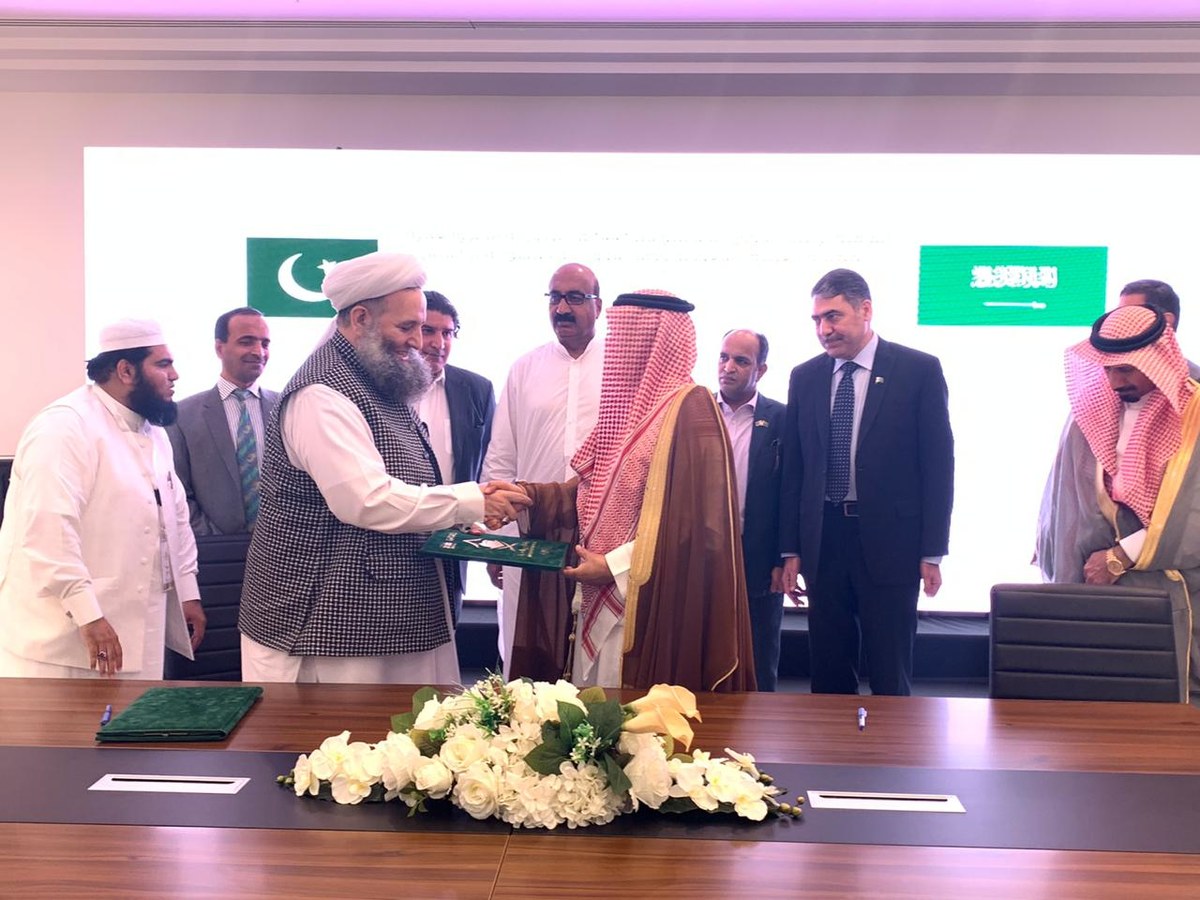


Pakistan's Federal Minister for Religious Affairs and Interfaith Harmony signs Hajj agreement in the holy city of Makkah with Saudi Hajj and Umrah Minister Dr. Mohammed Saleh bin Taher Benten on December 4th, 2019. (Photo courtesy: Ministry of Religious Affairs and Interfaith Harmony)

According to the press release, the Pakistani delegation demanded several facilities for their country’s pilgrims while interacting with the Saudi authorities.

It asked for an additional Hajj quota for Pakistan and said that the “Road to Makkah” project should be extended to other cities as well.

The official handout claimed that the Saudi minister described Pakistan’s participation in the scheme last year as “extremely successful.”

He continued that Pakistan’s request for additional Hajj quota would be taken up with the Kingdom’s higher authorities, though he also said there was limited space in Mina.

The two sides also agreed to set up a joint committee to address any possible complaints from the pilgrims related to Mina, Muzdalifah and Arafat.

The Pakistani delegation will also hold official meetings with Saudi authorities on Thursday.


Pakistan to press ahead with privatization after $441 million net loss in FY2024-25

Updated 5 sec ago
Follow

Pakistan to press ahead with privatization after $441 million net loss in FY2024-25

  • National Highway Authority and power distribution companies are major loss contributors
  • The government says reforms agenda is shifting ‘from diagnosis to delivery’ after PIA sale

KARACHI: Pakistan is pressing ahead with plans to privatize state-owned enterprises (SOEs) after official data released on Friday showed the sector posted a net loss of PKR 122.9 billion ($441 million) in the year ended June 2025, with the government approving new transactions involving power utilities, an international airport and other major assets.

The Cabinet Committee on State-Owned Enterprises, chaired by Finance Minister Muhammad Aurangzeb, reviewed the Annual Consolidated Performance Report of SOEs for the fiscal year ended June 2025. The report was prepared by the Finance Division’s Central Monitoring Unit, which showed SOEs remain a significant drag on public finances.

“The Committee was informed that during FY 2024-25, aggregate revenues of SOEs stood at approximately PKR 12.4 trillion [$44.6 billion], reflecting a decline largely attributable to reduced profitability in the oil sector following lower international oil prices,” said an official statement circulated by the Finance Division.

“Aggregate profits of profit-making SOEs declined by 13 percent to PKR 709.9 billion [$2.55 billion] compared to PKR 820.7 billion [$2.95 billion in the preceding year], while aggregate losses of loss-making SOEs showed improvement, declining by around 2 percent to PKR 832.8 billion [$2.99 billion],” it added. “Despite this improvement, the net result was an overall net loss of PKR 122.9 billion [$441 million] for the SOE sector, compared to a net loss of PKR 30.6 billion [$110 million] in the previous year.”

It was highlighted that losses remain heavily concentrated in a small number of entities, particularly in the transport and power distribution sectors.

“National Highway Authority and several power distribution companies continued to be major loss contributors, reflecting structural issues, high depreciation, financing costs, and the public service nature of certain operations that are not commercially viable,” the statement said.

It added the cabinet committee directed that the findings of the report be shared with relevant ministries to inform reform measures and that progress on audits, governance reforms, debt rationalization and fiscal risk containment be reviewed regularly.

In a separate post on X, government finance adviser Khurram Schehzad said the SOE reform agenda was shifting “from diagnosis to delivery,” citing recent privatizations including First Women Bank, the shutdown of Utility Stores Corporation and progress on Pakistan International Airlines.

The Privatization Commission also held a meeting during the day, saying it would also move ahead with the privatization of power distribution companies while recommending that Islamabad International Airport be included in the privatization program under an open, competitive concession model.

It also decided to restart the sale process for House Building Finance Company Limited after terminating an earlier negotiated transaction that failed to meet valuation benchmarks.

Pakistan is implementing structural reforms under a $7-billion program agreed with the International Monetary Fund, which has urged Islamabad to rein in losses at state firms and reduce fiscal risks stemming from debt and guarantees.