Germany kicks out Russian diplomats over Berlin murder

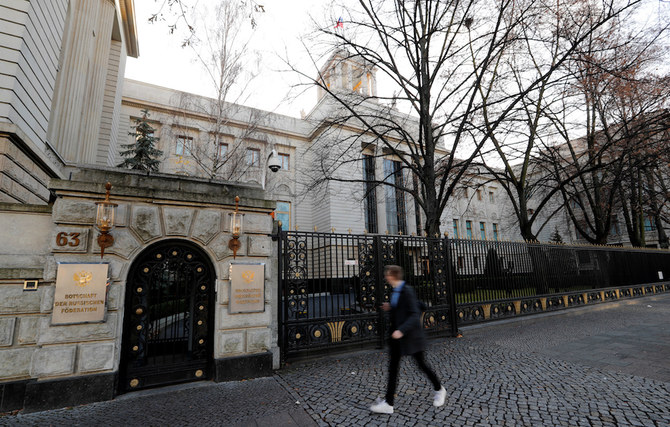
A general view shows the Russian embassy after Germany expelled two Russian diplomats in Berlin, Germany, December 4, 2019. (Reuters)
Updated 04 December 2019
Follow

Germany kicks out Russian diplomats over Berlin murder

  • After Germany’s move, a Russian foreign ministry representative pledged “retaliatory measures.”
  • German media said the suspicion was that Russian intelligence agencies had recruited him after the 2013 killing

BERLIN: Germany expelled two Russian diplomats on Wednesday after prosecutors said Moscow could be behind the killing of a former Chechen rebel commander in a Berlin park.
Zelimkhan Khangoshvili, a 40-year-old Georgian national, was shot twice in the head at close range in Kleiner Tiergarten park on August 23, allegedly by a Russian man who was arrested shortly afterwards.
The case has been compared with the poisoning of former Russian agent Sergei Skripal in Britain last year with a Soviet-era nerve agent, widely blamed on Russian intelligence.
The attempted murder plunged relations between Britain and Russia into a deep freeze, leading to tit-for-tat diplomatic expulsions.
After Germany’s move on Wednesday, a Russian foreign ministry representative pledged “retaliatory measures.”
“A politicized approach to investigation issues is unacceptable,” said the representative, adding that Germany’s statements were “groundless and hostile.”
The suspect in the Berlin killing was said to be riding a bicycle and was seen by witnesses afterwards throwing the bike and a stone-laden bag with a gun into a river.
He has until now been named by police only as Vadim S but evidence revealed by German prosecutors on Wednesday indicated a possible fake identity.
“The foreign ministry has today declared two employees of the Russian embassy in Berlin as personae non gratae with immediate effect,” the ministry said in a statement.
“Despite repeated high-ranking and persistent demands, Russian authorities have not cooperated sufficiently in the investigation into the murder.”
Federal prosecutors in charge of intelligence cases earlier on Wednesday said they had taken over the investigation.
“There is sufficient factual evidence to suggest that the killing... was carried out either on behalf of state agencies of the Russian Federation or those of the Autonomous Chechen Republic,” the prosecutor’s office said in a statement.
Chechnya has been led with an iron fist since 2007 by Ramzan Kadyrov, a close ally of Russian President Vladimir Putin.
Outlining the results of their investigation so far, the statement said Vadim had traveled from Moscow to Paris on August 17 and then on to Warsaw on August 20.
He left his hotel in Warsaw on August 22 and his movements between then and the murder were unclear, it said.
Prosecutors said his visa for traveling to Europe indicated he was a civil engineer working for a company in Saint Petersburg.
But the company was not operational and a fax number for the firm was registered to another company belonging to Russia’s defense ministry.
Prosecutors said the man’s features matched those of a suspect in a 2013 murder in Moscow in which the suspect also approached the victim on a bicycle.
The investigative website Bellingcat on Tuesday said the suspect in both murders was 54-year-old Vadim Krasikov, who grew up in Kazakhstan when it was part of the Soviet Union before spending time in Siberia.
German media said the suspicion was that Russian intelligence agencies had recruited him after the 2013 killing.
Bellingcat said the victim had fought in the second Chechen war in 1999-2002, then continued supporting Chechen separatists from his native Georgia.
He also lived for a time under an assumed identity as Tornike Kavtarashvili, according to media reports.
Bellingcat said he “recruited and armed” a volunteer unit to fight Russian troops in Georgia in 2008.
After surviving two assassination attempts in Georgia, he had spent recent years in Germany and applied for asylum.


From AI to Starlink: how drone tech is reshaping war in Ukraine

Updated 4 sec ago
Follow

From AI to Starlink: how drone tech is reshaping war in Ukraine

KYIV: As the war in Ukraine drags into its fifth year, drones have come to completely dominate the front line — a transformation in modern warfare that is being watched around the world.
Here is a look at the technology that is reshaping the war, four years after Russia launched its full-scale invasion by pouring tanks and men over the border:

- Kill zone -

Ranging from cheap commercial devices designed for civilian use to explosive-packed miniature aircraft, drones are responsible for up to 80 percent of battlefield damage, Ukraine’s Defense Minister Mykhailo Fedorov has said.
“Modern warfare is now impossible without drones,” Koleso, a Ukrainian infantry soldier, told AFP in eastern Ukraine.
The front line has been transformed into a “kill zone” stretching up to 20 kilometers (12 miles) deep — “an area between two sides where nothing can survive because it’s constantly monitored by drones,” military expert Kateryna Bondar explained.
Soldiers can only operate there in small groups, moving fast and with their eyes fixed to the sky, hoping to stay undetected.
Heavy pieces of artillery, as well as sluggish tanks and armored vehicles, are too slow and visible — making them easy targets for both sides.
Unwilling to send more men that necessary into the kill zone, Ukrainian troops use ground drones to ferry supplies to dangerous areas and to evacuate wounded soldiers.

- Fibre optics -

Maintaining a stable connection between the drone and its operator, controlling it remotely, is a crucial task.
“That’s where the real race is happening — communications and connections,” Bondar said.
Initially, most drones operated on a radio connection.
But they proved vulnerable to electronic warfare — the practice of jamming and intercepting enemy craft, causing them to drop out of the sky or lose connection to the operator.
Russia has turned to drones controlled by ultra-thin fiber-optic cables, largely immune to electronic jamming.
In scenes that resemble a dystopian sci-fi movie, their widespread use has left swathes of frontline cities and fields entombed in webs of cable.

- Starlink -

In another alternative to radio control, Ukrainians have begun attaching Starlink terminals to drones.
This allows them to fly using a satellite Internet connection.
“We need to fly far away with a stable video signal and stable control,” said Phoenix, a commander from Ukraine’s Lasar Group, a pioneer in the use of Starlink.
Russian troops soon started copying, until Ukraine pushed Elon Musk last month to disable unauthorized Russian terminals.
The move disrupted both Russian and Ukrainian systems, military observers said.
The US-based Institute for the Study of War said the switch-off likely helped enable a localized, but rapid, Ukrainian advance in the southern Zaporizhzhia region in early February.

- Air defenses -

The spread of drones has forced a revamp of air defense systems.
Firing advanced missiles — which can cost millions — to down drones worth just a fraction of that is too expensive a response.
Alongside jamming, Ukraine has also developed cheap interceptor drones built specially to destroy other craft mid-air.
“We opened the chapter of the war of drones with drones,” said Marko Kushnir of General Cherry, a leading interceptor drone maker.
Roads near the front have been equipped with protective nets attempting to stop attacking drones, while trucks fitted with anti-drone cages and drone jammers speed along them.
Machine guns are also a last resort to shoot down drones from the sky.
Ukraine’s Western allies have increasingly looked to Kyiv’s experience after Russian drones made repeat incursions into European airspace in recent months.

- AI -

Engineers are racing to equip drones with artificial intelligence to improve their performance.
Ukrainian firms such as The Fourth Law (TFL) say they have developed so-called terminal guidance, which allows AI to take control of a device in the final moments before impact.
This is meant to improve the accuracy of strikes, especially as connection is typically lost in the final moments before a hit.
“Russia and China are also developing such technologies, and if our countries don’t... we will lose,” said TFL’s Maksym Savanevskyi.
But full autonomy remains some way off.
“AI is performing a helping function rather than substituting human,” said Bondar, the military expert.
“I thought they could simply remove people from battle equipment, that it could be fully automated. That’s a naive view,” said former Google CEO Eric Schmidt, now head of SwiftBeat, a company that supplies AI drones to Ukraine’s army.
“For the foreseeable future, you’ll have drones first, people second,” he told a conference in Kyiv.
All the way on the eastern front, Koleso said foot soldiers would always remain relevant.
“Until you plant the flag yourself, with your own hands, and take the position, it cannot be considered yours,” he said.