Musharraf says ready to testify from hospital bed

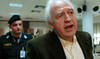
Pakistan's former President Gen retired Pervez Musharraf in a hospital in Dubai on Dec 3, 2019. (Screengrab from his video message)
Updated 04 December 2019
Follow

Musharraf says ready to testify from hospital bed

  • 76-year-old former military ruler is facing high treason charges in Pakistani courts
  • In a video message, invites court rep to record his statement from hospital in Dubai

ISLAMABAD: Pakistan’s former military ruler Gen. Pervez Musharraf said on Tuesday he was willing to testify in a high treason case against him, if investigators travel to Dubai, where he is hospitalized.
Musharraf said in a video message from his hospital bed that a special commission investigating his case “can come here (Dubai).” “I can give them a statement,” he said, “they can come and hear me, see my (health) condition and then decide.”
He added the commission can record his statement to brief the court.
Musharraf, 76, is living in Dubai in self-exile. He has been hospitalized since Monday.
“Musharraf is seriously ill and still hospitalized,” Mehrene Adam Malik, the secretary general of Musharraf’s All Pakistan Muslim League (APML) told Arab News on Wednesday.
“Because of health issues he cannot travel, but is willing to record his statement in front of the court-appointed commission. Musharraf’s point of view must be heard on humanitarian grounds as he cannot travel,” Malik said, adding “there shouldn’t be one-sided verdict.”
Musharraf complained in the video message that his point of view was not being heard and maintained that the high treason case against him was “baseless” as he had served Pakistan for almost a decade.
“Even my lawyer Salman Safdar is not being heard by the court,” he said, claiming that the lawyer “was being treated unjustly.”
The former military ruler has been charged with subverting the constitution and imposing a state of emergency on Nov. 3, 2007, when he was in power.
A special court on Nov. 19 concluded its trial proceedings and wanted to announce a verdict on Nov. 28, but on Nov. 27 the Islamabad High Court (IHC) stopped the process.
The high treason case was filed against Musharraf in 2013 by the then ruling Pakistan Muslim League-Nawaz (PML-N). The general was formally indicted in March 2014.
Musharraf became Pakistan’s first army chief to be charged with treason. He pleaded not guilty and dismissed the charges as being politically motivated.
High treason is punishable by death or life imprisonment under Pakistani law.
Musharraf seized power in a bloodless coup on Oct. 12, 1999, when he was serving as the army chief. He stepped down in 2008, amid mass protests. He was later allowed to leave Pakistan in 2016 for health reasons.


Curfew extended in Gilgit-Baltistan, probe ordered after deadly Khamenei protests

Updated 03 March 2026
Follow

Curfew extended in Gilgit-Baltistan, probe ordered after deadly Khamenei protests

  • At least 15 people were killed in clashes with law enforcement agencies over the weekend in Gilgit-Baltistan
  • Government also announces a de-weaponization campaign, crackdown on hate speech and cybercrime in region

ISLAMABAD: The government in Pakistan’s Gilgit-Baltistan (GB) region on Tuesday extended a curfew in Gilgit district and ordered a judicial probe into violent protests over the killing of Iranian Supreme Leader Ali Khamenei in US-Israeli strikes last week, an official said.

At least 15 people were killed in clashes with law enforcement agencies over the weekend in GB, where protesters torched and vandalized several buildings, including United Nations regional offices, an army-run school, software technology park and a local charity building.

The violence prompted regional authorities to impose curfew in Gilgit and Skardu districts on March 2-4 as officials urged people to stay indoors and cooperate with law enforcers, amid widespread anger in Pakistan, particularly among members of the Shiite minority, over Khamenei’s killing.

On Tuesday, the GB government convened to review the situation and announced the extension of curfew in Gilgit among a number of security measures as well as ordered the establishment of a judicial commission to investigate the weekend violence in the region.

“The government has made it clear that the law will strictly take its course against elements involved in vandalism at government institutions, private properties and incidents of vandalism in Gilgit and Skardu and no kind of mischief will be tolerated,” Shabbir Mir, a GB government spokesperson, said in a statement.

“In view of the security situation, curfew will remain in force in Gilgit, while the decision to extend the curfew in Skardu will be taken keeping the ground realities and the changing situation in view.”

The statement did not specify how long the curfew will remain in place in Gilgit.

Besides the formation of the judicial commission to investigate the violent clashes, the government also decided to launch a large-scale de-weaponization campaign in the entire Gilgit district, for which relevant institutions have been directed to immediately complete all necessary arrangements, according to Mir.

In addition, a crackdown has been ordered on hate speech, spread of fake news and cybercrime.

“The aim of these decisions is to ensure the rule of law, protect the lives and property of citizens and crack down on miscreants,” he said. “Approval has also been given to immediately survey the affected infrastructure and start their restoration work on priority basis.”

Demonstrators in Pakistan’s southern port city of Karachi also stormed the US Consulate on Sunday, smashing windows and attempting to burn the building. Police responded with batons, tear gas, and gunfire, leaving 10 people dead and more than 50 injured.

Pakistani authorities have since beefed up security at US diplomatic missions across the country, including around the US consulate building in Peshawar, to avoid any further violence.