

Pakistan establishes permanent mission to the OIC

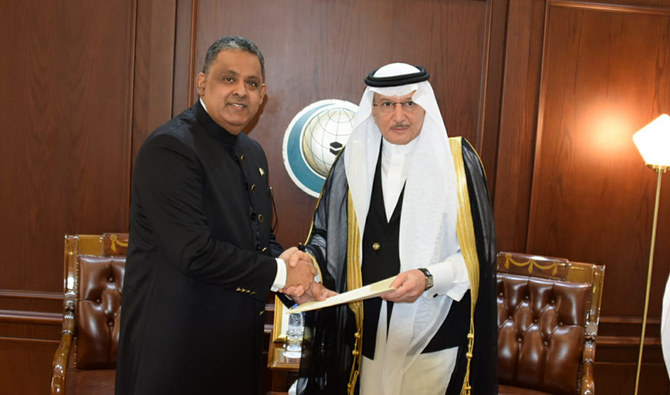
Ambassador Rizwan Saeed Sheikh, Pakistan's newly-appointed Permanent Representative to the Organization of Islamic Cooperation (OIC), is seen here in a meeting with the OIC's Secretary General Dr. Yousaf bin Ahmed Al-Othaimeen, in Jeddah on Monday. (Pic courtesy – Pakistan Consulate in Jeddah).
Updated 03 December 2019
Follow

Pakistan establishes permanent mission to the OIC

  • Earlier, the country's ambassadors to Riyadh represented Islamabad at the OIC
  • The OIC encouraged member states to set up permanent missions in Jeddah for a more efficient dealing

ISLAMABAD: Pakistan’s newly-appointed Permanent Representative to the Organization of Islamic Cooperation (OIC), Ambassador Rizwan Saeed Sheikh, met with the OIC’s Secretary General, Dr. Yousaf bin Ahmed Al-Othaimeen, at the group’s headquarters in Jeddah, Saudi Arabia on Monday.
A statement released by Pakistan’s consulate in Jeddah said that Sheikh then presented his credentials to the OIC’s Secretary General.
“Presentation of credentials by Ambassador Sheikh marked the establishment of Pakistan’s dedicated Permanent Mission to the OIC and other international organizations. Earlier, ambassadors of Pakistan in Riyadh used to represent the country at the OIC,” it added.
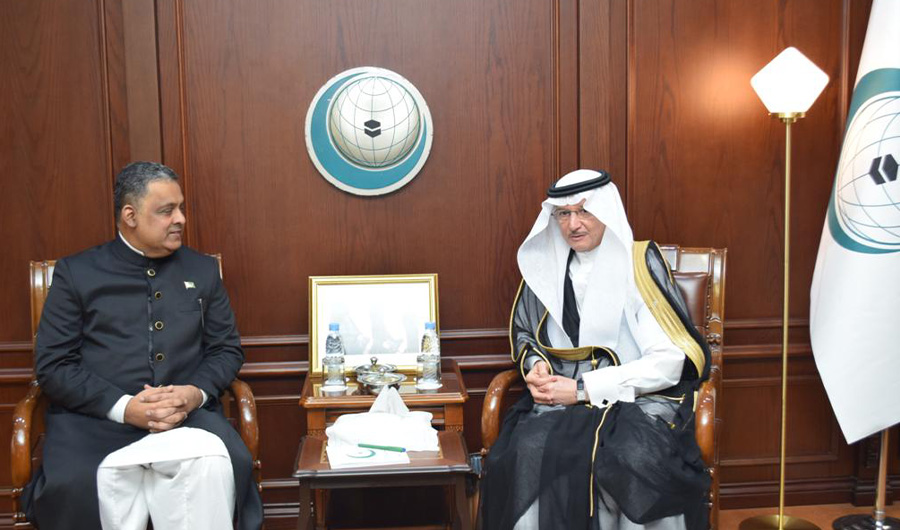


Ambassador Rizwan Saeed Sheikh, Pakistan's newly-appointed Permanent Representative to the Organization of Islamic Cooperation (OIC), is seen here in a meeting with the OIC's Secretary General Dr. Yousaf bin Ahmed Al-Othaimeen, in Jeddah on Monday. (Pic courtesy – Pakistan Consulate in Jeddah).

Pakistan’s decision to establish its permanent mission is an acknowledgement of the OIC’s various resolutions which encourages member states to set up their respective missions in Jeddah and handle their affairs in a more efficient manner.
The establishment of the new mission – which coincides with the golden jubilee celebrations of the OIC – is based on a system-wide approach, reflecting Pakistan’s intent “to strengthen its engagement with the Islamic body and other specialized and subsidiary institutions that are a part of the broader OIC system.”
“As a founding member, Pakistan attaches great importance to the OIC, which apart from lending an institutional expression to the pan-Islamic sentiments is the second largest intergovernmental organization after the UN,” the statement read.
The OIC, for its part, has always extended its consistent support to the Kashmir cause.
Additionally, Islamabad remains one of the largest beneficiaries of the financial assistance provided by the Islamic Development Bank group – a specialized branch of the OIC system.
The statement added that setting up of the permanent mission is also aimed at “enhancing Pakistan’s footprint in the organization and forging a mutually-beneficial, multifaceted relationship with the larger OIC system.”
It follows a two-day visit to Saudi Arabia by Firdous Ashiq Awan, Special Assistant to Prime Minister Imran Khan on Information and Broadcasting on November 25, where she attended the OIC’s golden jubilee celebrations in Jeddah.


Pakistan to begin first phase of Hajj 2026 trainings from today

Updated 31 December 2025
Follow

Pakistan to begin first phase of Hajj 2026 trainings from today

  • Training programs to be held in phases across Pakistan till February, says religion ministry
  • Saudi Arabia allocated Pakistan a total quota of 179,210 pilgrims for Hajj 2026

ISLAMABAD: Pakistan’s religious affairs ministry has said that it will begin the first phase of mandatory Hajj 2026 training for pilgrims intending to perform the pilgrimage from today, Thursday.

The one-day Hajj training programs will be held in phases across the country at the tehsil level until February. The ministry directed intending pilgrims to bring their original identity cards and the computerized receipt of their Hajj application to attend the training sessions.

“Pilgrims should attend the one-day training program according to their scheduled date,” Pakistan’s Ministry of Religious Affairs (MoRA) said in a statement.

The ministry said training schedules are being shared through the government’s Pak Hajj 2026 mobile application as well as via SMS. It added that details of the schedule are also available on its website.

According to the ministry, training programs will be held in Abbottabad on Jan. 2; Ghotki, Thatta and Kotli on Jan. 3; and Tando Muhammad Khan and Khairpur on Jan. 4.

Hajj training sessions will be held in Rawalakot, Badin and Naushahro Feroze on Jan. 5, while pilgrims in Fateh Jang, Dadu and Tharparkar will receive the training on Jan. 6.

The ministry said training programs will be conducted in Umerkot and Larkana on Jan. 7, followed by sessions in Mirpurkhas, Shahdadkot and Mansehra on Jan. 8.

Pakistan’s religious affairs ministry has previously said these trainings will be conducted by experienced trainers and scholars using multimedia.

It said the training has been made mandatory to ensure that intending pilgrims are fully aware of Hajj rituals and administrative procedures.

Saudi Arabia has allocated Pakistan a quota of 179,210 pilgrims for Hajj 2026, of which around 118,000 seats have been reserved under the government scheme, while the remainder will be allocated to private tour operators.

Under Pakistan’s Hajj scheme, the estimated cost of the government package ranges from Rs1,150,000 to Rs1,250,000 ($4,049.93 to $4,236), subject to final agreements with service providers.