Russian scientists present ancient puppy found in permafrost

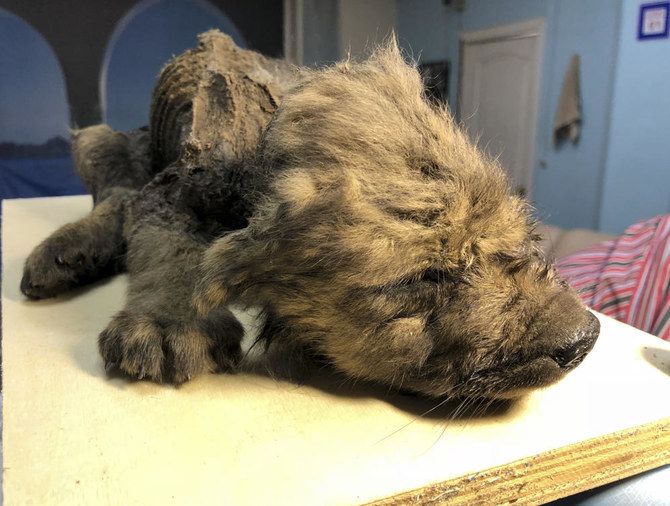
A photo taken on Sept. 24, 2018, showing a 18,000 years old puppy found in permafrost in the Russia's Far East, on display at the Yakutsk's Mammoth Museum, Russia. It was shown to the public on Dec. 2, 2019. (AP)
Updated 02 December 2019
Follow

Russian scientists present ancient puppy found in permafrost

  • When the puppy was discovered, scientists from the Stockholm-based Center took a piece of bone to study its DNA
  • Recently, Russia’s Far East has provided many riches for scientists studying the remains of ancient animals

YAKUTSK: Russian scientists on Monday showed off a prehistoric puppy, believed to be 18,000 years old, found in permafrost in the country’s Far East.
Discovered last year in a lump of frozen mud near the city of Yakutsk, the puppy is unusually well-preserved, with its hair, teeth, whiskers and eyelashes still intact.
“This puppy has all its limbs, pelage – fur, even whiskers. The nose is visible. There are teeth. We can determine due to some data that it is a male,” Nikolai Androsov, director of the Northern World private museum where the remains are stored, said at the presentation at the Yakutsk’s Mammoth Museum which specializes in ancient specimens.
In recent years, Russia’s Far East has provided many riches for scientists studying the remains of ancient animals. As the permafrost melts, affected by climate change, more and more parts of woolly mammoths, canines and other prehistoric animals are being discovered. Often it is mammoth tusk hunters who discover them.
“Why has Yakutia come through a real spate of such unique findings over the last decade? First, it’s global warming. It really exists, we feel it, and local people feel it strongly. Winter comes later, spring comes earlier,” Sergei Fyodorov, scientist with the North Eastern Federal University, told The Associated Press.
“And the second very serious, deep reason, of why there a lot of finds is the very high price of mammoth tusk in the Chinese market.”
When the puppy was discovered, scientists from the Stockholm-based Center for Palaeogenetics took a piece of bone to study its DNA.
“The first step was of course to send the sample to radio carbon dating to see how old it was and when we got the results back it turned out that it was roughly 18,000 years old,” Love Dalén, professor of evolutionary genetics at the center, said in an online interview.
Further tests, however, left the scientists with more questions than answers — they couldn’t definitively tell whether it was a dog or a wolf.
“We have now generated a nearly complete genome sequence from it and normally when you have a two-fold coverage genome, which is what we have, you should be able to relatively easily say whether it’s a dog or a wolf, but we still can’t say and that makes it even more interesting,” Dalén said.
He added that the scientists are about to do a third round of genome sequencing, which might solve the mystery.


Arts festival’s decision to exclude Palestinian author spurs boycott

Randa Abdel Fattah. (Photo/Wikipedia)
Updated 12 January 2026
Follow

Arts festival’s decision to exclude Palestinian author spurs boycott

  • A Macquarie University academic who researches Islamophobia and Palestine, Abdel-Fattah responded saying it was “a blatant and shameless act of anti-Palestinian racism and censorship,” with her lawyers issuing a letter to the festival

SYDENY: A top Australian arts festival has seen ​the withdrawal of dozens of writers in a backlash against its decision to bar an Australian Palestinian author after the Bondi Beach mass shooting, as moves to curb antisemitism spur free speech concerns.
The shooting which killed 15 people at a Jewish Hanukkah celebration at Sydney’s Bondi Beach on Dec. 14 sparked nationwide calls to tackle antisemitism. Police say the alleged gunmen were inspired by Daesh.
The Adelaide Festival board said last Thursday it would disinvite Randa ‌Abdel-Fattah from February’s ‌Writers Week in the state of South Australia because “it ‌would not ​be ‌culturally sensitive to continue to program her at this unprecedented time so soon after Bondi.”

FASTFACTS

• Abdel-Fattah responded, saying it was ‘a blatant and shameless act of anti-Palestinian racism and censorship.’

• Around 50 authors have since withdrawn from the festival in protest, leaving it in doubt, local media reported.

A Macquarie University academic who researches Islamophobia and Palestine, Abdel-Fattah responded saying it was “a blatant and shameless act of anti-Palestinian racism and censorship,” with her lawyers issuing a letter to the festival.
Around 50 authors have since withdrawn from the festival in protest, leaving it in doubt, local media reported.
Among the boycotting authors, Kathy Lette wrote on social media the decision to bar Abdel-Fattah “sends a divisive and plainly discriminatory message that platforming Australian Palestinians is ‘culturally insensitive.'”
The Adelaide Festival ‌said in a statement on Monday that three board ‍members and the chairperson had resigned. The ‍festival’s executive director, Julian Hobba, said the arts body was “navigating a complex moment.”

 a complex and ‍unprecedented moment” after the “significant community response” to the board decision.
In the days after the Bondi Beach attack, Jewish community groups and the Israeli government criticized Prime Minister Anthony Albanese for failing to act on a rise in antisemitic attacks and criticized protest marches against Israel’s war in ​Gaza held since 2023.
Albanese said last week a Royal Commission will consider the events of the shooting as well as antisemitism and ⁠social cohesion in Australia. Albanese said on Monday he would recall parliament next week to pass tougher hate speech laws.
On Monday, New South Wales state premier Chris Minns announced new rules that would allow local councils to cut off power and water to illegally operating prayer halls.
Minns said the new rules were prompted by the difficulty in closing a prayer hall in Sydney linked to a cleric found by a court to have made statements intimidating Jewish Australians.
The mayor of the western Sydney suburb of Fairfield said the rules were ill-considered and councils should not be responsible for determining hate speech.
“Freedom ‌of speech is something that should always be allowed, as long as it is done in a peaceful way,” Mayor Frank Carbone told Reuters.