YAKUTSK: Russian scientists on Monday showed off a prehistoric puppy, believed to be 18,000 years old, found in permafrost in the country’s Far East.
Discovered last year in a lump of frozen mud near the city of Yakutsk, the puppy is unusually well-preserved, with its hair, teeth, whiskers and eyelashes still intact.
“This puppy has all its limbs, pelage – fur, even whiskers. The nose is visible. There are teeth. We can determine due to some data that it is a male,” Nikolai Androsov, director of the Northern World private museum where the remains are stored, said at the presentation at the Yakutsk’s Mammoth Museum which specializes in ancient specimens.
In recent years, Russia’s Far East has provided many riches for scientists studying the remains of ancient animals. As the permafrost melts, affected by climate change, more and more parts of woolly mammoths, canines and other prehistoric animals are being discovered. Often it is mammoth tusk hunters who discover them.
“Why has Yakutia come through a real spate of such unique findings over the last decade? First, it’s global warming. It really exists, we feel it, and local people feel it strongly. Winter comes later, spring comes earlier,” Sergei Fyodorov, scientist with the North Eastern Federal University, told The Associated Press.
“And the second very serious, deep reason, of why there a lot of finds is the very high price of mammoth tusk in the Chinese market.”
When the puppy was discovered, scientists from the Stockholm-based Center for Palaeogenetics took a piece of bone to study its DNA.
“The first step was of course to send the sample to radio carbon dating to see how old it was and when we got the results back it turned out that it was roughly 18,000 years old,” Love Dalén, professor of evolutionary genetics at the center, said in an online interview.
Further tests, however, left the scientists with more questions than answers — they couldn’t definitively tell whether it was a dog or a wolf.
“We have now generated a nearly complete genome sequence from it and normally when you have a two-fold coverage genome, which is what we have, you should be able to relatively easily say whether it’s a dog or a wolf, but we still can’t say and that makes it even more interesting,” Dalén said.
He added that the scientists are about to do a third round of genome sequencing, which might solve the mystery.

Russian scientists present ancient puppy found in permafrost
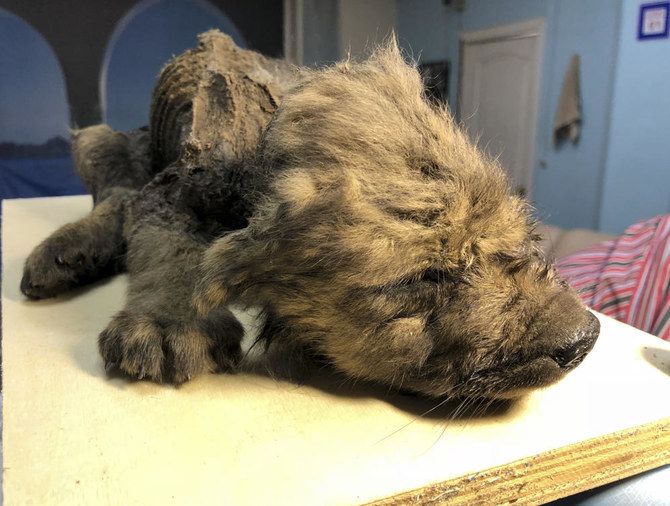
- When the puppy was discovered, scientists from the Stockholm-based Center took a piece of bone to study its DNA
- Recently, Russia’s Far East has provided many riches for scientists studying the remains of ancient animals
Not Italy’s Devil’s Island: Sardinia bristles at mafia inmate plan
- A third of top-risk mafia prisoners could go to Sardinia
- Officials say clans may follow relatives and infiltrate economy
NUORO: In Nuoro, a remote city on the Italian island of Sardinia, a high stone wall rings the local prison, a fortress-like complex once renowned for holding high-profile mobsters and convicted terrorists far from the mainland.
Only a handful of top mafiosi remain detained there and Sardinia is no longer seen as a dumping ground for criminals, instead building an international reputation around tourism.
But that could change under a plan of Prime Minister Giorgia Meloni’s government which has alarmed residents. In December, a justice undersecretary said about 750 prisoners held under the rigid “41bis” regime would be concentrated in just a few dedicated facilities across Italy, overseen by special guard units to improve security.
Sardinia has been told it may get nearly a third of them, split between Sassari in the north, already housing about 90, the capital Cagliari, where around 90 are due to arrive this month, and Nuoro — reviving old stigma concerns.
“Sardinia does not deserve to be seen as Italy’s Cayenne,” said Governor Alessandra Todde, invoking the notorious former French Guiana penal colony on Devil’s Island.
Worries of Mafia infiltration
Italy’s 41bis regime, named after the law that regulates it, is among the most restrictive in Europe. Introduced in 1992 after the murder of anti-mafia judge Giovanni Falcone, it imposes near-total isolation on prisoners and was designed to stop bosses running their operations from behind bars.
The law says it should “preferably” be enforced on Italy’s islands. The late boss of the Sicilian mafia, Salvatore “Toto” Riina, was among those once held in Sardinia.
Locals and authorities fear the government plan could prompt mafia clans to move from mainland Italy to be near jailed relatives, creating opportunities to launder illicit money and infiltrate business, particularly in less developed areas, such as Nuoro, a city of 30,000 people.
Silvio Lai, a Sardinian lawmaker with the opposition Democratic Party, visited the city prison last month and said renovation work was already ongoing, potentially making room for at least 30 new maximum-security inmates.
“Weak economies can be infiltrated easily, and Nuoro is about an hour’s drive from the Costa Smeralda,” Lai said, suggesting a mafia foothold in the city could swiftly spread to the island’s luxurious tourist resort.
The Justice Ministry did not respond to a request to comment on the work.
Improving national security
Autonomous mafia groups have never emerged in sparsely populated Sardinia, but magistrates say investigations have been opened into alleged clan penetration in the north of the island, possibly encouraged by the presence of detained mobsters.
“Prosecutors are keeping a close watch on the phenomenon of Camorra (a mafia group based around Naples) investments... especially in the tourism, hospitality and restaurant sectors,” said Cagliari chief prosecutor Luigi Patronaggio.
At a December meeting with regional officials, Justice Undersecretary Andrea Delmastro Delle Vedove downplayed the risk of a mass move to Sardinia, minutes show, arguing that families of 41bis detainees do not typically leave clan-controlled areas.
“This (plan) will ensure greater national security... will make individual prisons safer because only specialized prison guard units will be deployed,” Delmastro said.
However, Maria Cristina Ornano, head of the sentence enforcement tribunal in Cagliari, said police and the judiciary will need increased security resources if more mobsters arrive.
“Once organized crime takes root here, we will not be able to get rid of it. We can see it in parts of southern Italy, which are among the most


