

Malawi tobacco pressured as US butts in over labor abuses

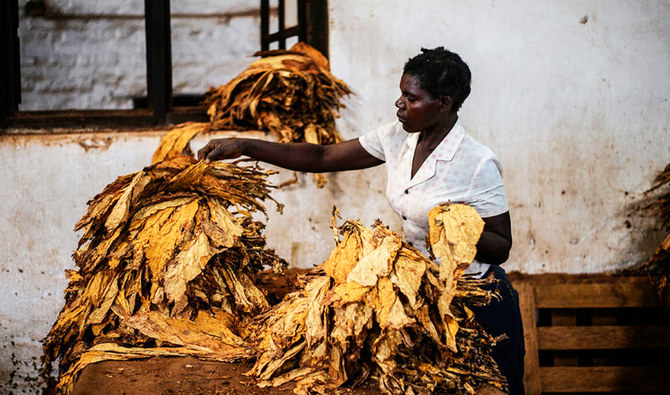
As tobacco, known locally as ‘green gold,’ is Malawi’s top crop in terms of employment, foreign exchange earnings and tax revenue, any trouble the sector runs into could quickly reverberate throughout the economy. (AFP/File)
Updated 01 December 2019
Follow

Malawi tobacco pressured as US butts in over labor abuses

  • As tobacco, known locally as “green gold,” is Malawi’s top crop in terms of employment

BLANTYRE: Malawi is being forced to confront child and forced labor practices after the US restricted tobacco imports from the impoverished southeastern African nation over allegations workers including children were being exploited.

Although exports to the US make up only a small part of Malawi’s total, the US move could make it harder selling its tobacco elsewhere and has sparked anxiety among farmers who fear they will be forced to accept lower prices.

As tobacco, known locally as “green gold,” is Malawi’s top crop in terms of employment, foreign exchange earnings (60 percent) and tax revenue (25 percent), any trouble the sector runs into could quickly reverberate throughout the economy.

The US decision piles even more pressure on the tobacco sector, already confronted with global anti-tobacco campaigns.

The trouble began in late October. British law firm Leigh Day announced it was preparing a landmark class action case against British American Tobacco (BAT) on behalf of 2,000 Malawian farmers, including hundreds of children, for forced labor and poverty wages.

BAT, which says it “takes the issue of child labor extremely seriously,” has denied any wrongdoing and noted that it buys tobacco from Malawi via international dealers who are required adhere to a code of conduct that does not tolerate child and forced labor.

The US suspended imports of tobacco from Malawi, saying it had information that reasonably indicated it was being produced using forced labor and forced child labor.

According to a survey conducted in 2017 by the country’s statistics agency the use of child labor in Malawi is extensive. It found that 38 percent of the country’s children aged between 5 and 17 were working.

Although the survey did not provide specific information about the tobacco sector, it is widely acknowledged that child labor is a problem.

Betty Chinyamunyamu, who heads an association of smallholder farmers, said incidents of child labor occur despite efforts to eliminate the practice.

Closing Bell: Saudi main market ends week in red at 11,189

Updated 05 February 2026
Follow

Closing Bell: Saudi main market ends week in red at 11,189

RIYADH: Saudi Arabia’s Tadawul All Share Index closed lower at the end of the trading week on Thursday, falling 1.34 percent, or 152.54 points, to finish at 11,188.73. 

The benchmark index opened at 11,320.52 and trended lower throughout the session, finishing well below its previous close of 11,341.27.  

Market breadth was sharply negative, with only 28 gainers compared with 236 decliners. Trading activity saw a volume of 239 million shares exchanged, with total turnover reaching SR5.5 billion ($1.47 billion). 

In the parallel market, Nomu closed higher, rising 0.23 percent to 23,865.95, although decliners continued to outnumber advancers. The MT30 index closed at 1,508.60, down 1.46 percent, shedding 22.38 points by the end of the session. 

Among the session’s top gainers, Dar Al Majed Real Estate Co. led advances, rising 5.43 percent to close at SR9.91. 

Al Aziziah REIT Fund added 4.67 percent to SR4.48, while Al Majed Oud Co. gained 2.81 percent to SR161.20. AFG International Co. advanced 2.45 percent to SR17.17, and Al Mawarid Manpower Co. rose 1.37 percent to SR125.70.

On the losing side, Saudi Research and Media Group posted the steepest decline, falling 6.88 percent to SR107. Cherry Trading Co. dropped 6.23 percent to SR28.88, while Saudi Arabian Mining Co. slipped 5.41 percent to SR72.55.  

Almasane Alkobra Mining Co. declined 5.38 percent to SR102, and Power and Water Utility Co. for Jubail and Yanbu ended 4.56 percent lower at SR31.36. 

On the announcements front, Saudi Industrial Investment Group released its interim financial results for the twelve-month period ended Dec. 31, 2025, reporting a return to profitability on an annual basis despite posting a quarterly loss.  

The company recorded a net loss of SR104 million in the fourth quarter, compared with a net profit of SR201 million in the same quarter of the previous year, which it attributed mainly to lower selling prices, higher operating costs, and increased general and administrative expenses.  

For the full year, however, the group posted a net profit attributable to shareholders of SR197 million, compared with SR161 million a year earlier, supported by higher sales volumes and improved operational performance at several subsidiaries. The stock last traded at SR14.77, down 3.59 percent. 

Separately, Saudi Exchange Co. announced the approval of a request by Merrill Lynch Kingdom of Saudi Arabia to terminate its market-making activities for Saudi Arabian Oil Co., effective Feb. 8.

The exchange said the termination relates specifically to the market-making agreement for Saudi Aramco shares and was approved in line with applicable market-making regulations.
