

Iraqi protesters torch Iranian consulate after Abdel Mahdi fall

1 / 3
An Iraqi demonstrator carries the national flag in Najaf on Sunday, where protests continued to rage. (Reuters)
2 / 3
Iraqi mourners carry the coffin of Haidar Ahmed Kazem, a high school student who was killed a day earlier, during his funeral procession in Tahrir square in the capital Baghdad, on Dec. 1, 2019. (Sabah Arar/AFP)
3 / 3
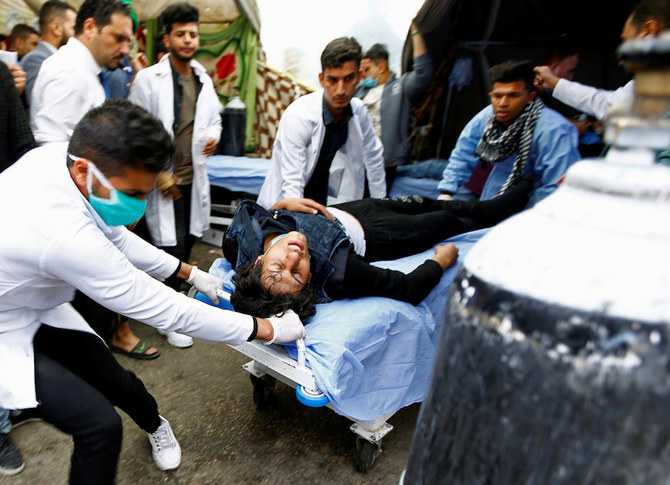
Medical crew carry a wounded man during ongoing anti-government protests in Najaf Sunday, (Reuters)
Updated 02 December 2019
Follow

Iraqi protesters torch Iranian consulate after Abdel Mahdi fall

  • Abdel Mahdi said he would submit resignation following spike in the death toll among protesters
  • Iraqi protesters set fire to Iranian consulate in Najaf for second time in a week

BAGHDAD: Iraqi protesters set fire to the Iranian consulate in Najaf on Sunday for the second time in a week, as demonstrations continued despite the confirmation of Prime Minister Adel Abdel Mahdi’s resignation.
More than 420 people have been killed in a violent Iranian-orchestrated response to two months of protests against corruption, economic hardship and failed public services.
In a victory for the protesters, a police major was sentenced to death and a lieutenant colonel was jailed for seven years for killing seven civilians in the southern city of Kut in November.
Pope Francis on Sunday joined criticism of the crackdown. “I am following the situation in Iraq with concern. It is with pain that I have learned of the protest demonstrations of the past days that were met with a harsh response,” said the pope, who wants to visit Iraq next year.
Meanwhile, funerals took place for dead protesters, and mourners marched for the first time in Salaheddin, a Sunni-majority province north of Baghdad.
Eight Shiite provinces also announced a day of mourning during which government offices would remain shut.
Clashes continued in Najaf, where armed men in civilian clothes fired on protesters who had torched part of a Shiite shrine.
Abdel Mahdi resigned last week under pressure from the influential Shiite spiritual leader Grand Ayatollah Ali Sistani, and Parliament on Sunday confirmed the fall of his government. President Barham Saleh will now be asked to name a successor.
Protesters demanded wider change. “Abdel Mahdi should go — and so should Parliament and the political parties and Iran,” said one demonstrator in Baghdad.

Iraq’s parliament voted on Sunday to accept the resignation of Abdul Mahdi. His decision to quit on Friday came after a call by Iraq’s top Shiite Muslim cleric Grand Ayatollah Ali Al-Sistani for parliament to consider withdrawing its support for Abdul Mahdi’s government to stem the violence.
“The Iraqi parliament will ask the president of state to nominate a new prime minister,” a statement from parliament’s media office said.
MPs said Abdul Mahdi’s government, including the prime minister himself, would stay on in a caretaker capacity until a new government is chosen.
Under the constitution, President Barham Salih is expected to ask the largest bloc in parliament to nominate a new prime minister to form a government, a move expected to trigger weeks of political wrangling.


Sudan’s war puts charity kitchen workers feeding displaced families at risk

Updated 34 min 41 sec ago
Follow

Sudan’s war puts charity kitchen workers feeding displaced families at risk

  • The real number of workers killed is likely far higher than the estimated 100, he says, but the war has prevented reliable data collection and record-keeping

CAIRO: Enas Arbab fled Sudan’s western region of Darfur after her hometown fell to Sudanese paramilitary forces, taking only her year-old son with her and the memory of her father, who was killed, she said, simply for working at a charity kitchen serving people displaced by the fighting.
The Rapid Support Forces — or RSF, a paramilitary group that has been at war with the Sudanese army since April 2023 — had laid siege on el-Fasher in the western Darfur region, starving people out before it overran the city.
UN officials say several thousand civilians were killed in the RSF takeover of el-Fasher last October. Only 40 percent of the city’s 260,000 residents managed to flee the onslaught, thousands of whom were wounded, the officials said. The fate of the rest remains unknown.
During the fighting, Arbab says RSF fighters took her father, Mohamed ِArbab, from their home after beating him in front of the family, and demanded a ransom. When the family couldn’t pay, they told them they had killed him, she says. To this day, the family doesn’t know where his body is.
When her husband disappeared a month later, Enas Arbab decided to flee north, to Egypt. “We couldn’t stay in el-Fasher,” she said. “It was no longer safe and there was no food or water.”
Her father was one of more than 100 charity kitchen workers who have been killed since the war began, according to workers who spoke with The Associated Press and the Aid Workers Security database, a group that tracks major incidents around the world impacting aid workers.
In areas of intense fighting — especially in Darfur — famine is spreading and food and basic supplies are scarce. The community-led public kitchens have become a lifeline but many working there have been abducted, robbed, arrested, beaten or killed.
Grim numbers in a brutal war
Volunteer Salah Semsaya with the Emergency Response Rooms — a group that emerged as a local initiative and now operates in 13 provinces across Sudan, with 26,000 volunteers — acknowledges the dangers faced by workers in charity kitchens.
The real number of workers killed is likely far higher than the estimated 100, he says, but the war has prevented reliable data collection and record-keeping.
Semsaya shared records showing that 57 percent of the documented killings of charity kitchen workers occurred in Khartoum, mainly while the Sudanese capital was under RSF control, before the army retook it last March. At least 21 percent of the killings were in Darfur.
More than 50 of those killed in Khartoum worked with his group, Semsaya said.
Sudan’s war erupted after tensions between the army and the RSF escalated into fighting that began in Khartoum and spread nationwide, killing thousands and triggering mass displacement, disease outbreaks and severe food insecurity. Aid workers were frequently targeted.
Dan Teng’o, communications chief at the UN office for humanitarian affairs, says it’s unclear whether charity kitchen workers are targeted because of their work or because of their perceived affiliation with one side or other in the war.
The kitchen workers are prominent in their communities because of the work they do, making them obvious targets, activists say. Ransom demands typically range from $2,000 to $5,000, often rising once families make initial payments.
“A clear deterioration in the security context ... has significantly affected local communities, including volunteers supporting community kitchens,” Teng’o said.
Kitchen workers face risks
Farouk Abkar, a 60-year-old from el-Fasher, spent a year handing out sacks of grain at a charity kitchen in Zamzam camp, just 15 kilometers (9 miles) south of the city. He survived drone strikes and remembers the day RSF fighters attacked his kitchen. One of them punched him in the face, knocking some of his teeth out.
Abkar said he fled el-Fasher at night with his daughter, walking for 10 days. Along the way, some RSF fighters fired birdshot, which hit him in the head, leaving a chronic headache.
Now in Egypt, he shares an apartment with at least 10 other Sudanese refugees and can’t afford medical care. The harrowing images from his hometown still haunt him.
“Many things happened in el-Fasher,” he said. “There was death. There was starvation.”
Mustafa Khater, a 28-year-old charity kitchen worker, fled with his pregnant wife to Egypt a few days before el-Fasher fell to the RSF.
During the 18-month siege, some el-Fasher residents collaborated with the RSF, telling the paramilitary fighters who the kitchen workers were, Khater said. Many disappeared.
“They would take you to an area where there is a dry riverbed and kill you there,” Khater said.
A volunteer working with Semsaya’s aid group in Darfur said some of his colleagues were beaten, arrested and interrogated, with their attackers accusing them of receiving “illicit funds” for the kitchen. The volunteer spoke on condition of anonymity for fear of reprisals.
Despite the challenges, many charity kitchens remain the only reliable food source in areas gripped by conflict and a place people can come to and give each other support, Semsaya said.
Struggling to feed thousands
The town of Khazan Jedid in East Darfur province has three charity kitchens feeding about 5,000 people daily, said Haroun Abdelrahman, a spokesperson for the Emergency Response Rooms’ branch in the area.
Abdelrahman says he was once interrogated by RSF fighters, while several of his colleagues have been robbed at knifepoint. Despite the fear and harassment, many kitchen workers are still volunteering and working, he said.
In Kassala in eastern Sudan, military agents questioned a volunteer with the branch there and his colleagues in January 2024, he said, after their kitchen started serving food and providing shelter to people who escaped nearby Wad Madani when RSF seized that town. He also spoke anonymously for fear of reprisals.
Khater, the 28-year-old who fled el-Fasher, said he heard from friends back home that after the RSF takeover, all charity kitchens in the city closed and his colleagues were either “killed or fled.”
Teng’o says the closures in areas of fighting have left “vulnerable households with no viable alternatives” and forced people to shop at local “markets where food prices are unaffordable.”
Arbab, the pregnant 19-year-old who fled with her baby boy, had hoped to rebuild her life in Egypt, her friends and a humanitarian worker said, speaking on condition of anonymity to talk about the young mother.
But while on the road to the northern city of Alexandria last month, she and her son were stopped by Egyptian authorities and deported back to Sudan.