

Iran on the rack: Demonstrations in Beirut over crackdown in Iraq

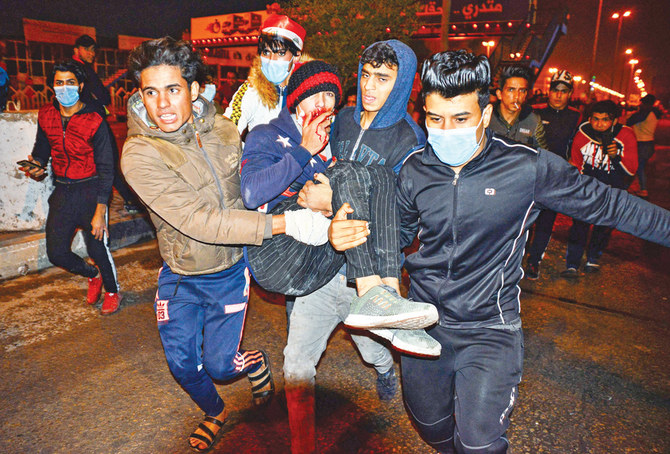
Iraqis kept up anti-government protests in Baghdad and the south on Saturday, dissatisfied with the premier’s vow to quit and insisting on the overhaul of the system. (AFP)
Updated 01 December 2019
Follow

Iran on the rack: Demonstrations in Beirut over crackdown in Iraq

  • Protesters in two countries unite to denounce Tehran’s violent repression of dissent

BEIRUT: Iran faced anger on two fronts on Saturday as demonstrators in Lebanon took to the streets of Beirut to support protesters in Iraq.

Tehran has orchestrated a violent crackdown on Iraqi protests in which more than 420 people have been killed, and its Hezbollah proxy in Lebanon has been accused of complicity in attacks on protesters demonstrating there against corruption and financial hardship.

Demonstrators staged a candlelit vigil outside Iraq’s embassy in Beirut on Saturday to denounce the violence in Baghdad and southern Iraq. They held up photos of Iraqi protesters who have been killed, and one woman wrapped an Iraqi flag around her shoulders.

“The uprising in Iraq and the uprising in Lebanon are one,” said vigil organizer Layal Siblani. “A protester killed there is a protester killed here.” 

Another demonstrator in Beirut said: “We have to stand in solidarity with our Iraqi counterparts who are being arrested and killed on a daily basis.”

Elsewhere in Beirut, the mothers of activists targeted by opponents of the protests marched under banners declaring “nothing divides us” as they voiced their anger over violent attacks on protesters.

Opinion

This section contains relevant reference points, placed in (Opinion field)

A group of mothers in Tabaris, a largely affluent Christian neighborhood, marched to Khandak El Ghamik, a poorer area with a large number of Amal Movement and Hezbollah supporters.

One woman urged residents of the area not to attack protesters. “Politicians disagree in the day and agree in the evening, and we should not be dragged into incitement,” she said.

Protesters also organized a demonstration outside a barracks of the Internal Security Forces in Beirut, in protest at the arrest of activists.

Meanwhile in Iraq protesters burned tires and surrounded a police station in the southern city of Nassiriya on Saturday. Demonstrations also continued in Baghdad, but there were fewer reports of casualties than on the previous two days.

Security forces have used live ammunition, tear gas and stun grenades against protesters for nearly two months, and dozens have been killed in the past few days in Nassiriya and Najaf.

Iraq’s Cabinet on Saturday approved the resignation of Prime Minister Adel Abdul Mahdi, which is expected to be confirmed by Parliament on Sunday.


Kurdish dissident groups say they are preparing to join the fight against Iran

Updated 4 sec ago
Follow

Kurdish dissident groups say they are preparing to join the fight against Iran

  • Kurdish groups are widely seen as the most well-organized segment of the fragmented Iranian opposition and are believed to have thousands of trained fighters
  • If the Iranian and Iraqi Kurdish groups were to join the war, it would be the first entry of a significant ground force into the battle
IRBIL, Iraq: Kurdish Iranian dissident groups based in northern Iraq are preparing for a potential cross-border military operation in Iran, and the US has asked Iraqi Kurds to support them, Kurdish officials told The Associated Press.
The Kurdish groups are widely seen as the most well-organized segment of the fragmented Iranian opposition and are believed to have thousands of trained fighters. Their entry into the war could pose a significant challenge to the embattled authorities in Tehran and could also risk pulling Iraq further into the conflict.
Khalil Nadiri an official with the Kurdistan Freedom Party, or PAK, based in northern Iraq’s semi-autonomous Kurdish region said Wednesday that some of their forces had moved to areas near the Iranian border in Sulaymaniyah province and were waiting on standby.
He said Kurdish opposition group leaders had been contacted by US officials regarding a potential operation, without giving more details.
Asked about reports that the Trump administration was considering arming Iranian Kurdish groups, Defense Secretary Pete Hegseth told reporters Wednesday: “None of our objectives are premised on the support or the arming of any particular force. So, what other entities may be doing, we’re aware of, but our objectives aren’t centered on that.”
Before the US and Israel attacked Iran on Saturday, triggering a new war in the Middle East, the PAK had claimed attacks on the paramilitary Revolutionary Guard in retaliation for Tehran’s violent crackdown on protests. But an official with the group said it had not sent forces from Iraq into Iran.
If the Iranian and Iraqi Kurdish groups were to join the war, it would be the first entry of a significant ground force into the battle. The Kurdish groups have battle experience from the fight against the Daesh group.
An official with Komala, another of the Kurdish Iranian groups, said Wednesday that their forces are ready to cross the border within a week to 10 days and were “waiting for the grounds to be suitable.” He spoke on condition of anonymity out of security concerns.
Kurds in Iran have a long history of grievances and uprisings against both the current Islamic Republic and the monarchy that preceded it. During the rule of Shah Mohammad Reza Pahlavi Kurds were marginalized and repressed and sometimes rebelled.
After Iran’s 1979 Islamic Revolution, the new theocracy also battled Kurdish insurgents. Iranian forces destroyed Kurdish towns and villages in fighting that killed thousands over several months.
While they share a desire to see the current authorities ousted, the Kurdish groups have also butted heads with other opposition groups — notably the faction led by the former shah’s son, Reza Pahlavi, who has accused the Kurds of being separatists aiming to carve up Iran.

Iraqi Kurds hesitant to join the fray

The potential operation has put leaders of the Iraqi Kurdish region in a delicate position.
Three Iraqi Kurdish officials told the AP that a call took place Sunday night between US President Donald Trump and Masoud Barzani and Bafel Talabani — the heads of the Kurdistan Democratic Party, or KDP, and the Patriotic Union of Kurdistan, or PUK, the two main Kurdish parties in Iraq — to discuss the situation in Iran.
They spoke on condition of anonymity because they were not authorized to comment publicly.
One of the officials said Trump had asked the Iraqi Kurds to militarily support the Iranian Kurdish groups in operations in Iran and to open the border to allow the Iranian Kurdish groups to move freely back and forth.
When asked about the call and reports that Trump has sought military support for Iranian Kurdish groups, White House press secretary Karoline Leavitt said: “He did speak to Kurdish leaders with respect to our base that we have in northern Iraq” but denied that Trump had agreed to a specific plan.
The Iraqi Kurdish official said the Iraqi Kurds were concerned that getting directly involved in the conflict would draw a harsh Iranian response. Already the Kurdish region has seen a string of drone and missile attacks by Iran and allied Iraqi militias in recent days, targeting US military bases and the US Consulate in Irbil as well as the Kurdish groups’ bases.
While most of the attacks have been intercepted, civilian homes have been damaged, and the region is suffering from electricity cuts after a key gas field halted operations due to security concerns.
In a statement, the PUK confirmed that Talabani had spoken by phone with Trump, who “provided clarification and vision regarding US objectives in the war.” The statement said the PUK “believes that the best solution is a return to the negotiating table.”
Spokespeople for the Kurdish regional government in Iraq and for Barzani declined to comment.
The news site Axios first reported the call between Trump and the Kurdish leaders, and CNN reported that the Trump administration was in discussions with Kurdish groups over providing military support.
Iraq moves to seal the border
The presence of armed Iranian Kurdish groups in northern Iraq has been a point of friction between the central Iraqi government in Baghdad and Tehran.
Iraq in 2023 reached an agreement with Iran to disarm the groups and move them from their bases near the border areas with Iran — where they potentially posed an armed challenge to Tehran — into camps designated by Baghdad.
Their military bases were shut down and their movement within Iraq restricted, but the groups did not give up their weapons.
Iraq’s National Security Adviser Qassim Al-Araji said in a post on X that Ali Bagheri, deputy secretary of Iran’s Supreme National Security Council, had requested in a call between them “that Iraq take the necessary measures to prevent any opposition groups from infiltrating the border between the two countries.”
Al-Araji said Iraq is committed to “preventing any groups from infiltrating or crossing the Iranian border or carrying out terrorist acts from Iraqi territory” and noted that security reinforcements had been sent to the border.
In addition to retaliation by Iran, any movement by Iraqi Kurds to join a cross-border attack would likely inflame tensions with Iran-backed Iraqi militias, which have already claimed missile and drone strikes on Irbil in recent days.