Al-Rajhi holds off Peterhansel to extend lead in Riyadh Rally

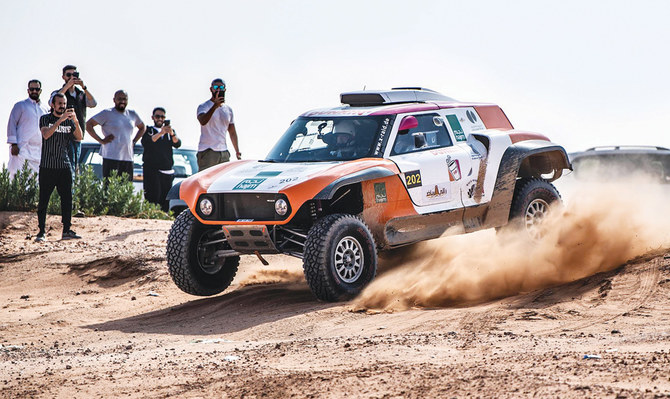
Riyadh Rally is being organized by the Saudi Automobile and Motorcycle Federation, under the chairmanship of Prince Khalid bin Sultan Al-Abdullah Al-Faisal. (Photo/Supplied)
Updated 29 November 2019
Follow

Al-Rajhi holds off Peterhansel to extend lead in Riyadh Rally

  • The Rumah stage victory extends the Saudi driver’s overall advantage to 54 seconds
  • On Saturday, competitors will tackle a shorter section of 160 km through the scenic Saad National Park before a ceremonial finish at Diriyah

RIYADH: Saudi Arabia’s Yazeed Al-Rajhi beat French legend Stéphane Peterhansel by 46 seconds in the challenging second 307 km section through the deserts around Rumah on Friday morning.

The Rumah stage victory extends his overall advantage in the Riyadh Rally to 54 seconds.

Aiming to win the inaugural Saudi Toyota Desert Rally Championship and continue valuable pre-Dakar Rally testing, Al-Rajhi and Northern Irish co-driver Michael Orr clocked a time of 2 hours, 18 minutes, and 40 seconds in a Toyota Hilux.

Like Peterhansel, series rival Yasir Seaidan drove an X-raid prepared MINI JCW Buggy and finished the stage in third, 2 minutes, 41 seconds adrift of the outright leader. Czech driver Miroslav Zapletal slipped to fifth place behind ED Racing’s Essa Al-Dossari and a plethora of Saudi drivers filled the remaining places inside the top 10. Mutair Al-Shammeri was the best of the bunch in sixth, followed by Faris Al-Moshna Al-Shammeri, Sami and Al-Mashna Al-Shammeri and Khalid Al-Remali.

Salman Al-Shammeri moved to the top of the T2 standings for series-production cross-country vehicles with the fastest time, putting the Nissan driver 4 minutes and 41 seconds ahead of Farhan Al-Muharib. Yousef Al-Suwaidi held third overall and Talal Al-Bader moved his Ford up into fourth.

SPEEDREAD

  • Like Peterhansel, series rival Yasir Seaidan drove an X-raid prepared MINI JCW Buggy and finished the stage in 3rd, 2 minutes and 41 seconds adrift of the outright leader.
  • Czech driver Miroslav Zapletal slipped to 5th place behind ED Racing’s Essa Al-Dossari and a plethora of Saudi drivers filled the remaining places inside the top 10.
  • Mutair Al-Shammeri was the best of the bunch in 6th, followed by Faris Al-Moshna Al-Shammeri, Sami and Al-Mashna Al-Shammeri and Khalid Al-Remali.

Saleh Al-Saif extended his advantage in the NUTV section to 1 minute 49 seconds at the wheel of a Can-Am Maverick X3. Yousef Al-Dhaif maintained second position and Khalil Al-Tuwaijri was third. 

Saudi Arabia’s leading rider Mishal Alghuneim hit the front in the motorcycle category with the fastest time of 3 hours 53 seconds. That enabled the KTM rider to forge a 1 minute 20 seconds advantage over Abu Dhabi’s Mohammed Al-Balooshi. His brother Sultan came home in third place after incurring a one-minute penalty and Kuwait’s Abdullah Al-Shatti rounded off the top four.

As both Abdullah Al-Malki and Abdullah Al-Shegawi retired from the quad category, pre-race favorite Abdulmajeed Al-Khulaifi incurred 57 minutes of time penalties and plummeted down the running order before retiring from the day with another fistful of penalties.

Sultan Al-Masoud clocked the unofficial fastest time before any potential penalties were imposed and returned to Riyadh on his Yamaha ahead of Fahad Al-Madah and Sufyan Al-Omar.

The event is being organized by the Saudi Automobile and Motorcycle Federation, under the chairmanship of Prince Khalid bin Sultan Al-Abdullah Al-Faisal and supervision of former International Automobile Federation Middle East champion Abdullah Bakhashab.

The rally runs with the support of the Saudi Automobile and Motorcycle Federation, the General Sport Authority, Abdul Latif Jameel Motors (Toyota), the MBC Group, Al-Arabia outdoors and the Saudi Research and Marketing Group.

On Saturday, competitors will tackle a shorter section of 160 km through the scenic Saad National Park before a ceremonial finish at Diriyah, near Riyadh.


How international academies are shaping Saudi football’s next generation

Updated 05 January 2026
Follow

How international academies are shaping Saudi football’s next generation

  • Building a unified national footballing philosophy in Saudi Arabia is no simple task

Saudi Arabia’s football transformation has been impossible to ignore since the arrival of Cristiano Ronaldo at the end of 2022. An influx of global stars followed, and with it, unprecedented attention on the Saudi Pro League.

Yet beneath the spotlight, a more pressing question emerged amongst domestic fans: “What is the long-term strategy for developing local players?”

Building a unified national footballing philosophy in Saudi Arabia is no simple task. The sheer size of the Kingdom presents logistical challenges unlike those faced by smaller neighbouring nations, making grassroots development harder to centralize. In this landscape, the work of individual institutions can contribute significantly to the broader football ecosystem.

One such contributor is Juventus Academy Saudi Arabia, an official extension of one of world football’s most historic clubs, operating under the umbrella of Al-Shoaibi Group. Arab News spoke to head of public relations at Juventus Academy, Malak Al-Awami, based in Alkhobar, to understand how the academy fits into the Kingdom’s long-term football vision.

“Saudi Arabia is experiencing a transformational moment under Vision 2030, prioritizing youth development and active lifestyles,” Al-Awami explained. “The  academy arrives at a perfect time to contribute to a world-class methodology while helping nurture the next generation of Saudi footballers.”

At Juventus Academy, success is deliberately defined beyond results and trophies.

“We’re not just training players,” Al-Awami said. “We’re shaping future leaders for the Kingdom.”

That philosophy has been reflected in how the academy balances Juventus’ global philosophy with local Saudi culture. While all coaches undergo Juventus’ training standards, cultural understanding remains a priority.

“All of our coaches are guided to respect Saudi values, culture and communication styles,” Al-Awami said. “Technical excellence matters, but the coach’s character is just as important as their certification.”

One of the academy’s defining features has been its inclusivity and cultural awareness. Players can join as young as four years old and continue until the age of 18, with programs open to both boys and girls.

That inclusivity has had a tangible impact. Juventus Academy played a role in the formation of Khobar FC, a women’s team that competed in the inaugural season of the SAFF Women’s Second Division League.

“We even used the same kit style as Juventus, getting approval from the club itself,” revealed Al-Awami.

Operating as an extension of the academy, the team finished just a few points behind established clubs like Al-Nahda and Al-Fateh in their regional group.

Al-Awami noted that the group is also exploring complementary initiatives aimed at elite player development beyond the academy itself. Among them is the planned Superior Striker Project, a specialized program designed to bring international attacking expertise to Saudi Arabia through short-term clinics for youth and professional players.

It is this broader contribution that highlights the growing importance of international academies in Saudi Arabia. Beyond providing structured training, they are helping build communities, instil values and strengthen the foundations of the domestic football pyramid. 

When asked about what success would look like for Juventus Academy in 5-10 years, Al-Awami was clear. “It is definitely not about trophies or big contracts,” he said, before adding, “it is the legacy we leave behind. If, in 10 years we see confident young Saudi players competing at elite levels, local coaches growing through our programs, and families trusting football as a tool for personal development, then we will know that we have truly succeeded.”

Juventus Academy Saudi Arabia builds on Al-Shoaibi Group’s original ambition in 2018: to create meaningful football opportunities for families in the Kingdom. Today, that ambition has evolved into a structured pathway contributing to Saudi football future, blending global expertise with local identity to help shape the next generation.