

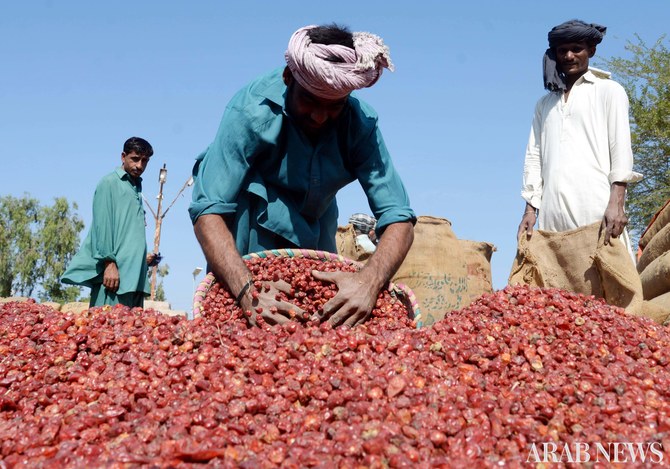

UMERKOT, SINDH: “Twelve thousand rupees! Yes! For this good produce, let’s start from Rs12,000!” Muhammad Waseem shouts in Sindhi as he takes a handful of peppers from a heap of red chilies.
Agents continue to bid and the price goes up to Rs14,000 ($75). “Close it at 14,000,” Waseem instructs his assistant and proceeds to another bid. With a register in hands, the broker’s helper accompanies him. Commission agents follow.
The peppers Waseem and others sell at the chili market in the small town of Kunri in Umerkot district are not ordinary peppers. These dundicut chilies have a distinct flavor which is in demand among importers from the US, UK, Saudi Arabia, UAE, Bangladesh, Sri Lanka and European countries.

Kunri has the largest chili market in Pakistan, where over 100,000 tons of the special 'dandicut lungi' are traded between September and January. (AN Photo/S.A. Babar)
The seeds of the chilies reached this area from Radha Ram near Lahore in the 1960s. A decade later Kunri was the largest chili market in Asia. The region has an exceptionally suitable climate for growing chilies, Mian Muhammad Saleem told Arab News at his plantation, 16 kilometers away from the city.
“Almost 85 percent of red chilies of Pakistan are produced in Umerkot, and parts of Badin, Mirpurkhas and Sanghar districts of Sindh,” the farmer and president of a red chili growers association said with pride.
Overseeing workers cutting the chilies from the plants on his field, he looked worried. Climate change affects harvest. “The chilies cultivated in March and by mid of April didn’t yield and this happened for the first time in four decades, due to climate change,” he said.
The chilies, Saleem explained, require a day temperature of 40°C. “At night the temperature should be 26°C. But this year the temperature went up, as a result the production dropped by almost 60 percent.”
“The chilies cultivated after mid-April did well, but not like in the previous year. Our annual production had been up to 125,000 tons. Given the trading in chilies’ market, it seems it will be low, very low this year,” he said with disappointment.

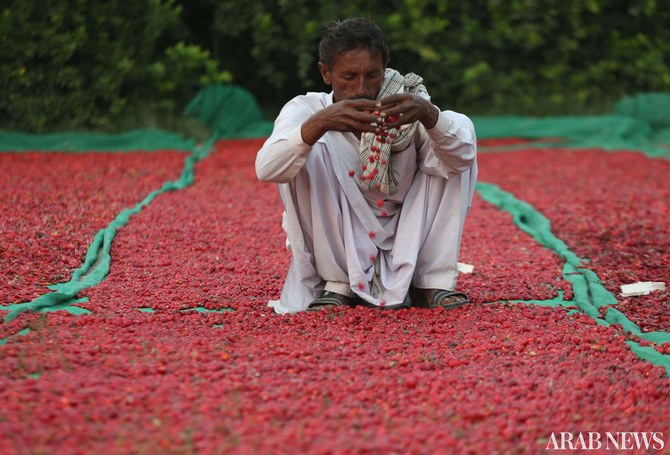
A man collects red chilies at a farm in Kunri, Sindh, on November 26, 2019. The region is a main producer of chilies in Asia. (AN Photo/S.A. Babar)
His own export abroad was 500 tons last year. “This year, I haven’t exported a single ton. If we do not export, India, which is a major producer, will fill the gap.”
Prem Maheshwari, a commission agent who has been associated with the market for the last 15 years, echoed Saleem’s concerns, saying that in the peak season – from September to December – 350,000 sacks of 40 kilograms used to be brought to the market. “This year, the figure has reached just 175,000.”
Although the growers have adopted several good agricultural practices, including the use of geotextiles for healthy drying and keeping fungus away from the peppers, they feel helpless in the face of changing climate conditions.

Workers cut red chilies at a plantation in Kunri, Sindh, on November 26, 2019. (AN Photo/S.A. Babar)
“Climate change is affecting us. But the change is not for us alone. It’s a worldwide phenomenon. The difference is that we continue to fall prey to it. Others do research and find the ways to tackle it,” Saleem said.
When Arab News reached the Sindh Horticulture Research Institute’s laboratory for chili research, located between Kunri and Umerkot city, a guard said that no one of its 17-member staff members was present. There was not a single chili plant either.
Only Waseem from the Kunri market seemed content with global warming and production. “My job has become easy with the decrease in quantity this year,” he turned to tell Arab News as he convinced the agents to bid higher. “But I am happy that the quality as usual is excellent. We trade high quality chilies.”

The laboratory for chili research of the Sindh Horticulture Research Institute is desolate on November 26, 2019. (AN Photo/S.A. Babar)
The quality of their special chili is the farmers’ pride.
The USAID has tested the Kunri breed on their request and confirmed that the distinct flavor cannot be found anywhere else in the world, Saleem said with a smile and vowed that they “will fight all adverse conditions” as their chilies keep the food spicy and tasty.


