

Arab envoy calls for end to Lebanon deadlock

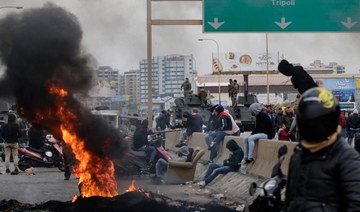
Protesters chant slogans, during ongoing protests against the Lebanese government, in front of the Central Bank, in Beirut, Lebanon. (AP)
Updated 29 November 2019
Follow

Arab envoy calls for end to Lebanon deadlock

  • Arab League ready to help the country out of its political and economic crisis

BEIRUT: The Arab League told Lebanese leaders on Thursday that it is ready to help the country out of its political and economic crisis. 

Hossam Zaki, the league’s assistant secretary-general, delivered his message of solidarity after a meeting with President Michel Aoun, Parliament Speaker Nabih Berri and caretaker Prime Minister Saad Hariri.

The envoy’s comments came as widespread protests over government inefficiency and alleged corruption among the Lebanese leadership entered their 43rd day.

Zaki described Lebanon as “an important founding country in the Arab system” and said developments in the country “are of concern to Arabs as they have always had repercussions, some of which are regional.”

However, he warned that “the biggest burden of assistance lies on the Lebanese themselves, and external parties support attempts to find a solution to the crises.” 

Zaki said: “Everyone knows that the movement of the street, with the acknowledgment of all Lebanese politicians and leaders, is right in its demands. We understand this, but the movement also comes at an economic cost that increases the seriousness of the situation.

“The issue of forming a government must be solved despite its difficulty because it is essential for Lebanon to avoid any negative impact on its economic situation and civil peace.”

Earlier Aoun claimed that insufficient aid had been provided to displaced Syrians in Lebanon, leaving the country to pick up the bill.

“So far, Lebanon has suffered losses of more than $25 billion, in addition to the unemployment that has afflicted Lebanese workers,” he said.

As the government crisis deepens, there is no sign that Aoun will set a date for parliamentary talks to assign a replacement for Hariri.

Hezbollah on Thursday backed a call by Berri for a caretaker government to be established. His parliamentary bloc believes that “constitutional obligations require the outgoing government to shoulder its legal responsibility toward citizens in light of rising prices and currency deterioration.”

Meanwhile, gas station operators in Lebanon went on strike after fuel importers refused to accept purchases in Lebanese currency.

Banks also refused to issue US dollars to customers.

Charles Jabbour, head of the Lebanese Forces’ communications and media department, told Arab News: “In light of the economic collapse in Lebanon, an economic and political alert is needed to face the crisis. This cannot be done through the government’s classic methods. It is not possible to form a national unity government or a political government. Lebanon needs a technocratic government that creates a positive shock abroad and generates revenue. Anything else would be stalling and taking the country to further collapse.”

Lebanon’s worsening economic situation was highlighted by Ibrahim Kanaan, the finance and budget committee chairman, who said after a meeting to discuss the 2020 draft budget that state revenues after the protests started “are almost nonexistent.”

“The draft budget prepared before the current crisis did not include any tax or add any fees. It includes a charge of $5,000 billion to the Banque du Liban (central bank) and the banking sector,” he said.

“The deficit is exacerbated in trade and payments balances due to suspension of overseas transfers and the erosion of deposits,” he added.

Trump says Iran government change ‘best thing that could happen’

Updated 9 min 9 sec ago
Follow

Trump says Iran government change ‘best thing that could happen’

  • US president's comments come after he ordered a second aircraft carrier to head to the Middle East

FORT BRAGG, United States: US President Donald Trump said a change of government in Iran would be the “best thing that could happen,” as he ordered a second aircraft carrier to head to the Middle East.
“Seems like that would be the best thing that could happen,” Trump told reporters at the Fort Bragg military base in North Carolina when a journalist asked if he wanted “regime change” in Iran.
“For 47 years, they’ve been talking and talking and talking. In the meantime, we’ve lost a lot of lives while they talk,” he told reporters.

Trump declined to say who he would want to take over in Iran from supreme leader Ayatollah Ali Khamenei, but he added that “there are people.”
He has previously backed off full-throated calls for a change of government in Iran, warning that it could cause chaos, although he has made threats toward Khamenei in the past.
Speaking earlier at the White House, Trump said that the USS Gerald R. Ford — the world’s largest warship — would be “leaving very soon” for the Middle East to up the pressure on Iran.
“In case we don’t make a deal, we’ll need it,” Trump said.
The giant vessel is currently in the Caribbean following the US overthrow of Venezuela’s Nicolas Maduro. Another carrier, the USS Abraham Lincoln, is one of 12 US ships already in the Middle East.

When Iran began its crackdown on protests last month — which rights groups say killed thousands — Trump initially said that the United States was “locked and loaded” to help demonstrators.
But he has recently focused his military threats on Tehran’s nuclear program, which US forces struck last July during Israel’s unprecedented 12-day war with Iran.
The protests have subsided for now but US-based Reza Pahlavi, the son of Iran’s last shah, urged international intervention to support the Iranian people.
“We are asking for a humanitarian intervention to prevent more innocent lives being killed in the process,” he told the Munich Security Conference.
It followed a call by the opposition leader, who has not returned to his country since before the revolution, for Iranians at home and abroad to continue demonstrations this weekend.
Iran and the United States, who have had no diplomatic relations since shortly after the revolution, held talks on the nuclear issue last week in Oman. No dates have been set for new talks yet.
The West fears the program is aimed at making a bomb, which Tehran denies.
The head of the UN nuclear watchdog, Rafael Grossi, said Friday that reaching an accord with Iran on inspections of its processing facilities was possible but “terribly difficult.”

Trump said after talks with Israeli Prime Minister Benjamin Netanyahu earlier this week that he wanted to continue talks with Iran, defying pressure from his key ally for a tougher stance.
The Israeli prime minister himself expressed skepticism at the quality of any agreement if it didn’t also cover Iran’s ballistic missiles and support for regional proxies.
According to the US-based Human Rights Activists News Agency, 7,008 people, mostly protesters, were killed in the recent crackdown, although rights groups warn the toll is likely far higher.
More than 53,000 people have also been arrested, it added.
The Norway-based Iran Human Rights (IHR) NGO said “hundreds” of people were facing charges linked to the protests that could see them sentenced to death.
Figures working within the Iranian system have also been arrested, with three politicians detained this week from the so-called reformist wing of Iranian politics supportive of President Masoud Pezeshkian.
The three — Azar Mansouri, Javad Emam and Ebrahim Asgharzadeh — were released on bail Thursday and Friday, their lawyer Hojjat Kermani told the ISNA news agency.