MOSCOW: Pilot error and possible disorientation of the crew during bad weather led to the fatal crash in Russia in 2016 of a Flydubai passenger jet, according to a report published by Russia’s Interstate Aviation Committee on Tuesday.
The Boeing 737-800 from Dubai, operated by the Dubai-based budget carrier Flydubai, came down in the early hours of March 19, 2016, at Rostov-on-Don airport in southern Russia on its second attempt to land. All 62 people on board died.
“The fatal air accident ... occurred during the second go-around, due to an incorrect aircraft configuration and crew piloting (and) the subsequent loss of the (commanding pilot’s) situational awareness at night-time,” the report said.
It said bad weather and dangerous local turbulence known as wind shear were also factors.
“This resulted in a loss of control of the aircraft and its impact with the ground,” it said.
The Boeing 737 was being flown by the captain at the time of the crash, the investigation said.
Addressing one of the most publicized concerns after the crash, the report said the pilots had had enough pre-flight rest, but that the possible “operational” tiredness of the crew as the flight progressed was probably a contributing factor.
The accident involved a Boeing 737-800, the predecessor to the Boeing 737 MAX, which remains grounded after two fatal crashes in the past 13 months. The 737-800 does not contain the MCAS software implicated in those crashes.

Pilot error caused fatal 2016 Flydubai plane crash, says Russian aviation authority
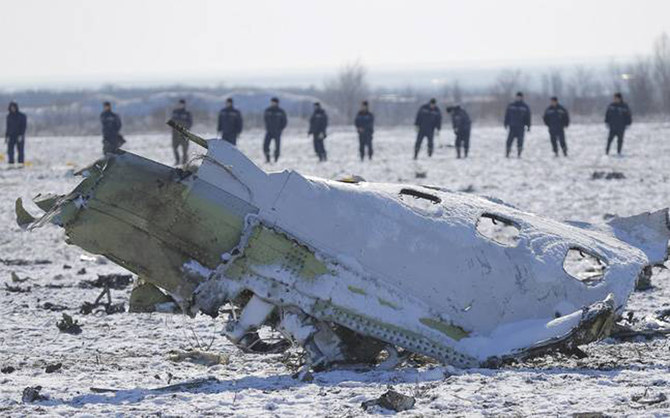
- The Boeing 737-800, operated by Dubai-based budget carrier Flydubai, came down in the early hours of March 19, 2016 at Rostov-on-Don airport in southern Russia
- ‘The fatal air accident ... occurred during the second go-around, due to an incorrect aircraft configuration and crew piloting (and) the subsequent loss of the (commanding pilot’s) situational awareness at night-time’
Bangladesh sends record 750,000 workers to Saudi Arabia in 2025
- Latest data shows 16% surge of Bangladeshis going to the Kingdom compared to 2024
- Bangladesh authorities are working on sending more skilled workers to Saudi Arabia
DHAKA: Bangladesh sent over 750,000 workers to Saudi Arabia in 2025, marking the highest overseas deployment to a single country on record, its labor bureau said on Friday.
Around 3.5 million Bangladeshis live and work in Saudi Arabia, sending home more than $5 billion every year. They have been joining the Saudi labor market since the 1970s and are the largest expatriate group in the Kingdom.
Last year, Saudi Arabia retained its spot as the top destination for Bangladeshi workers, with more than two-thirds of over 1.1 million who went abroad in 2025 choosing the Kingdom.
“More than 750,000 Bangladeshi migrants went to Saudi Arabia last year,” Ashraf Hossain, additional director-general at the Bureau of Manpower, Employment and Training, told Arab News.
“So far, it’s the highest number for Bangladesh, in terms of sending migrants to Saudi Arabia or any other particular country in a single year.”
The latest data also showed a 16 percent increase from 2024, when about 628,000 went to the Kingdom for work, adding to the largest diaspora community outside Bangladesh.
Authorities have focused on sending more skilled workers to Saudi Arabia in recent years, after the Kingdom launched in 2023 its Skill Verification Program in Bangladesh, which aims to advance the professional competence of employees in the Saudi labor market.
Bangladesh has also increased the number of certification centers, allowing more candidates to be verified by Saudi authorities.
“Our focus is now on increasing safe, skilled and regular migration. Skilled manpower export to Saudi Arabia has increased in the last year … more than one-third of the migrants who went to Saudi Arabia did so under the Skill Verification Program by the Saudi agency Takamol,” Hossain said.
“Just three to four months ago, we had only been to certify 1,000 skilled workers per month. But now, we can conduct tests with 28 (Saudi-approved) centers across the country, which can certify around 60,000 skilled workforces (monthly) for the Kingdom’s labor market.”
On Thursday, the BMET began to provide training in mining, as Bangladesh aims to also start sending skilled workers for the sector in Saudi Arabia.
“There are huge demands for skilled mining workers in Saudi Arabia as it’s an oil-rich country,” Hossain said.
“We are … trying to produce truly skilled workers for the Saudi labor market.”
In October, Saudi Arabia and Bangladesh signed a new employment agreement, which enhances worker protection, wage payments, as well as welfare and health services.
It also opens more opportunities in construction and major Vision 2030 projects, which may create up to 300,000 new jobs for Bangladeshi workers in 2026.